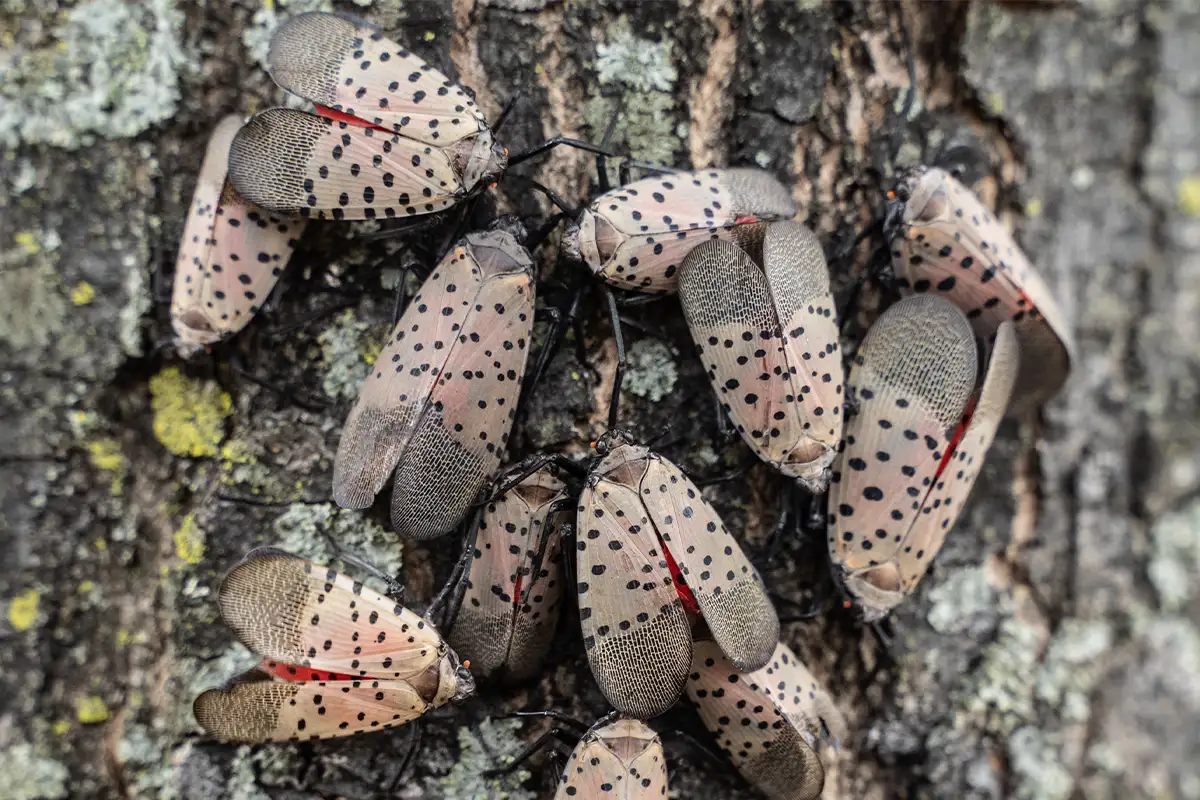
The spotted lanternfly continues its spread through Virginia. A local entomologist has suggestions for protecting your yard and garden.
Doug Pfeiffer, of the entomology department at Virginia Tech, says the flies, which were first discovered in Virginia in a square mile of territory in 2019, are currently “through the entire Shenandoah Valley and most of the Piedmont.”
Spotted Lanternfly Is ‘A Known Hitchhiker’
One tip that holds true: Check your car before any long trips. “It’s a known hitchhiker,” Pfeiffer says, “and you can see it following counties along I-81 and I-64. And there’s an infestation in Carroll County that is at the confluence of I-77 and US-58.” It takes rides on trucks, cars, and trains. It likes to hang out on Tree of Heaven, “which tends to grow in disturbed habitats, including along roadsides, along highways and along railroad beds.”
The main threat the flies pose is to grapevines, which spells trouble for Virginia’s wine industry. “If they’re left uncontrolled, they can kill vines by weakening the vine, either killing it outright or reducing winter hardiness so that it can’t survive the winter,” Pfeiffer says. It can be controlled by insecticides, but that puts a heavy load on the environment and on winemakers’ bank accounts.
What to Watch For
Pfeiffer says lanternflies “can be a severe nuisance pest in yards.” They’re attracted to large shade trees. And when they feed there, their waste — “honeydew,” Pfeiffer calls it — can make things sticky under the trees and attract a sooty mold. They’re not likely to kill the trees, Pfeiffer says, but they can impede the trees’ growth.
There are insecticides available for home use. Some are sprayed on; some are injected, which should be done by a professional tree service. “But there’s not a whole lot that homeowners can do other than that,” Pfeiffer says.
Help from Mother Nature might be on the way. One of the reasons the lanternflies have exploded since their arrival is that they have no predators that primarily feed on them. Some “generalist predators” will feed on the spotted lanternfly, but since they also eat other bugs, it’s “not enough to put a dent in the population,” Pfeiffer says.
But the U.S. Department of Agriculture has two types of wasps from China — “specialist” predators of spotted lanternfly — in quarantine. It takes years to make sure they don’t have their own diseases or parasites and aren’t going to disturb native insects. And Pfeiffer says one variety has already washed out on that score, but another one is looking safer in quarantine. “So hopefully it won’t be too far into the future where we get permission to have that released.”
Cicadas Chilling Out
Meanwhile, Pfeiffer says it won’t be a major year for cicadas, especially in the Northern Virginia area. Last year, Virginia was spared the back-to-back emergence of a 17-year and 13-year brood that plagued Illinois and parts of the South. But the 13-year brood did emerge in the southern Piedmont area, and Pfeiffer says that next 13-year emergence, in 2037, will coincide with a major nine-year brood in southwest Virginia.
Until then, however, while there will be other emergences, including a 14-year brood in Frederick and Wise counties which may give apple farmers in Frederick County some headaches. “It shouldn’t be a big cicada year,” Pfeiffer says.
Feature image, stock.adobe.com