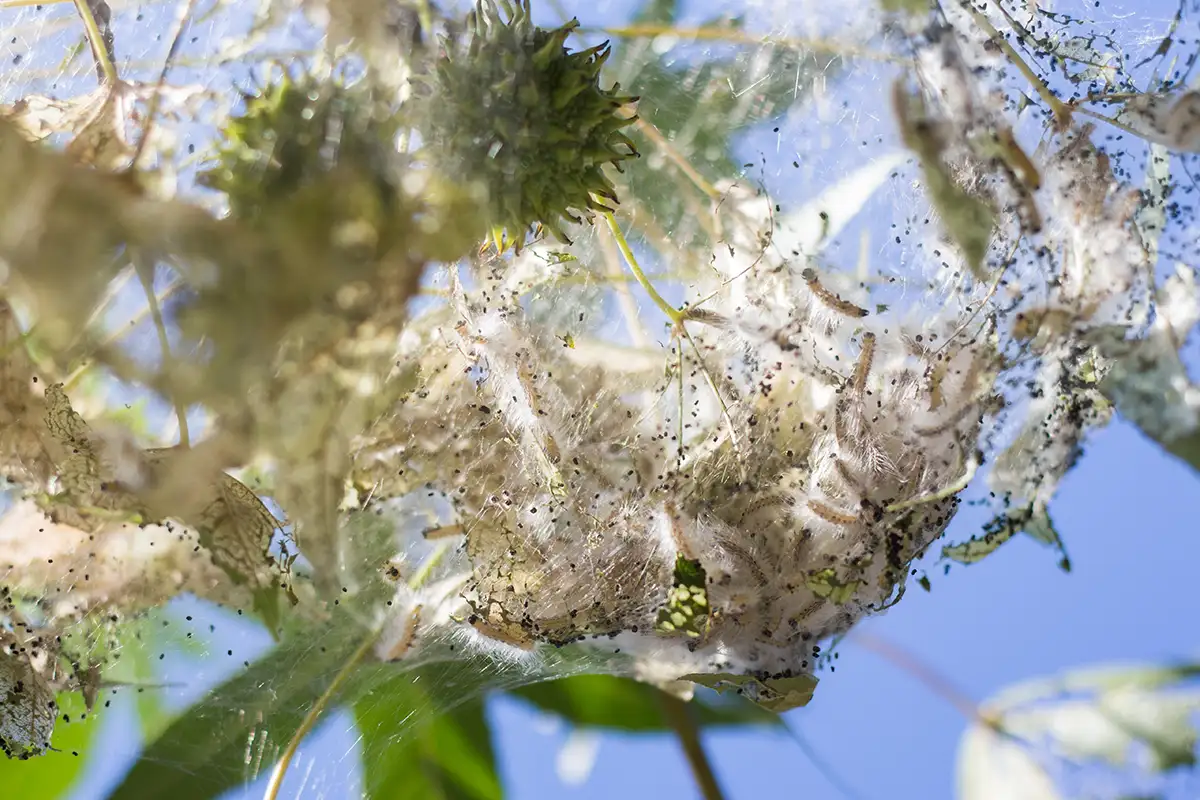
This time of year, you may notice large clusters of webs covering branches in trees and shrubs. These aren’t spiderwebs — they’re likely the work of fall webworms.
Webworms are caterpillars that build large webs in the branches of trees and eventually turn into moths. The web “protects the caterpillars while they feed on the vegetation of the tree. It protects them while they sleep,” says Lou Meyer, an arborist with Davey Tree.
The webs can be up to two to three feet in length and diameter, and each one holds many webworms. They eat 90 different tree species, but particular favorites are walnuts, hickories, cherries, and birches, Meyer says.
Are Fall Webworms Destructive?
The good news is they’re not dangerous to people, forests, or even the trees they nest on, and they’re not an invasive species. The biggest problem these critters introduce is an aesthetic one.
Webworms can have a slight impact on the host tree, but not enough to kill or significantly damage it. “It will harm it as much as it defoliates it. It’ll eat some of the leaves that are on the tree,” Meyer says. But they eat less than 5 percent of the canopy of the tree, which is not enough to harm it. And, because they feed in the fall, trees have already photosynthesized the nutrients they need, making defoliation even less of a concern.
Plus, Meyer says, there are plenty of birds, bugs, and spiders that feed on the fall webworms to “keep their population in check.”
“The only thing you really need to worry about is an aesthetic acceptance of ‘Does this bother me? Is this a nuisance? Do I have an event coming up that I don’t want my guests to see a tree with giant webs hanging from it?,’” Meyer says.
Modes of Removal
If you find the unsightly webs bothersome, there are simple ways to remove them. The least environmentally impactful is to manually remove them by pruning affected branches. You can also call an arborist to remove them for you, especially if the branches are too high to reach.
“We don’t encourage anyone to go out to spray these indiscriminately,” Meyer says. If you need to use pesticides, he says it’s best to apply them right to the affected branch when the webworms are young. “Otherwise, if they already built the nest and you spray them with pesticide, the web is going to stay there.”
It’s also possible you could be seeing eastern tent caterpillars, a similar insect that also builds nests. These caterpillars appear earlier in the season and tend to nest “where the branch comes off the trunk or two branches divide,” Meyer says, while fall webworms build nests at the end of the branches. Treatment is the same, as tent caterpillars are also only a risk to the aesthetic of your yard.
And, while these species aren’t a big concern for tree health, “they are a good reminder that our trees are living beings, and they react to natural forces, and it’s a good idea to have your trees checked out by an arborist every two to three years” to check for tree safety and health, Meyer says.
“Trees are the most important — I like to think — resource that we have for our health and our wellbeing in many different ways,” Meyer says. “It gives us an opportunity to focus on trees and be aware that they’re there. They’re important, and they need our assistance.”
Feature image, stock.adobe.com