Summer 2025 kicks off with Memorial Day Weekend, and with it comes the opportunity for swimming in backyard pools, local lakes, or the ocean. Youth water safety is crucial to ensure that everyone has a safe summer, so we spoke to Bethany Bray Patterson, communications director for the American Red Cross National Capital and Greater Chesapeake Region. Patterson gave advice on how to keep children safe around water this summer.
Never Swim Alone
This goes for both adults and children. “Never leave a young child unattended near water, or leave supervision to another child or young sibling,” Patterson says. “Do not trust a child’s life to another child.”
Permission Is Key
Teach children to always ask permission to go near water. Instilling this habit helps to make sure parents and guardians are always aware of a child’s presence near water. For younger children, asking for permission helps prevent their impulsivity.
“Most drowning deaths for children happen in residential pools owned by family, friends or relatives during non-swim times, when they were not intended to be in or near the water,” Patterson says. “In fact, many children who drown in home pools were out of sight for less than five minutes and in the care of an adult at the time—this emphasizes how important it is to prevent unsupervised access to water.”
Keep Pools Fenced
If you have a pool, make sure you have the proper fencing around it. Speaking of backyard pools, they should be surrounded with four-sided isolation fencing with a self-closing and self-latching gate that is out of reach of a child.
Watch Closely
Patterson recommends swimming in a lifeguarded area, and also making sure a “water watcher” keeps a close eye and constant attention on children and weaker swimmers. That way, the watcher can keep on eye on young ones until the next water watcher takes over.
“This includes avoiding distractions such as looking at a cell phone or leaving the pool or water area, even for a short time,” Patterson says.
Use Safety Gear
Have young children or inexperienced swimmers wear life jackets. Properly fitted U.S. Coast Guard–approved life jackets should be worn by young children and inexperienced swimmers, but do not rely on life jackets alone for safety, Patterson adds.
Get Lessons
Take part in formal water safety and swim lessons: Drowning is the leading cause of death for children ages 1 to 4 and the second leading cause of unintentional injury death for children ages 5 to 14, according to the Centers for Disease Control and Prevention.
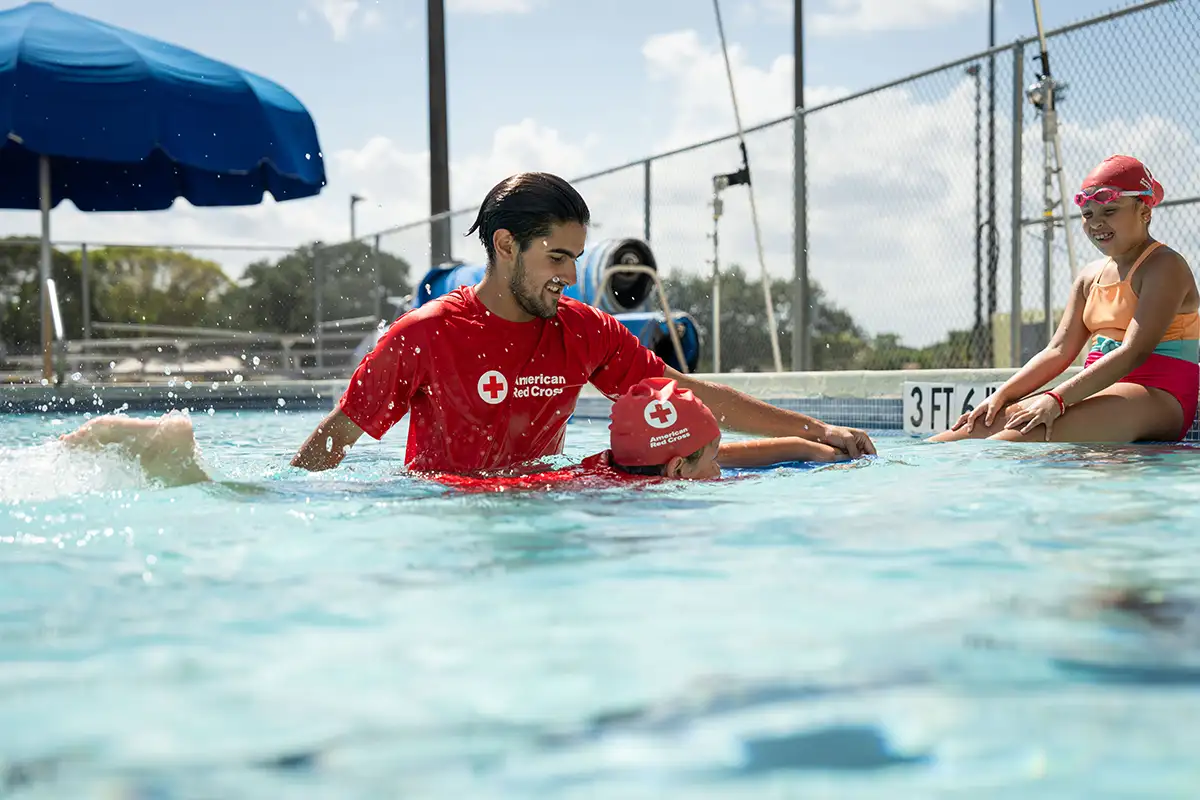
“However, having your child participate in swim lessons and water safety classes can reduce the risk of drowning by 88 percent for 1-to-4-year-olds,” Patterson says.
Don’t Jump In
In the event of an emergency, do not go in the water. It is better to reach or throw an object to the person in trouble rather than jumping into the water, as one can easily become a victim themselves.
The Red Cross offers a free online Water Safety for Parents and Caregivers course. Parents can find additional safety tips and resources at redcross.org/watersafety.
Feature image courtesy American Red Cross