
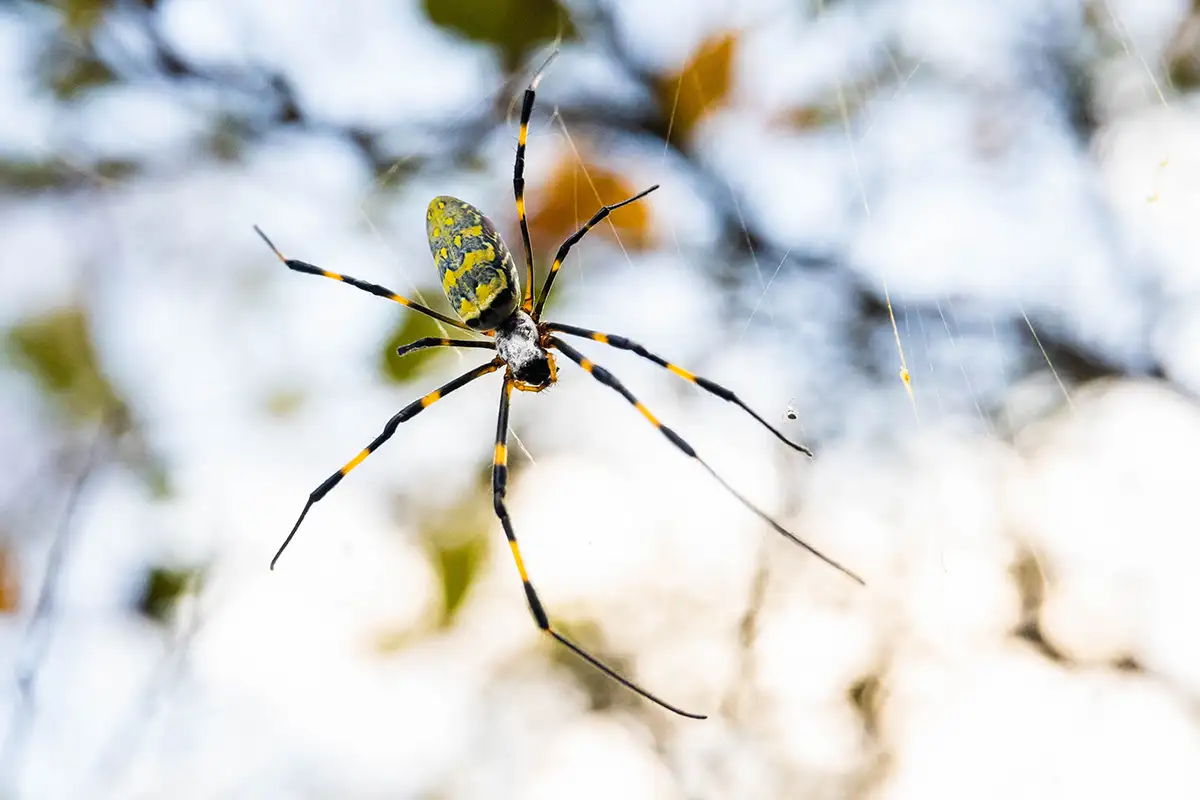
Spotted lanternflies aren’t the only invasive pests that have taken residence in Virginia. You may spot the Joro spider — a yellow-bodied arachnid that can be as big as a human palm — in the DMV.
Joro spiders are also known as the Golden Orb Weaver because of their golden-colored webs (which can be up to 10 feet wide). Native to Asia, they first landed in the U.S. around 2014 in Georgia. Populations have now been found as far north as New York, says Pat Wooden, the lab manager at Virginia Tech’s Insect ID Lab.
Still, Wooden says, there haven’t been many reports in Northern Virginia. “People usually notice them when they come into the western part of the state, and that’s largely because that’s where people are doing recreation” like hiking, Wooden says. There have also been sightings in Maryland, where people have spotted them in their gardens or near their homes.
Populations spread primarily through shipping containers, and they’re often transported in potted plants. They also spread using a method called “ballooning.” The baby spiders put out a small piece of web silk. The wind catches the silk and carries the spiders to new locations, much like a parachute.
Are They Harmful?
Because of their large size, Joro spiders might give you a fright if you spot one. But, they won’t hurt you. “They are not prone to biting. And most people aren’t going to reach out into a web and snatch the giant spider out of it,” Wooden says.
In the unlikely event of a bite, most people and pets will be fine. They do have venom — as most spiders do — but it’s meant to kill bugs, not hurt humans. The only caveat would be if you’re allergic. “Anything that has a venom, you can be allergic to,” Wooden says. “So, while most people will be totally fine [and] most pets will be totally fine, if you have an allergy and you get bitten, that’s a concern.”
As for the environment, it’s still too early to tell if they’re causing environmental impacts. In Georgia, reports have shown some reduced biodiversity in areas where Joro spiders are thriving. “We’re finding that in areas where it occurs it is decreasing the biodiversity — eating everything, including other spiders — and so it’s a little further up the food chain,” Wooden says.
What to Do if You Spot a Joro
Joro spiders are distinctive because of their size, but it’s easy to mix them up with other orb-weavers. One way to know for sure is to check the color of the web. If it’s yellow, it’s a Joro spider. They also have a red spot on the underbelly of their abdomen. Other similar-looking species will have a yellow spot instead.
If you think you’ve spotted a Joro spider, “first of all, don’t panic,” says Wooden. Snap a photo of the spider and send it to your local cooperative extension or the Virginia Tech Insect ID lab. They’ll use the photo to confirm if it’s a Joro spider, which helps with tracking the population.
“I largely say don’t kill it, not because we want invasive species, but because if it is a native orb-weaver, we don’t want people to accidentally kill the wrong spider,” Wooden says.
Joro spiders don’t invade homes, so it’s not likely you’ll have to deal with one inside, according to Virginia Tech. There’s also no need to spray your yard preventatively, as that can harm beneficial bugs like pollinators.
If you want to remove one from a doorway, patio, or porch, “they can be removed the same way as any other spider, using a broom or an aerosol insecticide spray,” Virginia Tech entomologist Theresa Dellinger wrote.
Feature image, stock.adobe.com