Northern Virginia will soon be swarmed once again by a now-familiar pest. Invasive spotted lanternflies have begun to hatch across the state — and it won’t be long until NoVA residents are seeing them everywhere again.
Lanternflies are an invasive planthopper that first arrived in Virginia in 2018. While they’re not directly harmful to people or pets, they feed on several Virginia crops (including grapevines) and can cause significant agricultural damage.
Here’s what to expect from the lanternflies this season.
Emerging Early
How early lanternflies hatch depends on the specific region and the weather conditions, says David Gianino, the program manager of the Office of Plant Industry Services at the Virginia Department of Agriculture and Consumer Services (VDACS). In Virginia, the first lanternflies began to hatch in late March. That’s “the earliest we have seen a hatch in Virginia,” he says.
“Over the last seven years … we have seen them shift up in their date of when they actually hatch out of the egg masses, which is interesting to say the least. We’re assuming that it has a lot to do with the growing degree days,” Gianino says. Growing degree days are days that stay below a certain temperature; when there are more growing degree days, lanternflies start hatching earlier.
Other factors could have to do with the lanternflies becoming more adapted to the environment, he says.
Early Life Stages
The lanternflies are here, but you may not recognize them at first. That’s because they’re currently in an early nymph stage — they won’t grow into their adult form for a few months.
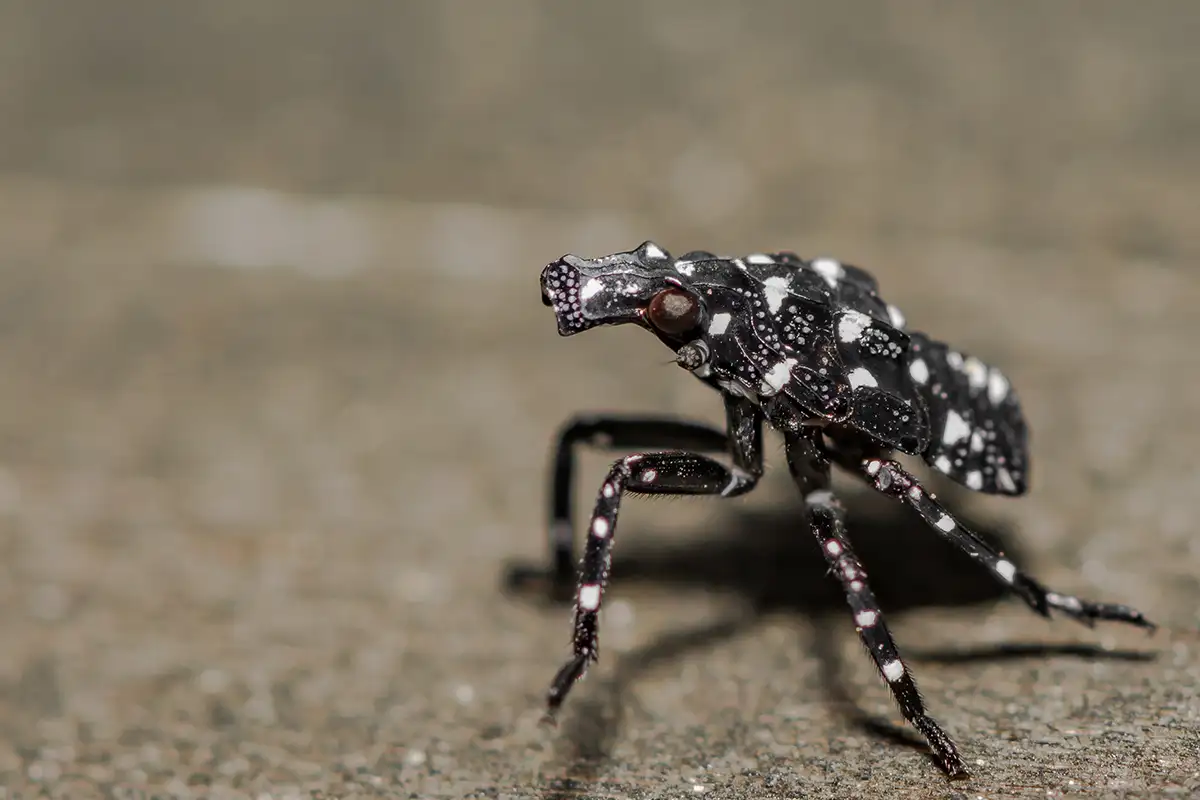
“The immature spotted lanternfly have hatched out of their eggs, and they are on the hunt for food,” Gianino says. At this stage, the insects look like small, black leaf-hoppers with white spots and can range from about a quarter-inch to a half-inch in size.
Lanternfly nymphs have shield-shaped bodies rather than round or ovular ones, with symmetrical white spots. They stay in an angled position rather than sitting perfectly parallel to the surface they’re on.
Lanternflies have four nymphal stages before they reach their adult form. The first three stages are black, then in the fourth, they turn red.
Based on historical data, Gianino estimates they’ll shift into that red stage in early to mid-June (though it could vary by region). Then, those red nymphs begin to molt into winged adults in mid-July.
A Heavy Infestation
The Northern Virginia area will likely see a large population of lanternflies again this year, but hope could be on the horizon.
According to Gianino, lanternfly populations tend to disperse slightly after about four or five years of living in an area. “What we have seen is that they do become a little bit more difficult to find in larger numbers once they’ve been there for between four and five years,” he says. This could be a result of their food sources — such as the invasive tree of heaven — becoming expended and the bugs seeking a new place to find food.
“The areas where the infestation started — Winchester, Frederick — there’s still a very large presence. I don’t want to underplay that, but … it might not be as intense as it was two years ago,” he says.
“We probably have another year or two of some larger populations up in the Northern Virginia areas,” Gianino says. “We first started finding them in 2022, 2023, and so we’re kind of on the tail end of that four-to-five-year cycle of heavy, dense populations. And then there may be migration out to other food sources or other areas.”
At that point, we may begin to see populations either plateau or decline.
Spotted Lanternfly Management
To keep populations in check, there are a few management techniques that work.
The most efficient is scraping or crushing egg masses on trees. “That’s actually what our top recommendation is for managing your local population, because an egg mass has between 30 to 50 eggs in it. So if you can squish or crush one egg mass, you’ve essentially and effectively eliminated 30 to 50 potential new spotted lanternfly,” Gianino says.
Now that they’ve hatched, there are a few ways to kill the bugs directly. They can be captured and crushed, or you can apply a pesticide that’s labeled for use on spotted lanternflies.
“Now’s a good time to manage for spotted lanternfly,” Gianino says. “When they become adults, they’re a little bit more challenging, because they can jump farther and they can kind of fly and glide around.”
Another efficient management technique is to remove the plants they eat. That’s especially true of the tree of heaven, which is the lanternflies’ chosen host plant and is also invasive. “Managing that tree on your property will ultimately reduce and lessen your spotted lanternfly pressure over the course of a season and in the future, too,” Gianino says.
Just be sure to follow the proper process to remove the trees by using herbicide. Because it spreads from the roots, simply cutting down tree of heaven won’t kill it.
Avoid using home remedies or off-label pesticides, which could be harmful to the environment.
Feature image, stock.adobe.com