If you’ve been spotting little black-and-white bugs around your house this spring, you’re not alone. While you can easily mistake them for a number of small bugs, these little creatures are actually nymphs — an early life stage — of the invasive spotted lanternfly.
“Most people in NoVA are pretty familiar with spotted lanternfly adults. But it can be really hard to connect these little black and white bugs on your rose bush with the spotted lanternfly covered tree trunks you see in the fall,” says Jules Amanita, the spotted lanternfly field supervisor with the Virginia Department of Agriculture and Consumer Services.
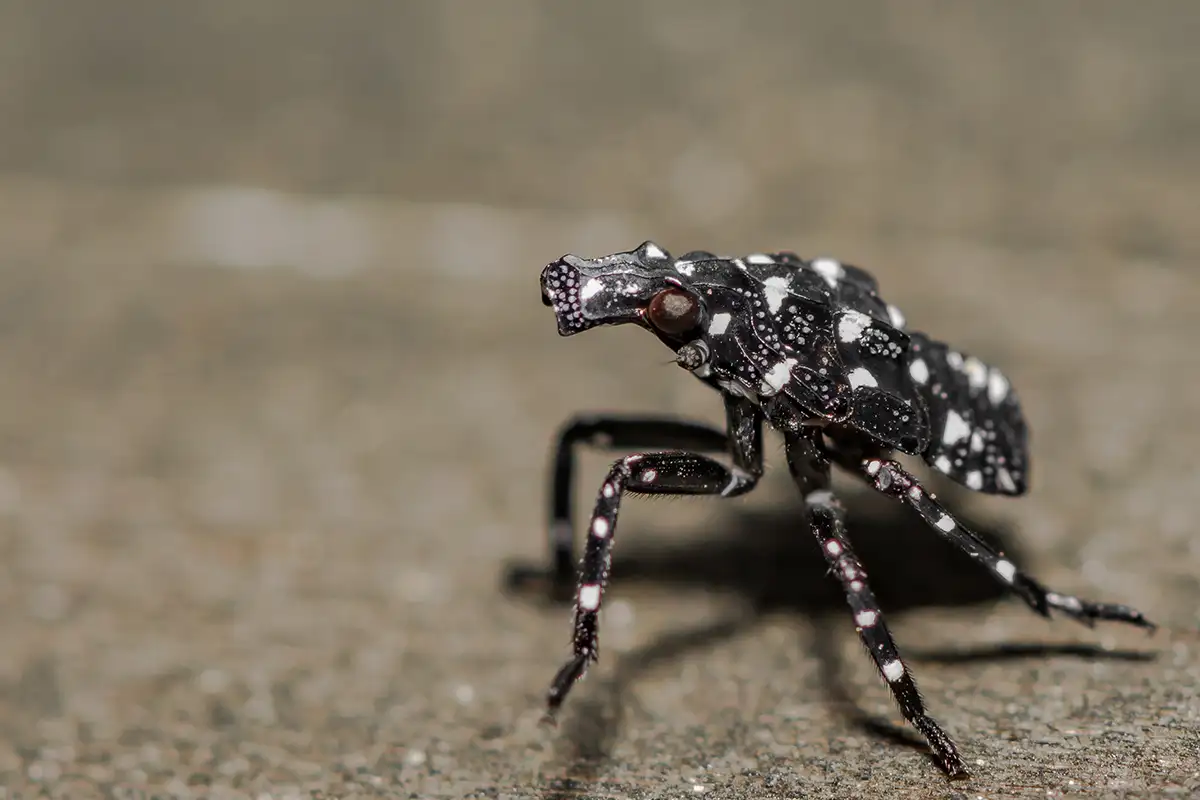
Spotted lanternflies have four nymphal stages before they molt into the winged creature you may recognize. In the first three stages, they are black with white spots and can be anywhere from around the size of a tick to about the size of a black bean, Amanita says. In the final nymphal stage, they turn red with spots and are about the size of a stink bug. Then, they turn into the larger winged bug.
How to Identify a Lanternfly
These bugs might be mistaken for any number of other creatures, including ticks, weevils, milkweed bugs, box elder bugs, oak leaf tree hoppers, and stink bugs. To identify an insect as a lanternfly nymph, Amanita points to a few key characteristics.
First, the nymphs have “shield-shaped” bodies rather than perfectly round or ovular bodies. They’ll also have symmetrical white spots, which ticks, weevils, and stink bugs don’t have.
Then look at the angle at which it’s sitting; lanternfly nymphs don’t sit with their bodies parallel to the surface they’re on. “Most of those other bugs that get misidentified for spotted lanternfly will be parallel to that surface. But with spotted lanternfly, think more of how a dog looks when they’re sitting, where their head is much higher than the back end of the body,” Amanita says.
Their bodies will be at about a 60-degree angle while sitting. And about a 30-degree angle while walking, Amantia says.
Adults Re-Emerging
In Northern Virginia, lanternflies are currently in the stage where they’ll appear as black-and-white bugs. Amanita says they’ve received some reports of sightings of the larger red nymph stage, so those will be emerging soon.
So how long before the adults are back? “We should expect to see the first adults emerging in NoVA … by the end of June this year. And we should expect to see all of the adults emerge by mid-August,” Amanita says.
And there may be even more around NoVA this year than last year, Amanita says. The bug’s fast reproduction cycle means rapid population increases.
Pest Management
These invasive bugs aren’t physically harmful to people or pets. But they do pose a risk to the environment, including agricultural crops like grape vines.
They’re often found on branches and vines, including the invasive Tree of Heaven (its host of choice), plus rose bushes, honeysuckle, Virginia creeper, and poison ivy, Amanita says. And they can cause damage to these plants.
To manage the pests, there are several options. For nonchemical removal, Amanita says vacuums can remove them from plants when they’re in the nymph stages (either a household vacuum or through a pest-control service.) There are also circle traps, which use window mesh to direct nymphs into a plastic bag for collection.
For insecticide, contact chemicals kill the bugs on contact, or systemic insecticides can be applied to plants that kill the bugs when they feed on a treated plant. With any insecticides, it’s essential to read and adhere to all label instructions, including where to apply it, to avoid environmental harm.
What Not to Do
Amanita strongly discourages home remedies like bleach, dish soap, or other household items that are not registered or approved as pesticides.
“Just because a chemical is totally safe to use indoors does not mean that it will not hurt the outdoors,” Amanita says. Chemicals can destroy a plant’s waxy cuticle, cause chemical burns on a plant, kill or harm pollinators, change the soil pH to make it turn toxic, and cause water pollution.
Another method that is not recommended is sticky bands, which wrap around a tree and catch the bugs. “Sticky bands cause extensive bycatch. So it could catch birds, amphibians, and other nontarget insects. We don’t want to do that,” Amanita says.
The VDACS website and the Virginia Cooperative Extension each have resources for the identification and management of spotted lanternflies.
Feature image, ondreicka/stock.adobe.com