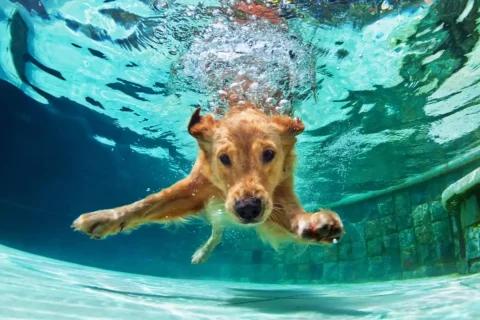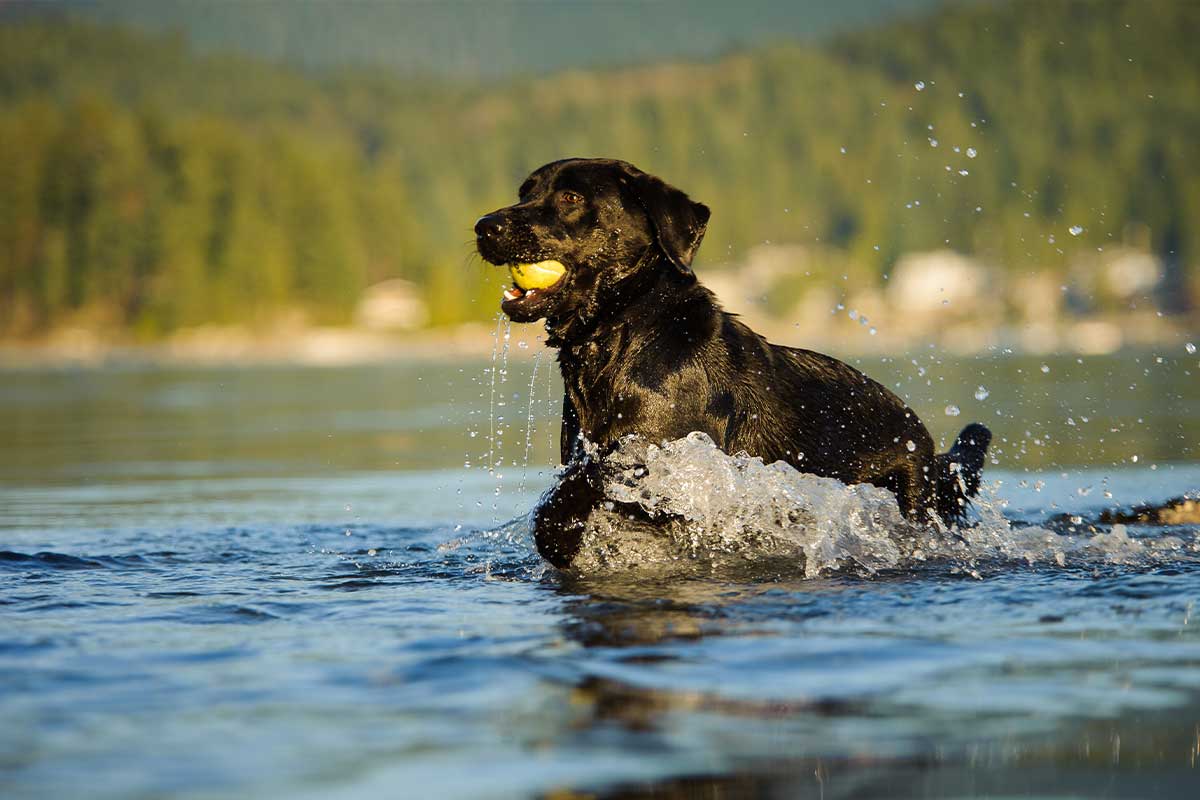
If you’re planning on visiting the beach or lake this summer, or perhaps want to involve your dog in backyard pool fun, what’s the best way to introduce your pet to the water and swimming?
Dogs, like humans, have different likes and dislikes. Some are afraid of waves as they crash onto the shore, while others are fascinated and want to play in them.
When introducing your dog to a body of water, whether it’s a pool, beach, or lake, it will always feel safer when it is more sure-footed. Lisa Tudor, owner of Kissable Canine Training & Behavior in Lewes, Delaware, says that while you may have a retriever that chases a backyard garden hose, it doesn’t equal the same experience as diving into water.
“They can like water in one context and be unsure of it in another,” says Tudor, a certified trainer.
Early socialization and acclamation to water is always best, says Brad Huber, director of training at Olde Towne School for Dogs in Alexandria.
Puppies that are 4 months old or younger are more open to new experiences and ideas, whereas adult dogs that have never gone for a swim may completely shut down when introduced to the idea.
“Typically, natural gradient entrances are easier and more logical for dogs to navigate, like entering a stream from an inclined bank versus stepping down 8 or more inches into a pool,” Huber says. “If you have access to clean water, I will always suggest introducing dogs to water that they can simply walk into gradually. Most dogs are happy to get their feet wet but may need extra encouragement and training to begin swimming.”
Tudor also recommends graded entry because dogs sometimes get uncomfortable when water touches their stomachs.
The bottom line is, some dogs that do like water won’t like all types of water, according to Huber.
Don’t Force It
“Introducing a dog who doesn’t immediately want to jump in to water, should be a very slow process,” says April Chillari, owner and certified trainer for Core Canine, a dog training business in Alexandria.
Chillari advises owners not force a swim if the dog doesn’t like it. She says owners need to listen to what dogs say with their body language and respect that.
“You can certainly try to help them like it, but if after some time they clearly have no interest in swimming, then I’d abandon the idea,” she says.
It’s also important to respect the reality that not all dogs like water. Certain breeds like bulldogs and dachshunds can’t stay afloat due to their body shapes and shouldn’t be forced to swim.
“If your dog is completely opposed to the idea of swimming after multiple attempts, a good dog owner should consider that water may just not be for them,” Huber adds.
Consider Using a Life Jacket
Should you put a life jacket on your dog when swimming or on a boat? There are pros and cons to doing so.
Karen Krieg, owner of Dreamy Skies Dog Training in Mount Airy, Maryland, always recommends a life jacket. “Just like for people, an ounce of prevention can go a long way to keep a dog safe,” Krieg says.
Chillari debunked the myth that all dogs know how to swim naturally. There are indeed dogs that are bred to swim, and those dogs tend to naturally know what they’re supposed to do as soon as they hit water. But swimming can be challenging for a lot of dogs, so it’s best to keep them safe with life jackets.
Huber though does not recommend using life jackets when dogs are learning to swim.
“If not fitted properly, they can do more harm than good, plus, they act as training wheels for dogs,” he says. “In other words, a dog who swims with a life jacket may not be able to stay afloat without it.”
Instead, Huber advises owners to act as the dog’s flotation device and get into the water to assist the pet until the dog no longer needs support.
Learn Specific Training Techniques
Krieg recommends starting with a dog pool to make things easier for your pet.
“To get started, you can put a minimal amount of water in the pool and let the dog get used to the sensation over time as you slowly increase the depth of the pool,” she says.
Tudor says a strong recall command is helpful when swimming or near a body of water with your dog.
Toys also area a helpful tool when introducing a dog to water.
“The most important thing is that your dog likes the toy that’s being thrown into the water,” Huber says. “If they have a particular favorite toy in the house, bring it to the pool and you may be surprised at your dog’s efforts to retrieve it from the water.”
Feature image, stock.adobe.com
For more stories like this, subscribe to Northern Virginia Magazine’s Family newsletter.