
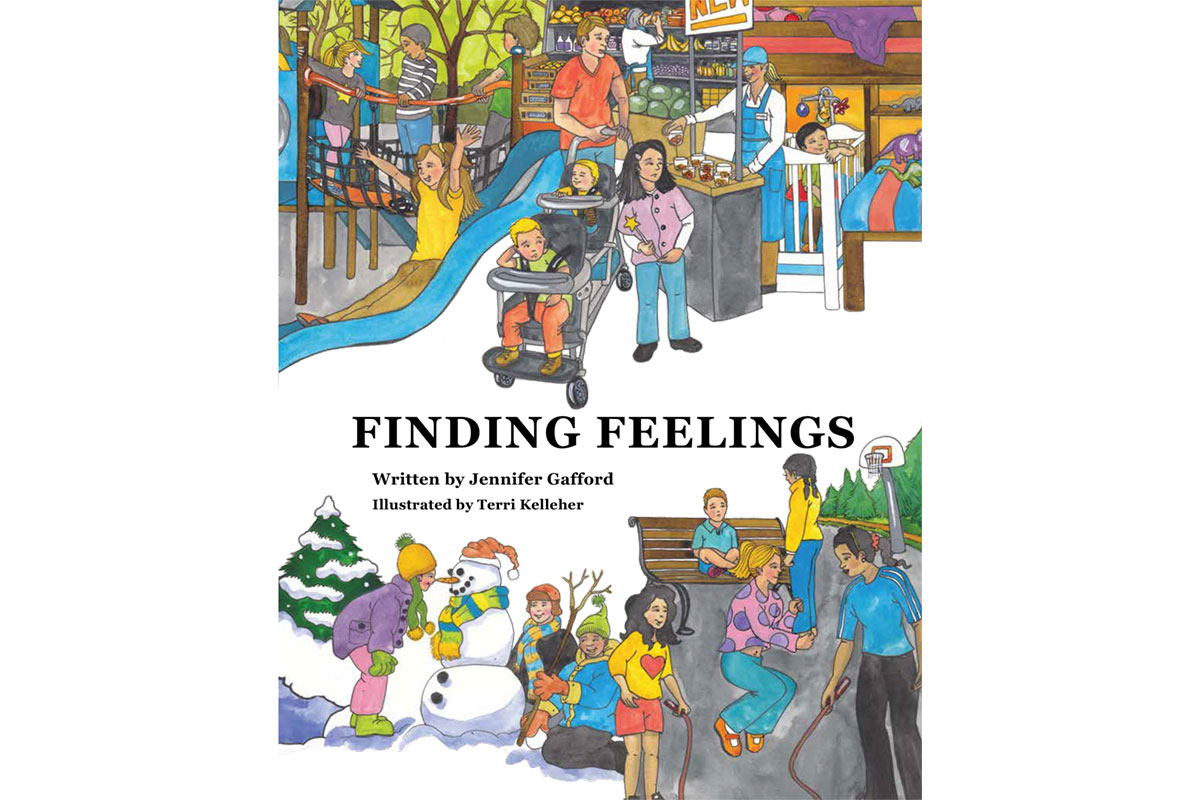
After a neighbor commented on Jennifer Gafford’s young son’s haircut, he crawled underneath the van in embarrassment. The former high school teacher (she taught Spanish at Mount Vernon High School) realized she needed a way to show him that feelings are normal and it’s okay to be overwhelmed. The eventual result was Finding Feelings, a search-and-find book geared for ages 3 to 7 that exposes young children to uncomfortable situations in a safe way, encourages them to grow their emotional language and expression and promotes empathy.
Gafford, a wife, mother of three sons and part-time writer, spoke to us about the inspiration for the book, how parents and kids can use it and why the subject matter is especially relevant right now.
How did your background help you write this book?
“As a teacher, I took courses on emotional intelligence, and learned that our EQ (emotional quotient) is a greater predictor of success and happiness than IQ. What a relief. Learning that our EQ is not stagnant, but can grow and develop, really hit me. Finally, a metaphorical muscle that was actually fun to exercise! The more I read about naming our emotions, practicing self control, developing grit and emotional endurance, the more I wanted to help kids learn these important skills. They are all foundational to becoming a compassionate person, and in this world, there is no greater gift.”
How is this book especially relevant right now?
“These poor kids, us poor adults. We’re all in this together, and it’s not easy. We are experiencing more stress, more frustration, more sadness. We need empathy, we need support, we need others to recognize our feelings. My book, while showing children unmasked and in large gatherings (!), asks the reader to find feelings, and then prompts; “What could you do to help?” or “How are you feeling?” It’s basic, but these are the questions we need to keep asking each other now more than ever.”
Can you give an example of how the book encourages ‘deducing body language and using contextual clues to locate both positive and frustrating feelings.’
“Finding Feelings starts off with one of my favorite scenes, a classroom of young children. “When I arrive at school in the morning, I’m nervous and my stomach hurts … Can you find me?” In the back, by the door, is a young girl, shy and struggling to enter the classroom. This makes me cringe thinking of my preschool sons, sobbing in their teacher’s arms as I left, close to tears myself. How many of us can relate to this girl, who may need to take a deep breath before bravely entering a social scene? Child or adult, some of us know how hard it is to enter a new situation. Being nervous is normal.”
In what ways can parents help children better express their emotions?
“Start with validating their emotions: name the feeling and mirror the child. “I see you’re angry. I WOULD BE ANGRY TOO! SO ANGRY! AHH!” It can be shocking for a toddler (or teenager) to be met not with resistance, but acceptance. When my sons are in their inevitable sibling fights, I’ll ask them to take turns telling each other their versions of the story. Then they have to repeat the accounts from the other’s perspective and I have them work through solutions. By the time the lengthy conversation is over, everyone is annoyed with me and they are happy and best friends again!
So much of emotional intelligence development can happen in hypothetical situations, before problems occur. By talking about it at home, analyzing previous behavior, asking kids to problem solve, and using a plethora of emotional vocabulary, you can teach emotion regulating behavior. Beat them to the metaphorical punch! Or perhaps the literal one!”
For more stories like this, subscribe to our Family newsletter.