This month PBS is placing its bets on the City of Alexandria with its newest series, “Mercy Street,” the first original American drama on the network in over a decade.
Set in 1862, “Mercy Street” takes audience members to a crossroads of the Civil War—a Southern town occupied by Union forces. The struggles of life are told through a story that has often been a footnote in our history: the horrific scenes of what happens after the battles in the hospitals, a place where country doctors must figure out how to tame the deadly outcomes. It is a story of the Civil War that Beth Hoppe, chief programming executive of PBS, describes as one that sheds light on a time that “transformed the lives of ordinary people, challenging their perceptions of right and wrong, good and evil, love and hate.”
While the show is overall a medical drama, it goes beyond touching on the horror of amputations and medical advancements of the time. It is a show that puts the spotlight on the characters—doctors and nurses, soldiers and residents, Union and Confederates and free blacks and contraband slaves—who are multifaceted with flaws that run deep during a time when the world is transforming around them.
“All the characters are trying to find ways to be a good person in the context of how they were raised and in the context of their circumstances,” explains Mary Elizabeth Winstead, who plays nurse Mary Phinney. “Every character, even the antagonistic ones, is trying to figure out how to be a good American in their world.”
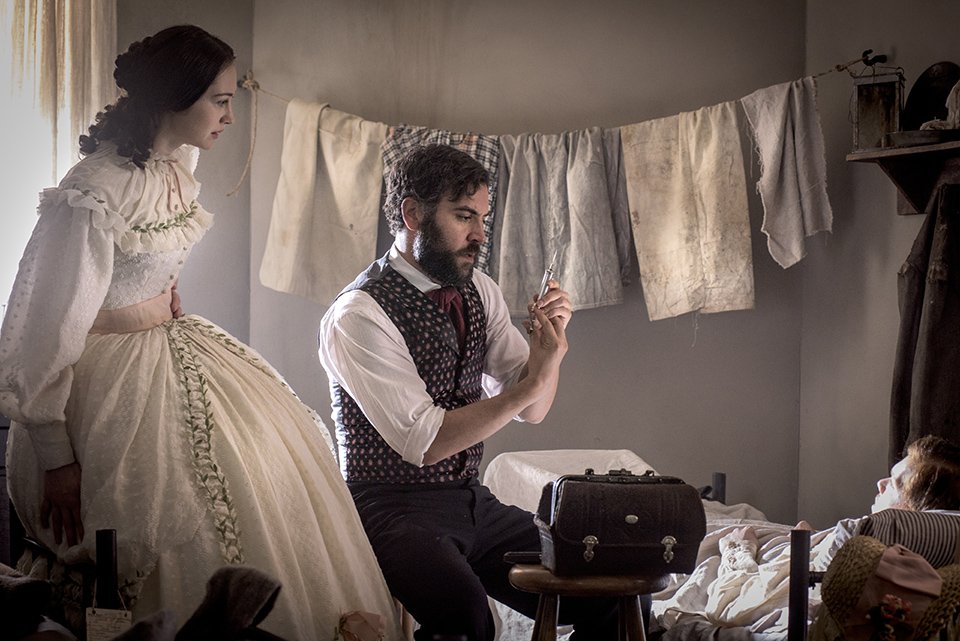
A New England transplant, Phinney has come to Mansion House Hospital, the luxury hotel-turned-Union hospital that is owned by the real-life Green family. She comes under the services of Dr. Jedediah Foster (Josh Radnor), a Union loyalist who was born and raised on a Maryland plantation with 64 slaves. Phinney works with the pretentious nurse Anne Hastings (Tara Summers) and her co-antagonist, Union doctor Byron Hale (Norbert Leo Butz). But there is no more a counterpart, yet in the same ways a mirror image, of Unionist Phinney as there is in Emma Green (Hannah James), the Southern belle and staunch Confederate who signs up to nurse at the hospital.
As the series moves through its slated six episodes, the audience will also come to know the struggles of contraband and free slaves on a deeper level through the Green’s servant, Belinda (L. Scott Caldwell), and Samuel Diggs (McKinley Belcher III), a black laborer in the Mansion House Hospital whose medical skills not only match but sometime surpass those of the doctors.
Ken Burns, the renowned “Civil War” documentarian, calls the show “alive,” “modern” and “organic.” He says: “There is no other place that you are going to get the diversity within characters as well as between characters. You are permitted the gradations of not only the African-American experience but each actor represents deeply flawed and deeply talented human beings who are wrestling with not only all the external conflicts that are besetting the nation, but that same self-division is mirrored in them.”
In keeping with the authenticity found in all of PBS’ dramas, the storyline follows what actually happened in our modern-day hub of culture and shopping.
“Alexandria presented itself as a place where we could cross all these different elements of the war and that time without having to strain in an artificial way,” says David Zabel, the show’s head writer and co-creator. And to drive home the authenticity for the viewers, director Roxann Dawson’s focus was to “take away the hindsight” for viewers.
“There is drama, but there is nothing that has to be manufactured,” she says. “Just drop these characters who are flawed and multifaceted into this situation, which is real, and let us all sit down and examine it and be right there with them and be relearning or, for some, learning for the first time the lessons that we should have learned at that time.”
“Mercy Street” premiers nationally Jan. 17 at 10 p.m. on WETA.