
The number of people, specifically children, with the flu in NoVA creeped up during the week of Thanksgiving, according to data reported by emergency departments and urgent care centers to the Virginia Department of Health.
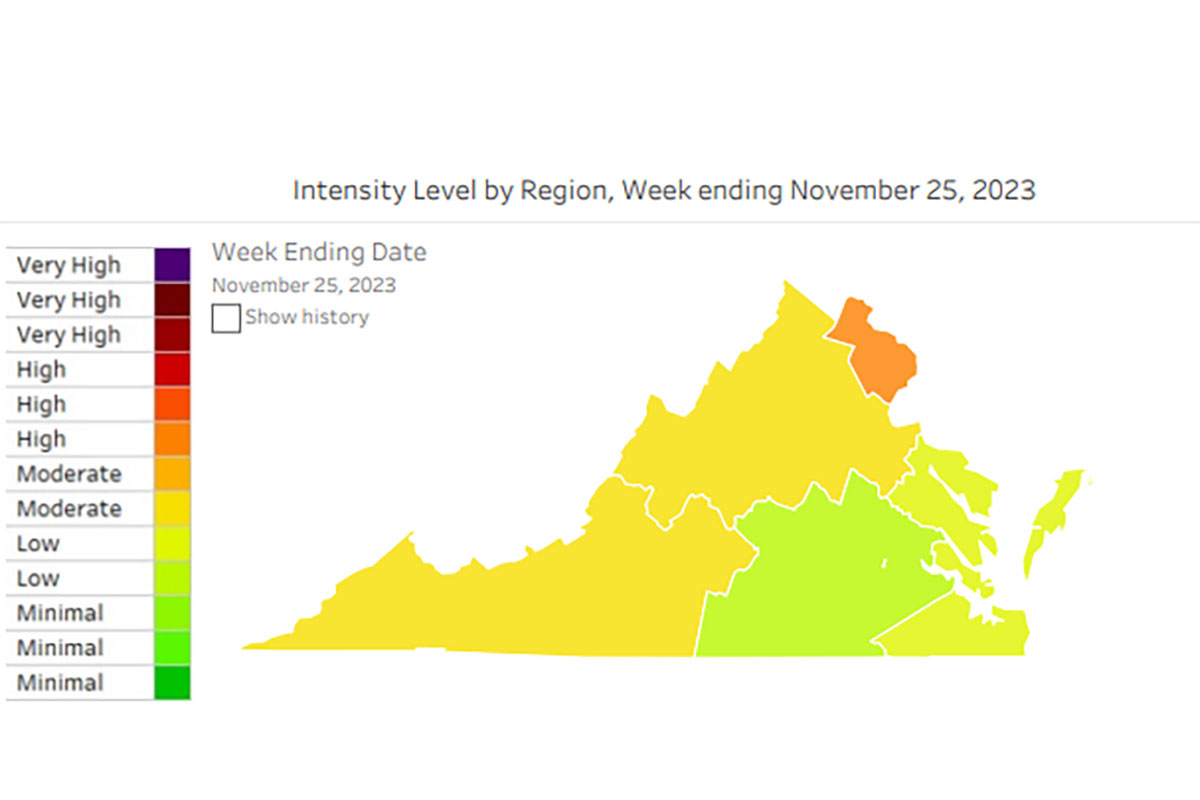
The state’s weekly influenza activity report for the week that ended November 25 characterized the overall intensity of flu cases in the Northern region of the state as “high,” the only region characterized that way. The intensity levels for the flu use a scale that goes up to 13. The Northern region was an 8, the lowest of the “high” levels. The Virginia health department’s Northern region encompasses the counties of Arlington, Fairfax, Loudoun, and Prince William, as well as the independent cities of Alexandria, Fairfax, and Falls Church.
Much of Virginia saw moderate influenza activity that week, including the Northwest region, which includes Stafford County and Fredericksburg in the Rappahannock Health District and Fauquier County in the Rappahannock/Rapidan Health District.
In the Northern region, the health department said that 58 percent of emergency department and urgent care center visits for the flu involved children under the age of 18, with 29.4 percent of those visits occurring in children who are 4 years old or younger, according to Lisa Sollot, VDH’s respiratory diseases coordinator.
Throughout the commonwealth, children from newborns to age 4 accounted for the largest percentage of visits to emergency facilities for influenza-like illness, or 12.7 percent, the week of Thanksgiving.
“Flu activity continues to increase across Virginia and the U.S. We expect this activity to continue increasing as people travel and gather for the holidays,” Sollot said.
Across Virginia, the health department data found influenza-like illness accounted for 3.8 percent of emergency department and urgent care center visits the week ending November 25. In the Northern region, the percentage jumped to 4.3 percent. Statewide, 154 facilities report data to the health department.
Virginia had 381 positive lab reports for the flu and one influenza outbreak Thanksgiving week. In the Northern region, there were 79. The outbreak was in Southwest Virginia.
Typically, the flu season begins in early October and ends in mid- to late May.
To date, there have been 1,504 reported infections. The health department said no predominant strain of influenza has been identified so far this season.
Last season, Virginia saw an unusually early peak in cases, Sollot said. This year, there have been 57 percent fewer visits to the emergency facilities for influenza-like illnesses.
“Current trends are more in line with previous flu seasons,” she said.
While anyone can get the contagious respiratory illness, flu is most serious in young kids, older people, and those with chronic illnesses or weakened immune systems.
Symptoms of the flu include feeling feverish, a cough, sore throat, runny or stuffy nose, body aches, headaches, and fatigue, according to the Centers for Disease Control and Prevention.
But there are emergency warning signs to watch for in children, according to the CDC and Virginia health department:
- Fast breathing or trouble breathing;
- Bluish skin color;
- Not drinking enough fluids;
- Not waking up or not interacting;
- Being so irritable that the child does not want to be held;
- Flu-like symptoms improve but then return with fever and worse cough;
- Fever with a rash.
“It’s never too late to get vaccinated against the flu. Vaccination can reduce your chance of getting the flu and spreading it to friends and family this holiday season,” Sollot said.
Influenza vaccinations are available for anyone who is at least 6 months old.
Feature image, Kirsten Davis/stock.adobe.com
For more stories like this, subscribe to Northern Virginia Magazine’s Health newsletter.