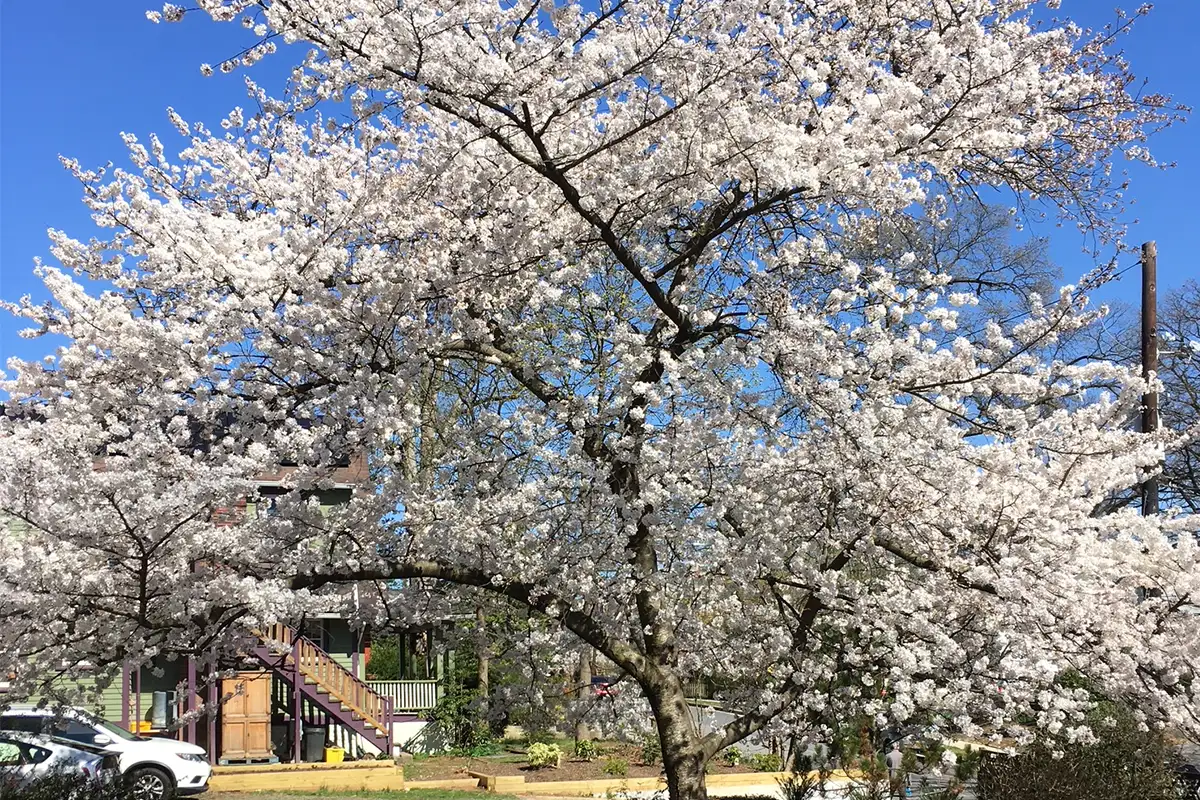
When Jan Herman arrived at the Navy Bureau of Medicine and Surgery in Washington, DC, in 1979, he expected history and government work. What he didn’t expect to find was a tree.
Tucked between a redwood fence and a parking lot stood a gnarled, aging cherry tree. Its bark peeled, its trunk appeared twisted and weakened by rot.
“Half the trunk was hollow,” says Herman, who worked as the Navy’s medical historian for 33 years. “Which is what happens to Yoshino cherry trees … after about maybe 65 to 70 years, they become very susceptible to disease.”
Unearthing the Past
And yet, every spring, delicate pink and white blossoms burst from its branches. Herman investigated and learned the tree had a remarkable past.
“When I first saw it, I did some research on the Old Naval Hospital and found out that these were transplants that had been down on the Tidal Basin,” he says. “This tree was one of those original trees from 1912. And, being a historian, I got very excited about the possibility of — wow — this is a little icon right here in Foggy Bottom.”
In 1909, the City of Tokyo donated 2,000 cherry trees to Washington, DC. The goodwill gesture initially ended in disaster when many trees were diseased and destroyed.
Herman found out a second donation of 3,020 trees arrived in 1912. Those form the iconic Tidal Basin groves we see today. Excess trees were distributed to government agencies, including the Washington Naval Hospital. Herman’s tree was the sole survivor by the time he arrived in 1979.
Extending the Historic Lineage
“I got the feeling that it would be really wonderful to propagate this tree somehow,” Herman says. “Not being an arborist, I wasn’t very successful. … so I called the National Arboretum. And they got very excited about the possibility of being able to propagate this tree.”
With help from the National Arboretum to get cuttings from the original tree, in 1990, Herman had several young Yoshino cherry trees to plant. He planted some on Navy grounds in Foggy Bottom and one in his own backyard in Takoma Park, Maryland.
A traditional Japanese tree-planting ceremony followed in DC. It included embassy staff and speeches commemorating friendship between Japan and the United States. Today, five of those trees still thrive on the former hospital grounds. Herman’s backyard tree has grown over the past 36 years to more than 30 feet tall.
“I don’t have to go down to the Tidal Basin, because it is in my yard,” he says. “People come over, they sit under it, and just sit there and meditate.”
The original Foggy Bottom tree ultimately died around 2015.
“The last I saw, it was in pretty bad shape,” says Herman, who retired in 2012. “A pine tree limb fell off and crushed it. There was just a trunk left.”
Yet, the cherry tree’s legacy lives on — on a hillside in Washington, DC, and in Herman’s backyard.
“Here’s the daughter — or the son — in the backyard,” he says. “So it’s identical to that original tree from 1912, which makes it a historical wonder right here in my backyard.”
Feature image courtesy Jan Herman