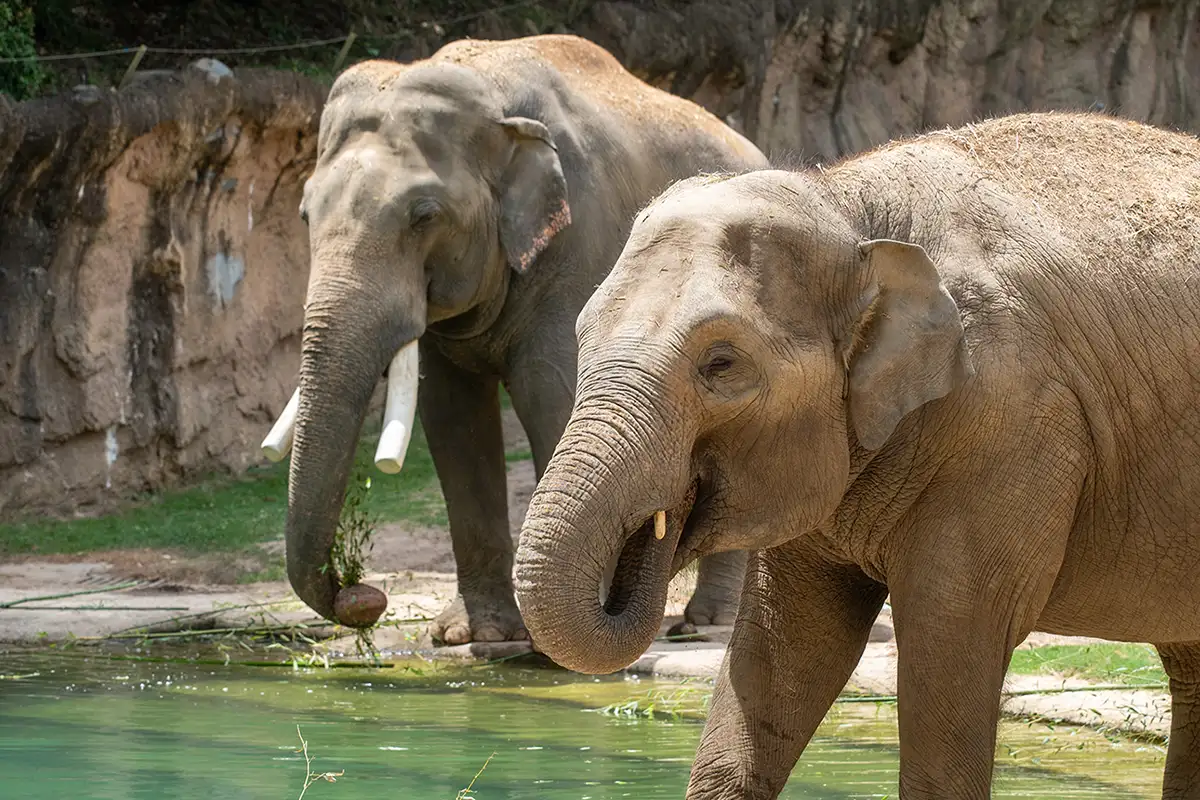
There’s big news at Smithsonian’s National Zoo. For the first time in nearly 25 years, staff anticipate the birth of an Asian elephant calf.
In April 2024, the zoo’s 44-year-old male elephant, Spike, bred with 12-year-old female Nhi Linh. Zookeepers have been closely monitoring Nhi Linh and now say they are “cautiously optimistic” she will deliver a healthy calf between mid-January and early March 2026. Asian elephant pregnancies last 18 to 22 months on average.
Saving an Endangered Species
The pregnancy is exciting news for the endangered species. There are currently fewer than 50,000 Asian elephants left in the world.
“This calf represents real hope for the future of Asian elephants,” Brandie Smith, John and Adrienne Mars director of Smithsonian’s National Zoo and Conservation Biology Institute, said in a release. “The first step to saving any species is getting people to care. As animal ambassadors, elephant calves are as charming and charismatic as they come. I can’t wait for visitors to experience the joy of watching our multigenerational herd socialize, play, and learn — reminding us how much we share with these gentle, intelligent animals.”
Zoo staff say Nhi Linh is “feisty and rambunctious. She is very inquisitive and brave when trying or exploring new things.” She is “smitten with Spike, who exudes a laid-back, gentlemanly attitude.”
Asian elephants are known for being extremely smart, sensitive, and social. The zoo’s elephant care team is “excited to see how the calf will bond with its mother, staff, and Spike, as well as their other herd mates — grandmother Trong Nhi (22), Bozie (51), Swarna (51), and Maharani (35).”
Pregnancy Updates
As Nhi Linh’s due date approaches, the zoo will provide updates through its website and social media accounts. At the zoo’s Elephant Trails exhibit, visitors can see the herd up close and meet their care team during daily 3 p.m. keeper talks.
Fans can also follow the elephants’ stories and stay connected via the Elephant Cam on the zoo’s website.
Feature image of Nhi Linh, foreground, and Spike courtesy Skip Brown/Smithsonian’s National Zoo and Conservation Biology Institute