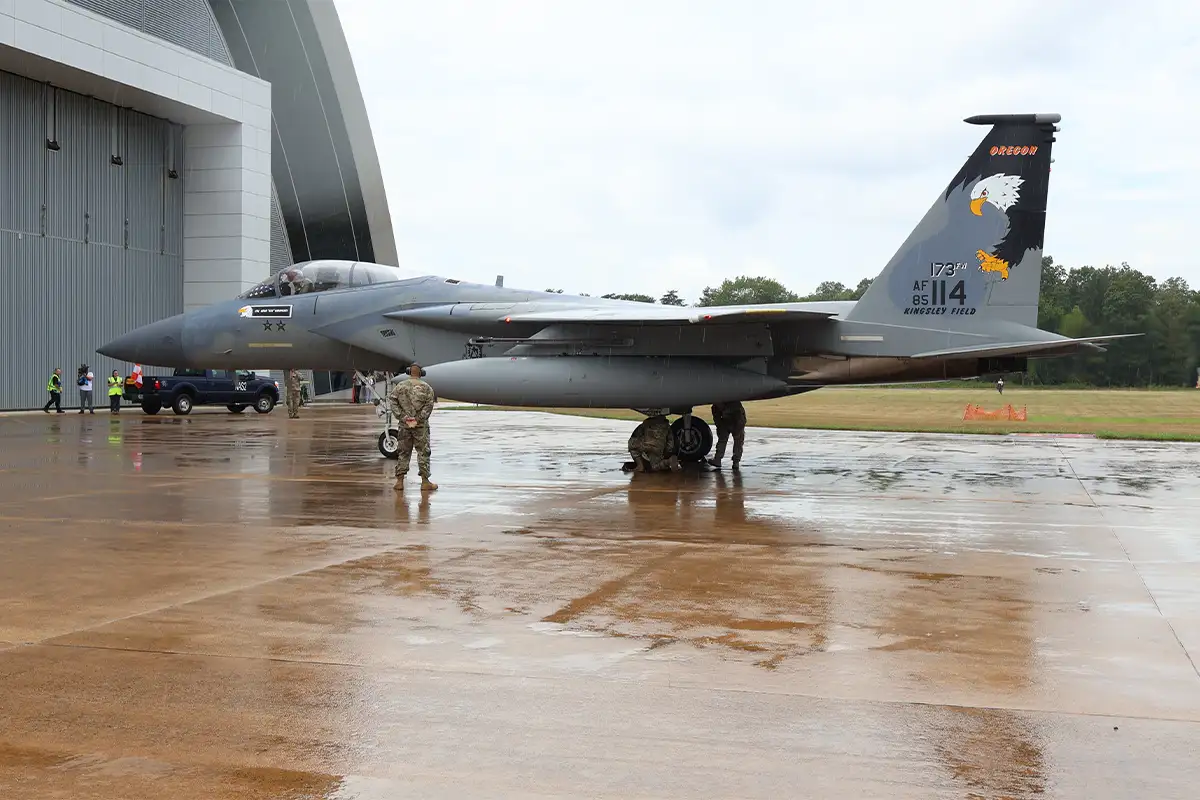
A McDonnell Douglas F-15C Eagle arrived at the National Air & Space Museum’s Udvar-Hazy Center in Chantilly today, where it will become part of the museum’s permanent exhibit.
The F-15C Eagle model is a U.S. Air Force air superiority, all-weather fighter jet known for its maneuverability. It’s considered “one of the most historically significant fighter planes of the post–WWII period,” according to the Smithsonian. This is the first of its kind to be acquired by the Smithsonian.
During a ceremony at the museum, the plane was rededicated in honor of Col. Cesar “Rico” Rodriguez, who achieved two aerial victories against Iraqi MiG fighters during Operation Desert Storm in 1991 in this very plane. Rodriguez later shot down another MiG-29 during Operation Allied Force in 1999 in a different F-15, making him one of only four Americans since 1972 to score three aerial victories.
At the dedication, Rodriguez said he was honored to see his name on the plane and emphasized the amount of teamwork that goes into the Air Force’s work.
“We are a more powerful Air Force, and a more powerful nation, when we are one team, one fight. As we say in the Air Force: fly, fight, win — that’s not ‘I fly, fight, win,’ that’s ‘we fly, fight, and win.’”
“I’m honored that it’s here, but this is about a lot of people,” Rodriguez says.
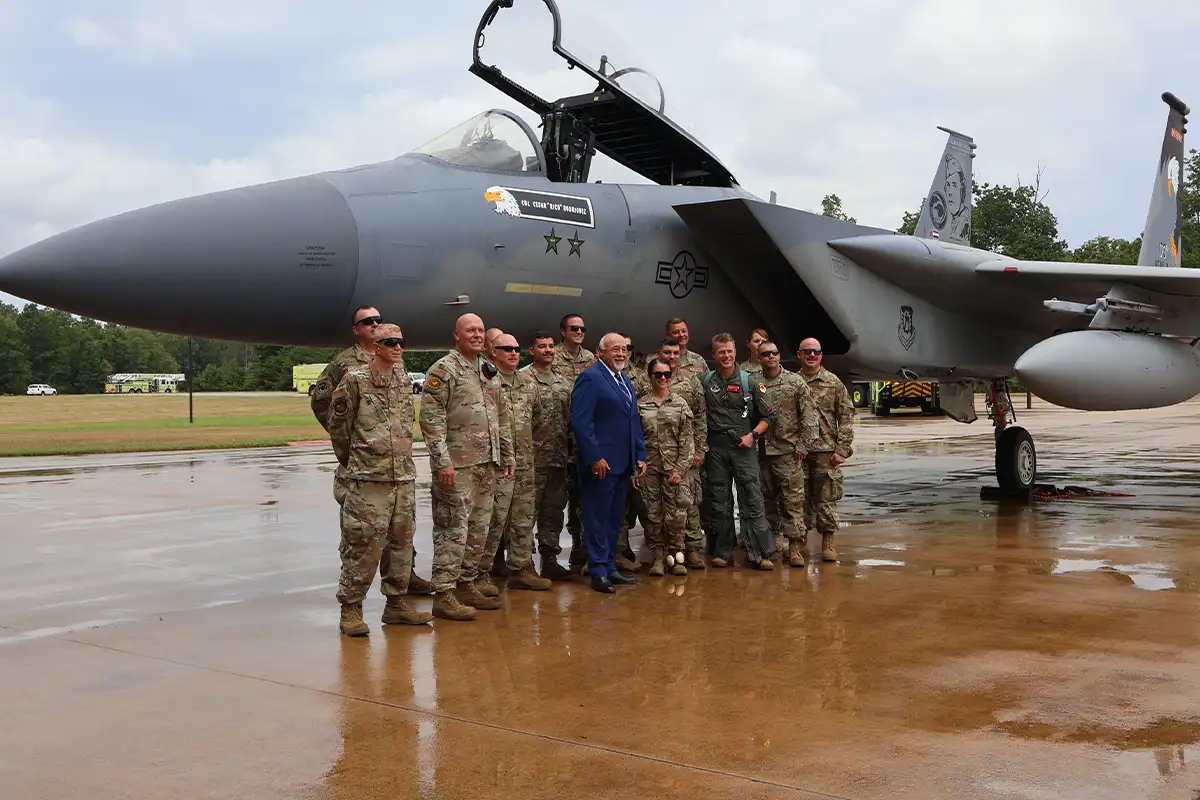
The F-15C Eagle
Michael Hankins, modern military curator at the museum, says the model is historically significant because it was created in the early 1970s, when the Air Force was looking to improve its air-to-air combat capabilities. The result was the F-15C Eagle, which was specifically “for maneuverability, hard turning, [and] can engage enemy aircraft in these kind of dog-fight situations,” Hankins says.
Pilots flying F-15s have shot down more than 100 enemy aircraft, and no F-15 Eagles have ever been lost in air-to-air combat to enemy action.
This particular plane was built in 1985 and has been flying ever since. “It’s been in several different wars, but also has been flying with lots of other squadrons over the years. … It’s got a long history,” Hankins says.
Prior to its new home at the Udvar-Hazy Center, this aircraft was flying with the Oregon National Guard in the 173rd Airway. The Air Force transferred the plane to the Smithsonian so it could officially become an artifact at the museum.
The museum typically doesn’t display aircraft that are actively in service, and most F-15C models are being retired this year, according to Hankins. So having this new plane will bring a more modern perspective to the museum.
“It really brings a little bit more recent past up to the present. We haven’t had a lot of post-Vietnam Air Force aircraft,” Hankins says. “The fact that we can now bring this into the collection and tell that story of how the Air Force is evolving and what kinds of missions it’s doing, and what kinds of wars it was fighting after the Vietnam War up to the present, that really lets us tell a lot of stories.”
Feature image by Michele Kettner