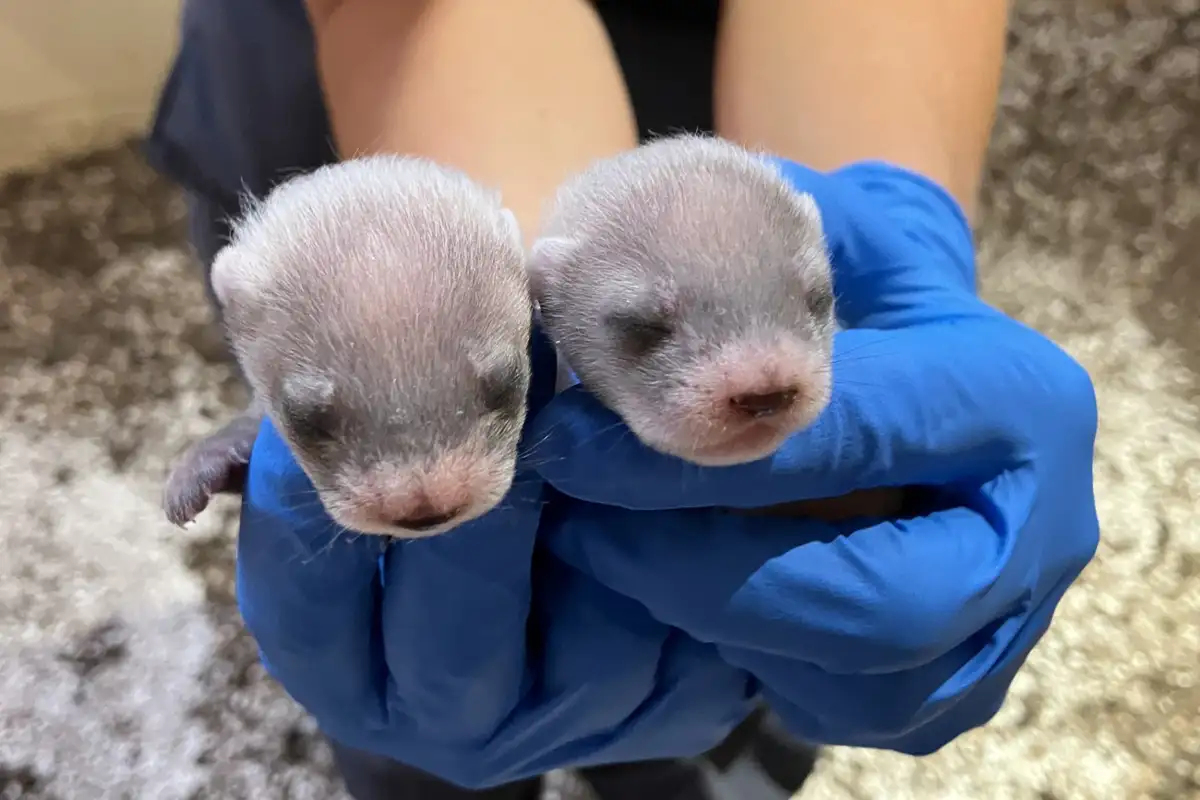
A black-footed ferret who was created by cloning has given birth to two healthy kits in the Smithsonian National Zoo and Conservation Biology’s Front Royal facility, in what the U.S. Fish and Wildlife Service called “a groundbreaking achievement in endangered species research.”
This is the first time in history a cloned U.S. endangered species has successfully produced offspring. The milestone shows “a critical step forward in using cloning to enhance genetic diversity in conservation efforts,” the Fish & Wildlife Service said.
The ferret, Antonia, was created by cloning using tissue samples collected in 1988 from a black-footed ferret named Willa, whose genetic material was preserved at the San Diego Zoo Wildlife Alliance’s Frozen Zoo. Antonia was one of three ferrets born as part of this program.
Black-footed ferrets are endangered, and the current population has a concerning lack of genetic diversity. Excluding the three cloned ferrets and these new kits, all living black-footed ferrets have descended from the same seven ancestors.
Comparatively, the genetic material from Willa contains three times the genetic diversity found on average in the current population.
Antonia mated with a 3-year-old male black-footed ferret named Urchin at the NZCBI and gave birth to three kits. One died shortly after birth, but the two surviving kits, one male and one female, are healthy and meeting developmental milestones.
“The successful breeding and subsequent birth of Antonia’s kits marks a major milestone in endangered species conservation,” said Paul Marinari, senior curator at the Smithsonian’s NZCBI. “The many partners in the Black-footed Ferret Recovery Program continue their innovative and inspirational efforts to save this species and be a model for other conservation programs across the globe.”
The possibility for cloned animals to reproduce proves that cloning can help restore genetic diversity and allow for future breeding to aid with species recovery.
In addition to the cloning efforts, researchers are also working on strategies such as habitat conservation, disease management, and the reintroduction of ferrets into the wild to help aid species recovery.
Revive & Restore and ViaGen Pets & Equine created the cloning technology for this project. Other partners include the Fish & Wildlife Service, NZCBI, San Diego Zoo Wildlife Alliance, and the Association of Zoos and Aquariums.
Feature image of Antonia courtesy the Smithsonian’s National Zoo and Conservation Biology Institute
For more stories like this, subscribe to Northern Virginia Magazine’s News newsletter.