For decades, Virginia wine has occupied an awkward place in the American wine conversation.
It’s old enough to have history — Thomas Jefferson was dreaming of a successful American wine industry more than two centuries ago — but young enough, in its modern incarnation, to still be explaining itself to wine drinkers beyond the Mid-Atlantic.
Now, a new documentary makes the case that Virginia’s wine story is about the people behind it, not just what’s in the bottle.
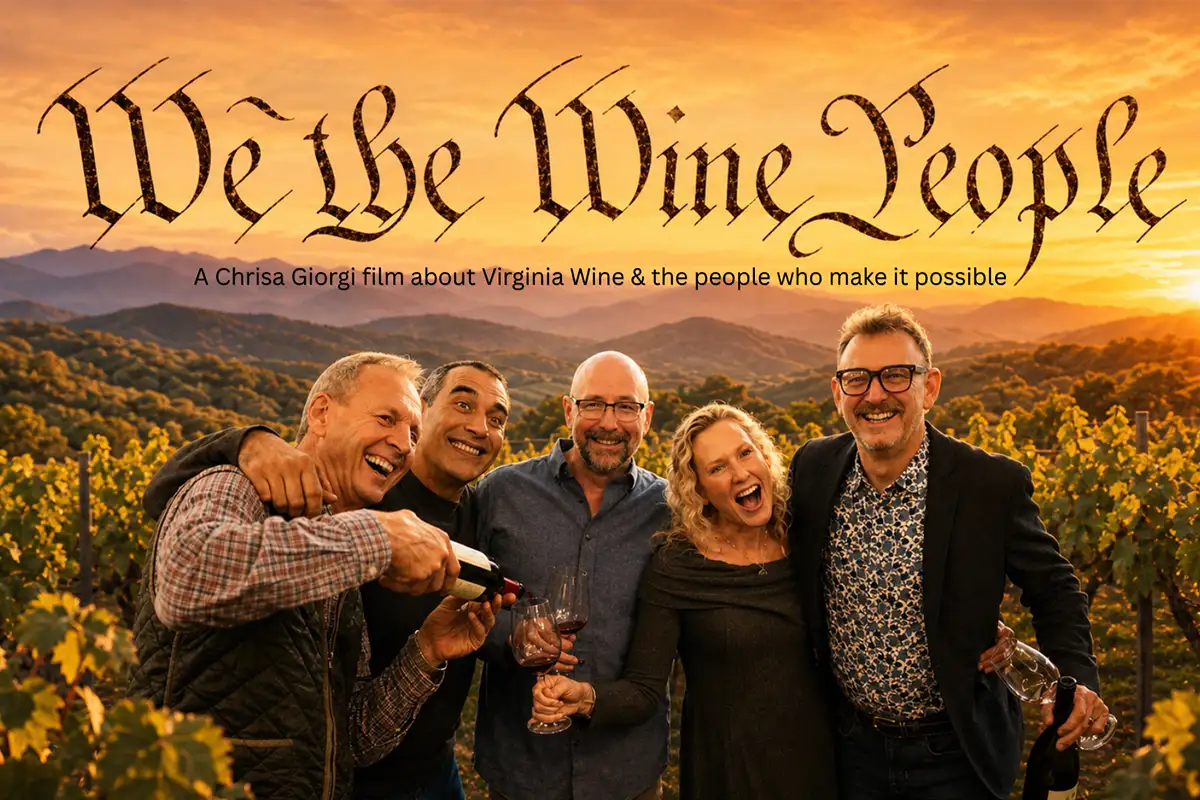
We the Wine People is a 96-minute documentary by Maryland filmmaker and wine professional Chrisa Giorgi. It follows Virginia winemakers, grape growers, researchers, educators, sommeliers, and advocates as they work to define a wine region still finding its identity. The film was released on Apple TV on September 15.
Making the Doc
Giorgi traveled throughout Virginia, filming at roughly 35 vineyards and wineries and following the industry through harvests, tastings, research meetings and conversations with people working across the state. She found something she hadn’t expected: collaboration.
“I discovered the [Virginia] Winemakers Research Exchange, which is a nonprofit formed by winemakers in Virginia, with the goal of experimenting, trial and error, and sharing the wins and the losses,” she says. “The free exchange of information between wineries, which is counterintuitive to what we know about markets and how competitive they are.”
That discovery became one of the film’s central ideas.
“The idea that I discovered with the Virginia wine community is that they compete with one another, not against one another, and that moved me,” Giorgi says.
A Region in Evolution
Giorgi, who grew up around family vineyards in Crete before immigrating to the United States, has previously made documentaries about wine in Crete and Italy. Virginia offered a different challenge because of its geographic and agricultural diversity.
“We have the Eastern Shore, we have the Chesapeake region, we have the Appalachian region, Shenandoah Valley, Central Virginia, Northern Virginia — all very different,” she says. “So when people ask me what kind of wines Virginia makes, I don’t have an answer.”
The variety extends to grape production, including hybrid grapes (crosses between native American and French vines) that can be better suited to Virginia’s weather.
“To me, all these things explain why Virginia wine is so complex to understand, but also so exciting to explore,” Giorgi says.
Luca Paschina, general manager and winemaker at Barboursville Vineyards, was among the first Virginia producers Giorgi contacted for the film. He was impressed by her willingness to spend time with growers throughout the state.
“She spent an incredible amount of time visiting all the producers and farmers and traveling all over and she did amazing work to make something very unique,” he says.
Paschina has watched the industry evolve over the past 36 years. “A lot has changed since my arrival 36 years ago,” he says. Back then, “with few exceptions, according to my palate, Virginia was a bit of a fine local food and wine desert.”
About a decade later, he says, a “food and wine revolution” brought more professional chefs and winemakers into the state. “Virginia wine is no longer considered an alcoholic beverage but as a refined local food,” Paschina says.
A Rising Tide
The collaboration Giorgi encountered extends beyond research. She points to Linden Vineyards owner and winemaker Jim Law, whose apprenticeship program trained aspiring winemakers who went on to work at other Virginia wineries.
“They’re still competing. They’re still out there for business, but they all believe in the rising tide that lifts all boats,” Giorgi says.
That attitude struck her as unusual. “For me, coming from Greece, I’ve never heard that reference before,” she says. “So I was very impressed and moved by this whole collaboration thing.”
The Real Deal
Some of Giorgi’s most memorable moments came when things went wrong. During one harvest, she arrived to find a winemaker devastated because deer had eaten most of the grapes the night before. Giorgi asked whether he wanted to reschedule.
“He’s like, ‘No, that’s part of the story. That’s part of the struggle,’” she says.
She also filmed during a severe spring freeze, watching growers try to protect vines with fires. “It’s a lot of heartache and heartbreak,” she says.
Being allowed to film during such a vulnerable time helped Giorgi understand what she wanted the documentary to show. “They don’t just want to show the beautiful tasting rooms and the wine pouring,” she says. “They want to show the real deal, because I think people value authenticity. These winemakers are authentic, 100%.”
Paschina believes the industry is moving in the right direction. “The aura of Virginia wines will organically continue to grow as it has in the recent years,” he says.
For Giorgi, the documentary is an invitation to discover that evolution firsthand. “Virginia wine is not a novelty,” she says. “It’s won its place on the table.” And for people who have never tasted it? “For many people it’s right next door, and they don’t know what they have right next door,” she says.
Feature photo by Sarah Cramer Shields