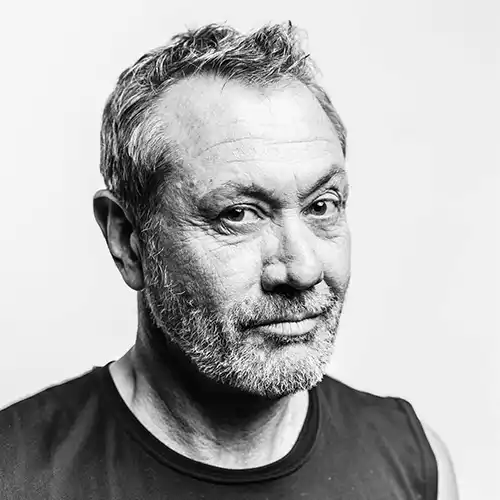
Fredericksburg native Jon Carroll, 68, has been making music around the world for decades. He achieved his first notoriety in 1976 with the quartet Starland Vocal Band. The group had — in fact, still has — a monster earworm in the harmonic pop classic, “Afternoon Delight.” (Everyone now: “Skyrockets in flight…!”) The song won two Grammy awards.
Carroll also wrote a top 30 song in 1982 for Linda Ronstadt, “Get Closer,” also the name of the album. He’s lived in Falls Church, Arlington, Old Town Alexandria, Reston, and finally, Leesburg. He retains what he calls a “dual citizenship” between Leesburg and Easthampton, Massachusetts, where he composes in a former textile mill. It’s where he lives with his wife, Meredith, an interior designer.
Carroll has had songs covered by and/or toured with Mary Chapin Carpenter, the Chicks, Rodney Crowell, Tom Jones, and countless others. He tells Northern Virginia Magazine his local haunts when he’s in town, and how his new album, Can’t Afford Not To — partially recorded in studios in Hamilton and Springfield — came together. And shares how an early gig opening for Jackson Browne makes an April 12 tribute to the troubadour at Wolf Trap a full-circle moment.
Where do you like to eat when you’re in NoVA?
I like to go to diners after a recording session. When I was staying in my sister and brother-in-law’s apartment in Alexandria — they were semi-retired from Joe Theismann’s restaurant, which is one of my favorite places to go for sure — I dropped in to a little breakfast place called Table Talk on Duke Street. They have scrapple every day. I like those kinds of places. I always try to make it by Amphora in Herndon. They have a beautiful building and a wonderful staff working there. I also like to get a big bowl of remedially mollifying pho. There’s a place in Falls Church on Broad Street near the State Theatre that’s great — Pho 88.
Can’t Afford Not To sounds so good — 14 songs with upbeat R&B tempos, hooky melodies, and words with meaning. And the harmonies … how many singers did you have in the studio singing behind you in that gospel-jazz garnish?
Well, I’m either proud or extremely ashamed — mostly the latter — to say I did all the vocal parts on this. Everyone loves harmonies, and that’s more or less been my wheelhouse since the beginning. There are no additional singers, which I would have liked very much to have had, but they’re really hard to round up. I have to say this record may sound a bit like what the 14th or 15th Starland Vocal Band album would sound like if we had stayed together.
You’re playing a key role in the April 12 BandHouse Gigs Tribute to Jackson Browne at Wolf Trap. The show will feature more than 30 of the region’s best musicians. Why are we still celebrating his music?
It qualifies as true Americana. He’s always been one of those paramount songwriters, very socially conscious. It seems to me these days that resonates. There are a lot of harmonies in his music, specifically a lot of bluegrass harmonies. When I first listened to those songs it was the piano that always grabbed me, but you don’t think of him as a piano player, which he is.
Bill and Taffy [Danoff from the Starland Vocal Band], [musician/songwriter] Mike Cotter, and I opened for Jackson Browne at DAR Constitution Hall in October of 1974. That was a turning point in my life, because I was going to the University of Miami, and I didn’t want to be there. I wanted to be playing music, not studying music. When we played that show, Jackson’s piano player, who later became Madonna’s music director, Jai Winding, pulled me aside and said, “Hey you! This is what you do. You can go back to college if you need it, but you should be doing this.” And the next week Bill and Taffy called and asked about starting Starland.
What was Jackson Browne like?
He looked like he hadn’t slept in a week. I said, “This must be hard, man. I want to do that.”
This interview has been edited for length and clarity.
Feature image by Brooke Lowe