Roughly 1,500 people gathered inside George Washington University’s Lisner Auditorium on September 18 to celebrate Patrick O’Connell. The chef behind the legendary Inn at Little Washington was launching his new memoir, Main, Middle & Gay.
Truffle popcorn from the Inn was passed through the audience. Champagne flowed. And O’Connell, dressed in a bedazzled black suit reminiscent of a bullfighter’s costume, was very much the star of his own show.
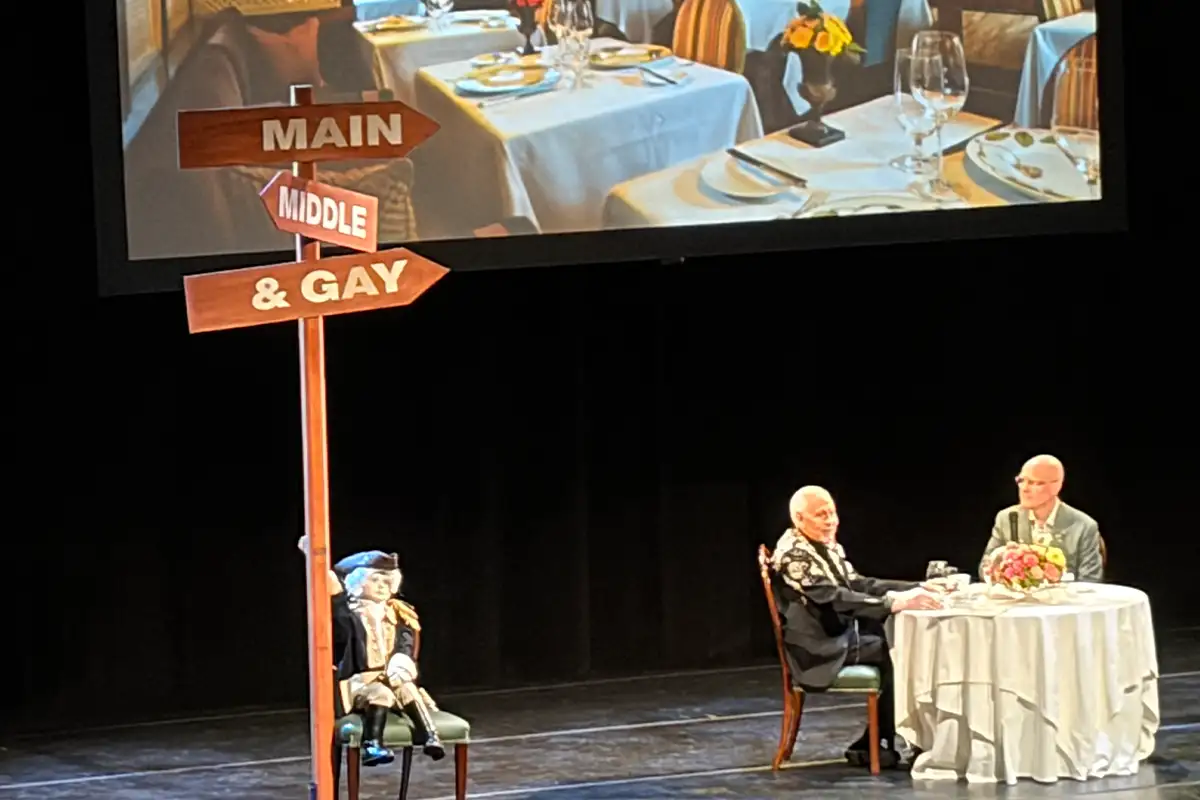
The stage had been transformed into an extension of the Inn: a dining table set with wine, a waiter at the ready and a backdrop showing the Virginia restaurant. It was, fittingly, a theatrical evening for a chef who once studied theater.
‘One of the most amazing culinary experiences anywhere else around the world’
The evening began with chef José Andrés, who delivered an affectionate introduction to the chef he considers a friend and mentor.
“We’re here to celebrate the gift that has been for Washington, DC, and America — the chef Patrick O’Connell,” Andrés told the audience.
Andrés praised O’Connell’s “imagination and courage” in creating the Inn nearly five decades ago in a small Virginia town. And transforming it into what he called “one of the most amazing culinary experiences anywhere else around the world. He made a forgotten part of Virginia one of the most celebrated neighborhoods and towns in the whole of America,” Andrés said.
Then the lights shifted, and the stage became the Inn.

‘His greatest production is the restaurant’
Seated at a dining table with wine and a waiter nearby, O’Connell settled into conversation with Tom Sietsema, The Washington Sun food correspondent and former long-time Washington Post food critic. Behind them, images of the Inn provided a visual reminder of the place at the center of O’Connell’s life and memoir.
“Never forget Patrick O’Connell studied theater,” Sietsema said. “His greatest production is the restaurant, where the star’s presence is felt even on the rare occasions he’s away.”
For Sietsema, that production has been decades in the making. He first heard about the Inn while he was a student at Georgetown University in the 1980s. The restaurant was already a destination he dreamed of visiting. He saved his tips as a waiter to afford the experience.
“My first visit, I swooned over the food and service,” Sietsema said. There was just one problem: “I worried throughout the meal that my credit card with its $300 limit might be declined.”
Fortunately, it wasn’t.
Sietsema would go on to become one of the Inn’s most familiar — and, for O’Connell and his staff, sometimes nerve-racking — visitors. During the interview, O’Connell joked about the lengths the restaurant went to when Sietsema came calling. Meanwhile, Sietsema revealed that he had used roughly 35 aliases over the years in an effort to dine anonymously.
“I had to figure out how to get in without anyone knowing,” Sietsema said. “And your people are very good at sussing people out ahead of time.”
O’Connell’s general manager, he recalled, had a simple philosophy: “It may be their job to remain anonymous, but it’s our job to know who they are.”
The exchange captured the warm relationship between critic and chef, but the conversation turned more personal.

‘If you feel at home, you do your best work’
O’Connell opened the Inn in 1978 in a former garage on the corner of Main and Middle streets. What began as a modest country inn evolved over the decades into an internationally recognized culinary destination, helping transform the tiny town of Washington, Virginia, into a place known to food lovers around the world.
The memoir, Main, Middle & Gay, chronicles that journey, but it also delves into the life behind the restaurant. O’Connell said he began writing the book simply to preserve memories before they became “misty and watercolored.” A memoir-writing teacher encouraged him to stop worrying about how the story might be received and simply write it for himself.
The book also reveals the vulnerability behind the theatrical persona. O’Connell spoke about growing up feeling that he wasn’t enough and finding a sense of belonging through the team and the vision he created at the Inn.
“I wanted to create a space where people could be themselves, however crazy they were,” he said. “If you feel at home, you do your best work.”
For O’Connell, the experience he creates is ultimately about something deeper than food. “Money was never the first concern or focus, beauty was,” he said. “Beauty is always worth pursuing. Beauty is healing.”
That philosophy helps explain the Inn’s distinctive combination of food, whimsy, hospitality and theatre. From its famously playful dishes to its mooing cheese cart and unexpected touches, the experience is designed to transport diners.
‘A great restaurant isn’t because of one person’
The same philosophy extends into O’Connell’s kitchen, where he says creativity is a collaborative process rather than the vision of one chef.
“A great restaurant isn’t because of one person,” he said. “It’s because of the collective team and the spirit of that team.”
But if the evening began like a book launch, it ended like opening night.
A Lady Gaga lookalike appeared onstage and launched into “Bad Romance” as dancers joined the performance. Then, in a final flourish worthy of O’Connell himself, the dancers carried the chef onto the stage for a curtain call. The audience erupted.
It was an ending tailor-made for O’Connell: joyful, theatrical and just a little unexpected. After nearly five decades of turning meals into experiences and a tiny Virginia hamlet into a destination, Chef spent the evening doing what he has always done best — putting on an unforgettable, spectacular show.
Feature image of chef Patrick O’Connell, left, and food critic Tom Sietsema courtesy Dawn Klavon