
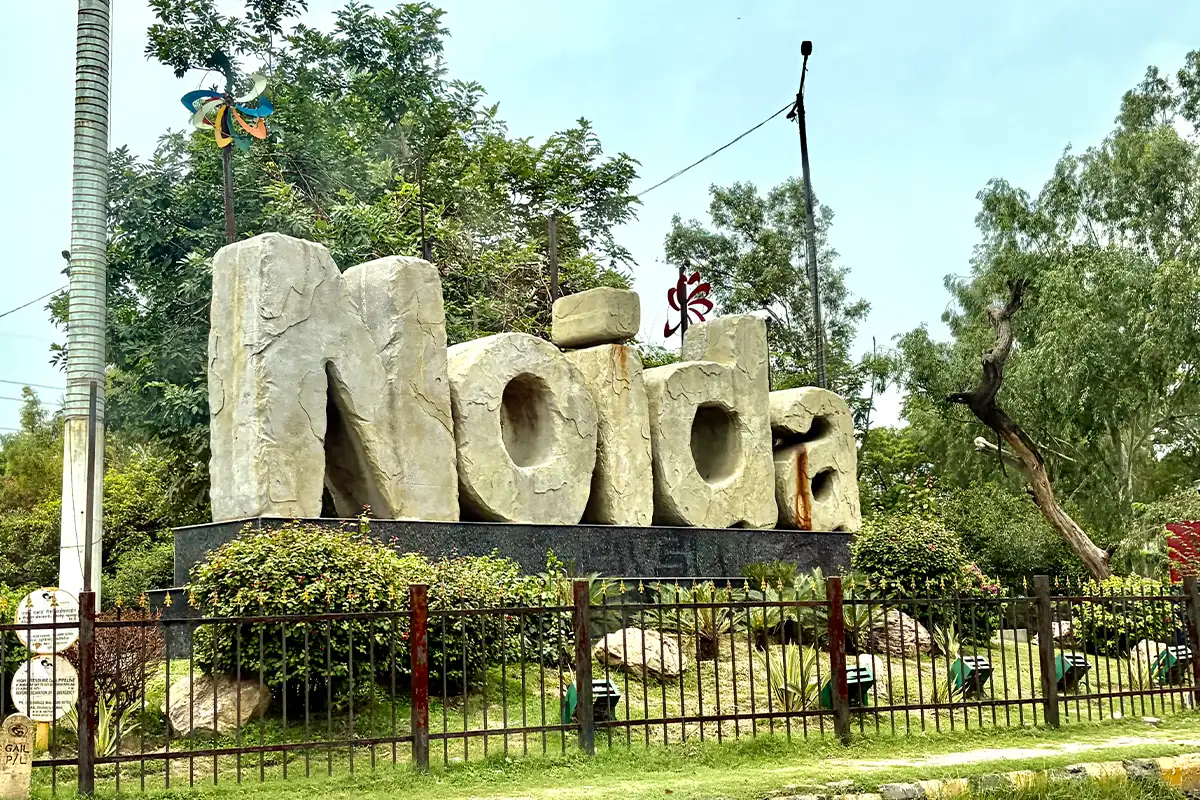
To drive in India, they say you need three things: good brakes, a good horn, and good luck.
Before dawn, the streets of Greater Noida are already alive. Cars, motorcycles, bicycle rickshaws, and motorized tuk-tuks weave through traffic in what first appears to be complete chaos. Drivers announce every lane change, merge, and pass with a quick blast of the horn — not in anger, but as a constant form of communication that somehow keeps traffic flowing.
Stray cows wander into traffic. Monkeys perch on walls and scamper across rooftops. Entire families balance on a single motorcycle while tuk-tuks somehow make room for parents, children and bags of groceries.
A world away, Loudoun County couldn’t seem more different. Rolling horse country, quaint, historic towns and more than 50 wineries share the landscape with Data Center Alley, the world’s largest concentration of data centers. On weekends, families browse farmers markets, gather at craft breweries and cheer beneath the Friday night lights.
More in Common than Meets the Eye
Yet despite those contrasts, the two have more in common than first meets the eye. Both are booming suburbs of global capitals. Both have become magnets for technology companies and are betting much of their future on innovation.
Those shared priorities led Loudoun County and Greater Noida to become sister cities in 2024.
Even the city’s official slogan hints at its ambitions: “Greater Noida City: Planned with an Obsession.” It’s a fitting description for a community built from the ground up to attract universities, manufacturers and global technology companies, making it a natural partner for Loudoun County.
“Loudoun has built strong relationships within India over many years,” says Buddy Rizer, executive director of Loudoun Economic Development. “Those conversations naturally led to Greater Noida because we recognized that both they and Loudoun are innovation-driven and forward-looking communities.”
Companies operating in both regions see those similarities firsthand. Rizer says Loudoun’s position as home to “Data Center Alley” and the world’s largest concentration of data centers offers Indian technology companies a natural gateway into the U.S. market.
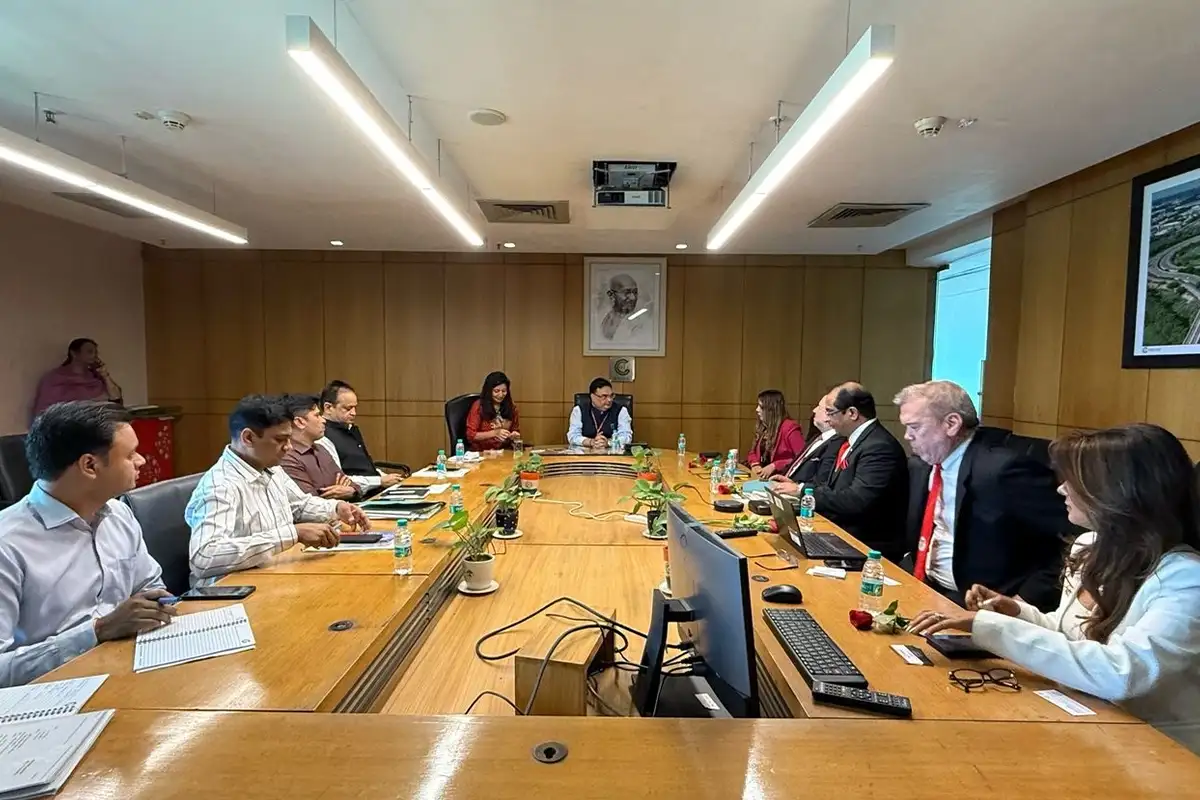
Unlike many sister-city relationships built primarily around cultural exchanges, this one has a distinctly economic focus. For Loudoun, the relationship could help attract new employers and investment while giving local companies another pathway into one of the world’s fastest-growing economies.
An Economic Focus
Noida itself began as the New Okhla Industrial Development Authority, a planned city southeast of Delhi. As growth accelerated, planners expanded outward, creating Greater Noida.
During a weeklong visit to Greater Noida last month, the city’s contrasts were impossible to ignore. Gleaming office towers, luxury hotels, and multinational headquarters stood beside roadside food stalls, open-air produce markets, and modest neighborhoods. At traffic lights, barefoot children tapped on taxi windows, asking for a few rupees. Dense tangles of power lines crisscrossed busy intersections while, just beyond them, construction cranes stretched across the skyline. It’s a world apart from Virginia, but the frenetic pace settled into its own rhythm.
“Noida became so populated and grew so much that it had to expand,” India native and Chantilly resident Amit Ganjoo says of the city bordering Delhi versus its southeastern extension. “Greater Noida is essentially a newer, more modern version — with newer office complexes, high-rises, and residential developments.”
Explosive Growth
Beneath visible differences, however, both communities are experiencing explosive growth.
“They’re both economic engines,” Rizer says. “We’re home to talented workforces, strong universities, thriving technology sectors, and leaders who are thinking about the future.”
Sahil Khan, a Delhi-area historian and tour guide has watched Greater Noida evolve over the past two decades. He says the city’s growth was carefully planned in phases. Rather than expanding all at once, neighborhoods, jobs, and industry were added in stages — a deliberate approach he believes transformed Greater Noida’s development.
Everywhere, signs of growth were impossible to miss. Electronics manufacturers, software firms, and multinational corporations continue to invest in Greater Noida. And the city’s skyline continues to evolve alongside that growth.
Sharing Ideas and Challenges
Neither community claims to have all the answers. At its core, the partnership is about sharing ideas with another region confronting many of the same challenges. Khan says one of India’s biggest challenges isn’t technology — it’s how people are treated in the workplace.
“People are overutilized and underpaid,” he says. “Instead of utilizing the same person for 10 or 12 hours, they should have kept it in shifts.”
Rizer believes Loudoun has just as much to learn as it has to offer.
“When communities are solving similar problems,” he says, “there’s tremendous value in sharing ideas and learning from each other’s experiences.”
Business Without Borders
For ANRA Technologies founder and CEO Ganjoo, the connection between Loudoun County and Greater Noida isn’t theoretical. His Chantilly-based aerospace and autonomous systems software company operates offices in Northern Virginia, Noida, London, Dubai, and Tartu, giving him a front-row seat to the strengths of both regions.
Although ANRA was founded in the United States, its first physical office opened in Noida in 2017. Ganjoo chose the city partly because his parents lived there, but also because Noida had already established itself as one of India’s premier technology hubs.
“Noida is one of the three or four major software development centers in India,” he says. “It’s an IT hub with young professionals, high-tech companies, and tremendous opportunity.”
Like Loudoun County, the Noida region has become a magnet for highly educated professionals pursuing careers in technology. Ganjoo sees that shared focus on innovation as one of the biggest reasons the two communities make natural partners.
“The similarities are the young demographic, the technology businesses, and the concentration of educated professionals,” he says. “People go where the opportunities are.”
For ANRA, maintaining offices on opposite sides of the globe also provides practical advantages. “Because we support customers around the world, we can follow the sun,” Ganjoo says.
By handing work from one office to the next, ANRA can support customers around the clock without requiring employees to work overnight. “Our teams in different time zones allow us to provide support without people having to work in the middle of the night,” he says.
While India offers a deep engineering talent pool and cost advantages, Ganjoo says each location brings different strengths to the company. ANRA’s early software development was driven largely from Noida, while its teams in the United States and Europe helped refine products for commercial markets.
“It made a significant difference in our early days,” he says. “Then, as we commercialized our products, having offices in the U.S. and U.K. helped raise the quality to the next level.”
More than Economics
Although the sister city agreement began with business, both sides hope it grows into something broader. Rizer envisions university partnerships, student exchanges, and entrepreneurs collaborating across continents.
“Economic development is really about people,” Rizer says. “Business relationships often lead to educational exchanges, cultural experiences, and lifelong friendships.”
Seven thousand five hundred miles separate Loudoun County and Greater Noida. One is known for data centers and vineyards, the other for crowded streets and rapidly rising skylines. Yet both communities are reinventing themselves through technology, entrepreneurship, and education.
Though their sister-city partnership began as an economic agreement, its greatest value lies in the relationships forged between the people working to build a more prosperous future on both sides of the globe.
Feature photo by Dawn Klavon