Wednesday’s fatal plane crash at Reagan National Airport is reviving long-held concerns over the airport’s crowded airspace.
Jim Brauchle, a former U.S. Air Force navigator and aviation attorney at the DC-based firm Motley Rice, shares insight about the traffic patterns and congestion that aviators have seen at the airport.
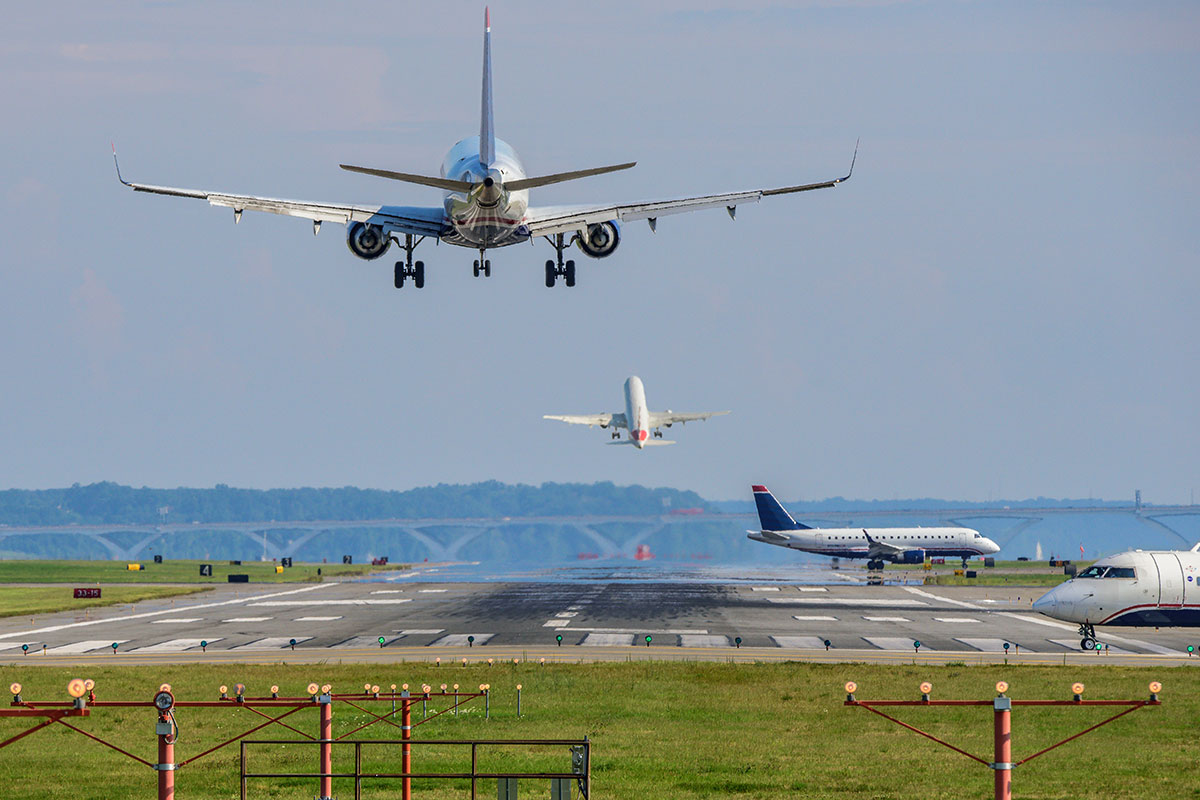
“Because it’s essentially in the heart of downtown DC, the airspace around it is very restricted, so you have very narrow pathways getting in and out of there. At the same time, [you] have a lot of traffic,” Brauchle says, noting that there is a combination of commercial, private, and military aircraft traffic in the area. “You’re trying to dump a lot of aircraft into a small space.”
As planes descend into Runway 33, he says, they fly down the eastern side of the river before making a 50-degree left turn toward the airport, descending from about 500 feet in the air to ground-level as they cross the Potomac.
What is unique to DCA, he says, is that there is a helicopter route that runs down the Potomac, intersecting with that plane-landing route, only about 200 feet below.
“So you have the final approach and this helicopter route that actually intersect, and the only deconfliction is by altitude. … When you’re putting airplanes in the same space with only a couple hundred feet of buffer, it’s not a lot.”
Heavy congestion at DCA has been a topic of concern in recent years. The airport has the busiest runway in the country. More than 23,000 flights out of the airport every month in 2024.
A string of near misses at DCA has also raised alarm about the airport’s safety from legislators (including Virginia Senators Tim Kaine and Mark Warner) and pilots alike.
“There have been several reported near misses. And I think a lot of pilots, airline pilots, that go in and out of there on a regular basis will talk about that there’s a lot of heavy helicopter traffic,” Brauchle says.
This was the deadliest plane crash in the U.S. since 2001, when an American Airlines flight crashed in Belle Harbor, New York, AP reports. There has not been a major fatal crash in the U.S. since 2009, near Buffalo, New York.
Looking ahead, Brauchle anticipates a thorough review of the DCA crash, led by the National Transportation Safety Board, where investigators will examine human factors, environmental factors, and review any evidence that will reveal what exactly contributed to the crash.
“One thing about the aviation community out of these disasters and tragedies, they try to learn and try to figure out, ‘Hey, what went wrong? How can we prevent this from happening again, and make changes to prevent it?,” he says.
“More safety reforms are needed but this investigation will take time, especially since multiple agencies and laws will be involved. We need to give regulatory agencies room to do what they need to do,” Brauchle says.
Feature image, stock.adobe.com