
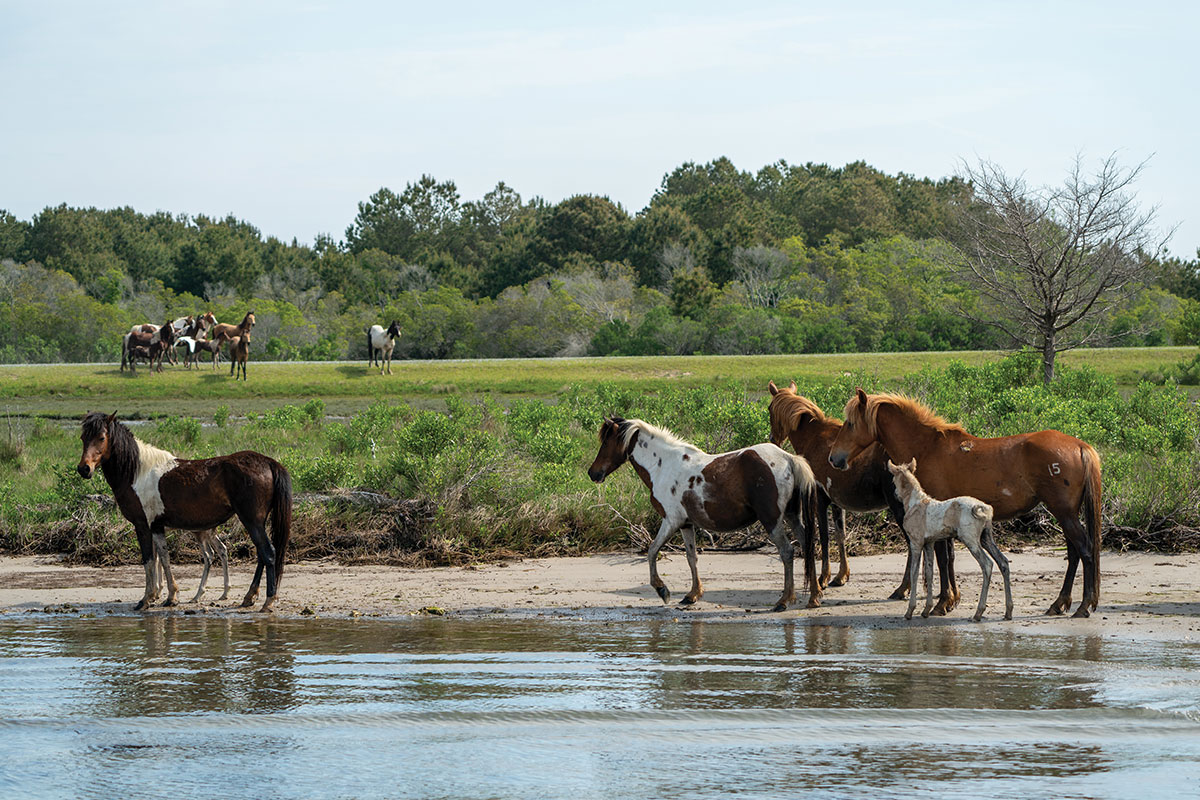
If you have yet to see the beloved wild horses of the Eastern Shore, odds are the experience is on your bucket list, especially if you loved the Misty of Chincoteague books as a child. Viewing the storied beasts in the flesh just takes a little planning. Assateague State Park’s park manager Angela Baldwin shares information and tips for planning a visit.
Know the Herds
There are two herds on Assateague Island, separated by a fence at the state line. The herd on the Maryland side is managed by the National Park Service, while the Virginia herd is managed and owned by the Chincoteague Volunteer Fire Department. The Virginia horses participate in the popular Chincoteague Pony Swim and auction in July, which draws tens of thousands of visitors annually. The Maryland side will likely be less crowded year-round.
“The volunteer fire company manages their horses a little bit more like a domestic animal, although they do roam free in the Chincoteague Wildlife Refuge,” Baldwin says. “The Assateague horses are, by and large, all-natural free-roaming, kind of considered as wild animals.” They can be spotted anywhere on the island at any time. The official word they use for these horses is “feral,” Baldwin says, which “basically means they’re descendants of domestic horses that have reverted to a wild state.”
Safety for All
While the horses may appear to be harmless, it’s important to remember that they are wild animals and should be treated as such. Think of them as you would think of a bear, Baldwin suggests, taking the same sort of precautions you would if you knew a bear would be in the area. It’s crucial to keep a safe distance, to always secure your food, and to check for horses when you’re driving.
“The rules are that you should never be closer than 40 feet to them, which is about the length of a school bus,” Baldwin says. “Sometimes even that’s too close, depending on the horse’s behavior. … If there are multiple horses in an area, they can be very unpredictable. They can be aggressive. They’re very food aggressive. … Folks need to secure their food at all times.”
If a cooler is left unattended, horses can get into it, so make sure you have a strap to secure it, Baldwin advises. If you’re bringing snacks to the beach, put them in a zippered bag. Just always be aware of your surroundings. If horses are approaching you, remember to get out of the way, because they’re not likely to move first.
When it comes to younger horses, Baldwin says to keep even more of a distance. With as many as ten foals born on the Maryland end each season, sightings are not uncommon. “It is really important to give them distance, even greater than the required 40 feet, because any human interference can impact the mother/foal relationship, cause them to separate, and/or endanger the animal’s welfare,” Baldwin says. “Seeing the new foals can be really exciting, but visitors must use extra precautions to make sure they are viewing them safely.”
On the Maryland side, where the horses roam freely throughout the park, you want to be extra careful when driving, Baldwin says, because cars have struck horses in the past. “We always tell folks, make sure you obey the speed limit, but also particularly at night, you want to go extra slow because it’s quite dark and the horses do come out on the road.”
Where to Stay & When to Visit
Camping on the beach with horses roaming the shore sounds like heaven, doesn’t it? Fortunately, the state park and the Assateague Island National Seashore in Maryland both have campgrounds, and they’re suitable for any level of camper. “The majority of the camping is pretty easy for folks who are new to camping,” Baldwin says. The state park has bathhouses with hot and cold running water throughout and flush toilets. The national park doesn’t have flush toilets, but it does have facilities in close proximity to the campsites.
Keep in mind that camping is very popular, especially at the height of summer, Baldwin says, and you’ll want to consider booking as soon as bookings open (about a year in advance for the state park and six months for the National Seashore).
Baldwin adds, “We do have a lot of cancellation or date changes. So, if you look at the websites, you can get some last-minute trips in, too.”
The park is about 8 miles from Ocean City, Maryland, so folks who aren’t big on camping can easily stay at an Ocean City rental or hotel and drive to see the horses during the day. Just make sure to go either early or later in the evening to avoid sitting in traffic, which can be congested on summer weekends. The state park opens at 7 a.m. and the National Seashore is open 24 hours a day. While there’s no guarantee that you’ll see the horses on your first visit, Baldwin says there is a good chance you will, since they are often in the park’s developed areas.
RELATED STORIES:
- Here’s What to Know About the Wild Horses on Assateague Island
- 7 Eastern Shore Nature Preserves Perfect for Birding
- Visit Wallops Island This Summer for a Glimpse into NASA’s Space Programs
- Berlin, Maryland, Is Small in Size but Big in Character
- Festivals and Events on the Eastern Shore You Won’t Want to Miss
- In St. Michaels, Maryland, a Peaceful Seaside Getaway Awaits
- Explore Easton on Maryland’s Eastern Shore
- How and Where to Find Eastern Shore Cruises in Maryland
- Get to Know the Types of Virginia Oysters and Where to Find Them
Feature image, Nathaniel Gonzales/stock.adobe.com
This story originally ran in our May issue. For more stories like this, subscribe to Northern Virginia Magazine.