
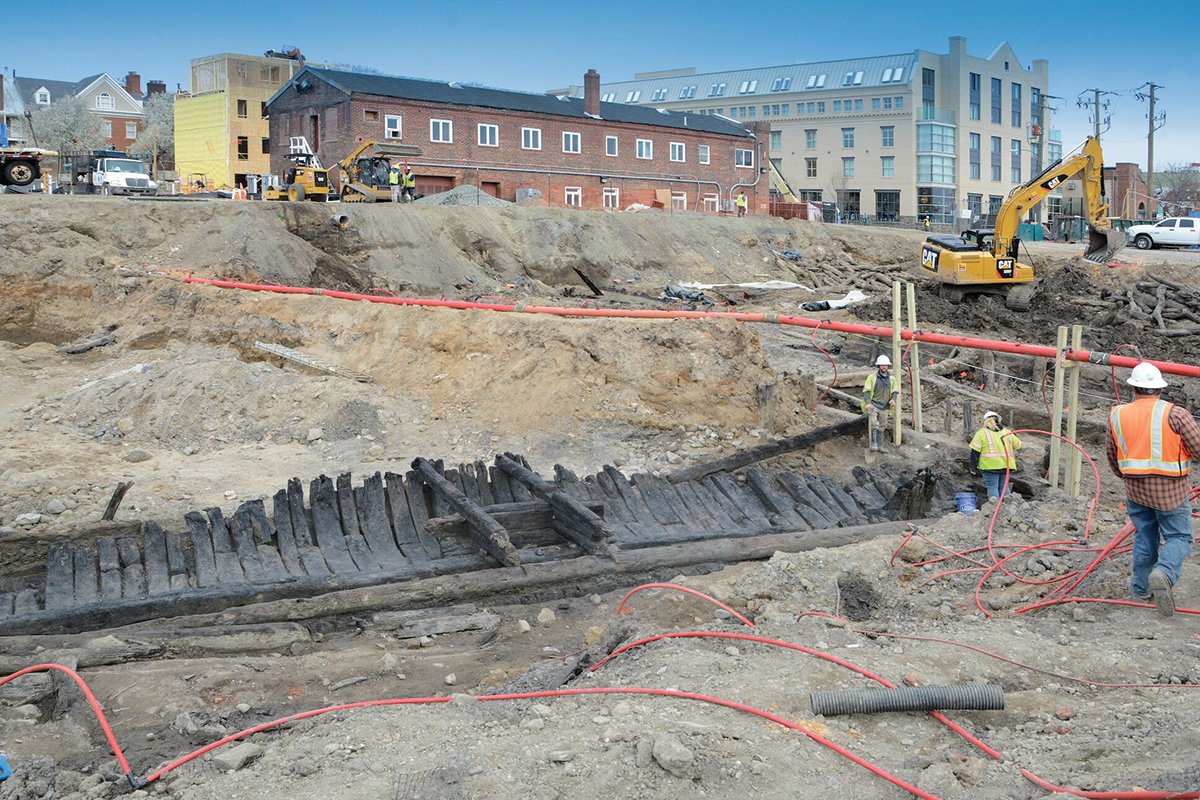
Alexandrians are continually learning they may be walking on historical goodies they didn’t know were there. Three years after an 18th century ship was found at the construction site of the Hotel Indigo on the waterfront of Old Town Alexandria, three more ships from the same era were discovered—dug up over a month from March to April—at the construction site for Robinson Landing, a townhome community from real estate developer EYA, a block from Hotel Indigo.
Alexandria’s archaeological production code required EYA to hire an archaeological consultant for the site, Thunderbird Archaeology, which was the same consultant used for the Hotel Indigo construction. In the year since construction began, artifacts from an early waterfront neighborhood were found, including house foundations, privies and the stone outline of an alleyway. As construction moved toward the water, they began digging up these new ships, buried about 15 feet underground. Since then, the Office of Histroic Alexandria has been working with the site to preserve the ships.
The first ship was found under the foundation of the old Pioneer Mills and was measured at 12 feet wide. The second ship was the first to be fully exposed and measured 12 feet wide and 46 feet long. The third ship was the most intact, with the bow of the ship having been exposed during construction; it measured 25 feet across and had an undetermined length at the time of printing.
“They’ve been kept wet and covered because as soon as the wood of ships or the wood of 18th century that has been waterlogged hits the air, hits oxygen essentially, it starts to degrade,” says Dr. Eleanor Breen, Alexandria’s city archaeologist. “So the goal is to really keep everything as wet as possible so you prevent shrinking and warping of the original surface of the wood.”
The three ships were carefully excavated so that they could be effectively dismantled and put in tanks of water in an Alexandria facility while Breen says that the city “comes up with a plan, quickly.” The second ship was the first that was able to be dismantled and removed from the site in April.
If the city follows the blue print of the Hotel Indigo ship, that’ll mean a trip to the Conservation Research Lab at Texas A&M. All 300-plus timbers of the Indigo ship were dismantled and shipped to the facility to remove the water from the wood and replace it with polyethylene glycol, a waxy substance that allows the wood to be exposed to air. Breen estimates that the conservation process will take about another five years, after which the plan is for the ship to have “one last voyage” (albeit on the highways) to Alexandria for display at a to-be-determined location.
That option is being kept open for the three new ships as well, but Breen notes that is an expensive process that would require special funding. Alternative perseveration methods are also being considered, including longer stabilization periods where the ships timbers would be reinterned in large bodies of water—a pond or a lake—and still be accessible for research and conservation.
Early hypotheses believe that these ships, like the one from Hotel Indigo, are merchant vessels that came to the port of Alexandria bringing goods from up and down the Eastern Seaboard, possibly across the Atlantic.
“What’s fascinating … is that they are utilized as part of the wharf construction,” says Breen. “The one that they have fully exposed … parallels the original shore line, parallels the Potomac River, and is actually part of a large bulk head wharf wall. So they had these derelict ships, and they made them derelict, but then they were reused as this everyday architectural solution; to make a wooden wall to then fill in with earth and allow Alexandrians to make usable land that didn’t exist before.”
Old Town Alexandria loves to emphasize its history, and these ships are just another example of all the history that is there.