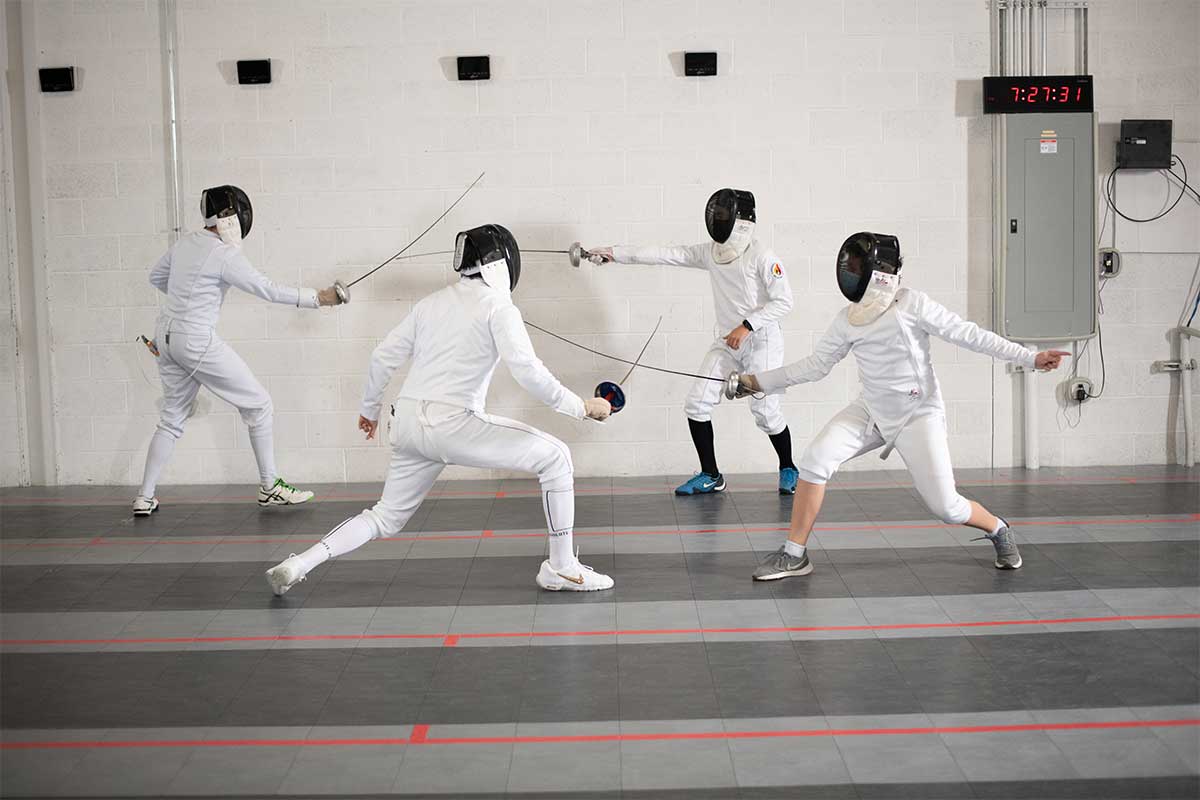
The immediate sensation I experienced upon walking into Cardinal Fencing Academy was cacophonous sound: more than a dozen people’s swords scraping metal on metal. But like typewriters in an old newsroom, while a single one might be irritating, enough in the same space paradoxically just became background noise.
I’d watched the sport at the Olympics, including last summer’s Tokyo Games. I’d seen it on this winter’s Disney+ show Hawkeye. But what does it feel like to actually fence? I went to Sterling to find out.
Coach Doug Tableman gave me my first-ever lesson on a recent Tuesday night, starting with this opening tip: “Everything about the way you move in fencing feels contrary to the way you move in real life.”
In soccer, you can’t use your arms, which is indeed contrary to the way you move in real life—but that rule only comes up when you have the ball in your possession, which is a vast minority of the game. Most of the game, you’re walking or running, which still feels like normal walking or running. In fencing, though, every single moment feels a little off.
My posture felt slightly unbalanced, particularly having one foot facing the opponent while the other foot faced 90 degrees away. At any moment, I was only allowed to move either forward (advancing) or backward (retreating), fighting my natural urge to move sideways at times. And I wasn’t supposed to grip the handle of the sword, or épée, fully, the way you would grab almost anything else. Instead, only the tip of your thumb is supposed to touch it, like you’re strumming guitar strings.
Even dressing in the standard uniform felt unusual because the zipper isn’t in the middle, as it is for a jacket, but rather off to the side and closer to one arm.
I felt a little more comfortable with the actual lunging motion. Keeping my elbow straight and extended, I was instructed to push off of my back leg and kick forward with my front. I was also taught the flèche attack, from the French word for arrow, a move in which the fencer is temporarily midair.
After a few minutes of practicing, I even managed to hit Tableman one time, which fortunately didn’t hurt him because he was wearing a piece of protective equipment called a plastron. (But mostly, I suspect, because his attempt to parry my blow was half-hearted.)
That suspicion was later confirmed when speaking to José de Olivares, an elite fencer in the over-70 division, who was also there to teach. Indeed, one of the top results when Googling his name is his mention in the magazine American Fencing from 1967. “It’s a lifelong sport,” he told me. “The other day, I was teaching a class of four teenagers, with a combined age younger than me. And I beat all of them.”
Why? “It’s physical chess,” de Olivares explains. “You’re thinking two or three moves ahead of your opponent … and the greatest think even further ahead than that. You’re luring opponents into traps, planning strategies. I meet very few dumb fencers.”
Feature image by Michael Butcher
This story originally appeared in the April issue of Northern Virginia magazine. Subscribe for more stories like this.