
Skin cancer specialist Suraj S. Venna, MD, serves as Section Chief of Onco-Dermatology for Inova. He is the Co-Director of the Melanoma and Skin Cancer Center at Inova Schar Cancer as well as an Associate Professor of Medical Education at the University of Virginia School of Medicine.
Why should people care about skin cancer?
The first thing to know about skin cancer is that it’s the most common cancer in fair-skinned people in the United States. About 6 million people will be diagnosed with two of the three major types of skin cancer – basal cell carcinoma or squamous cell carcinoma – this year. The third major type of skin cancer, melanoma, has the potential to be much more serious.
While melanoma makes up less than 5 percent of all skin cancer diagnoses in the U.S. (about 200,000 a year), melanoma accounts for 70 to 80 percent of skin cancer deaths. That’s because melanoma, unlike the two other major skin cancer types, has greater potential to spread to other areas of the body. About half of the melanomas diagnosed (100,000 a year) are invasive, and a subset of these will spread beyond the skin.
Another important thing to note about melanoma is that while darker-skinned people have a much lower chance of getting skin cancer (including melanoma), people of color are nearly twice as likely to die from melanoma due to delays in diagnosis. Everyone, no matter their skin tone, should keep their eyes open for signs of melanoma.
What are the signs of melanoma?
An easy way to remember the signs of melanoma is to remember ABCDE:
- Asymmetric – a mole that looks different on one side than the other
- Borders – a mole with irregular or uneven edges
- Color – a mole with different colors or variations in pigment
- Diameter – a mole that is larger than a pencil eraser
- Evolving – a mole that is changing or looks different than it did before
If one of your moles meets one or more of these criteria – even if you’re not sure – it’s smart to get it checked out. Talk with your dermatologist or your primary care provider if you see any mole that concerns you.
How is skin cancer diagnosed?
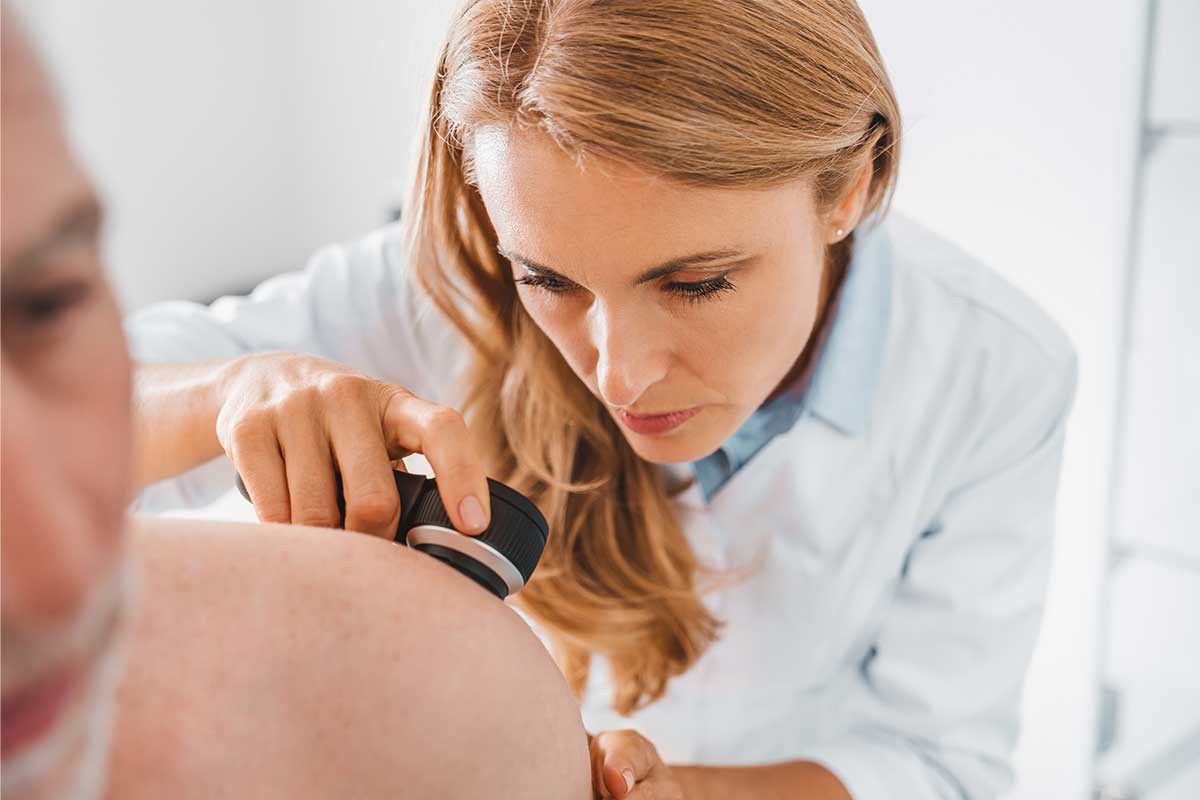
The first step is a thorough skin check, which is a visual inspection of a patient’s skin, head to toe, including creases and crevices. The second step is examining any questionable moles using a dermatoscope. This is a handheld device that illuminates and magnifies moles, giving the provider a closer look at the mole to evaluate any features that may indicate possible melanoma. When a suspicious mole is identified, the third step is to perform a skin biopsy and send it for testing.
For the patients who are at highest risk of melanoma and have many moles (think multiples of 100 moles on the body rather than 20), we may recommend imaging using the Vectra 360. The Vectra 360 is an AI-enabled mole-mapping system that uses 92 cameras to create a 3D model of the patient. The dermatologist can use that model as a reference point to determine whether moles are changing over time. Inova was the second health system in the nation to begin using the Vectra 360. Today, Inova’s team has two Vectra 360 machines (out of only 15 Vectra 360s nationwide), one in the Inova Saville Cancer Screening and Prevention Center and the other in the Inova Melanoma and Skin Cancer Center.
While it is not recommended for average-risk patients with a few dozen moles, it can be helpful for the highest risk patients who have a high mole burden. Not only can this technology aid the provider in the identification of melanomas earlier, but it can also help patients avoid unnecessary skin biopsies.
What treatment options are available for skin cancer?
For the most common skin cancers – basal cell carcinoma and squamous cell carcinoma – which account for 95 percent of the skin cancers found, treatment is most often a simple procedure to remove the cancer. Most are surgically excised, while others can be removed using destructive methods including cold energy, called cryotherapy, as well as other techniques such as curettage, topical chemotherapy or topical immunotherapy.
Melanoma has a different set of treatment options because of its tendency to spread to other organs. Although it’s true that melanoma accounts for the majority of skin cancer deaths, there is good news: About 80 percent of melanomas are caught very early, at Stage 1. Those patients have the best chance at a cure with surgery, which typically involves cutting around the melanoma with a wide margin and sometimes performing a lymph node biopsy to evaluate for microscopic spread of the cancer.
For the other 20 percent of cases, treatment varies but may include:
- Surgery to remove lymph nodes where the melanoma has spread
- Systemic immunotherapy, which harnesses the patient’s own immune system to fight the cancer
- Targeted therapy, which uses drugs designed to find and kill melanoma cells specifically
The era of immunotherapy has ushered in more hope and optimism for melanoma patients with advanced disease. Whereas 30 years ago, the 5-year survival rate of a patient with advanced melanoma may have been 5 percent, today it’s 50 percent or better – a tenfold increase in survival rates.
What about prevention of skin cancer including melanoma?
Even though treatment improvements have led to a much better outlook for melanoma patients, the best outcome is to prevent yourself from developing skin cancer at all. Here are my top recommendations:
- UV exposure is a top cause of melanoma, so focus on physical barriers to UV rays – hats, clothing with an ultraviolet protection factor (UPF) rating, wraparound sunglasses
- Look for UPF 50+ shirts, hats, shorts, and even cycling sleeves
- Consider getting your car windows tinted with a 99 percent UV-blocking film
- Avoid being in the sun when it is strongest, from 10 a.m. to 2 p.m.
- Be aware that sunlight can reflect off water or snow and can be stronger at certain latitudes or higher altitudes
- Use a broad-spectrum sunblock of at least SPF 30
- Reapply often – at least every two hours, especially if you’re in the water or are sweating a lot
- Get screened for skin cancer – catching it early makes all the difference when it comes to melanoma
How often should people get screened for skin cancer?
The U.S. Preventive Services Task Force (USPSTF) issued updated screening guidelines for skin cancer last in 2023. While there is no specific screening recommendation for people at average risk with no signs of skin cancer, getting screened every two or three years with a visual skin check is a good idea. This can be done by your primary care provider at your annual physical.
Things that could put you in a higher risk skin cancer category that might warrant at least annual skin cancer screening include:
- A history of one or more sunburns
- Having fair skin, freckles, or many moles
- Having a personal or family history of skin cancer
- Being immunosuppressed because of an organ transplant or other condition
Talk with your primary care provider if you fit any of these criteria. Your primary care provider can recommend a schedule of skin checks and can refer you to a dermatologist, if needed.
Learn more about the Inova Melanoma and Skin Cancer Center.
Feature image, stock.adobe.com