Famed Japanese artist Yayoi Kusama’s dazzling art will make a permanent return to the Hirshhorn in 2022 with One with Eternity: Yayoi Kusama in the Hirshhorn Collection. Originally slated to open at the Hirshhorn in April 2020, the collection has been postponed to an opening this year.
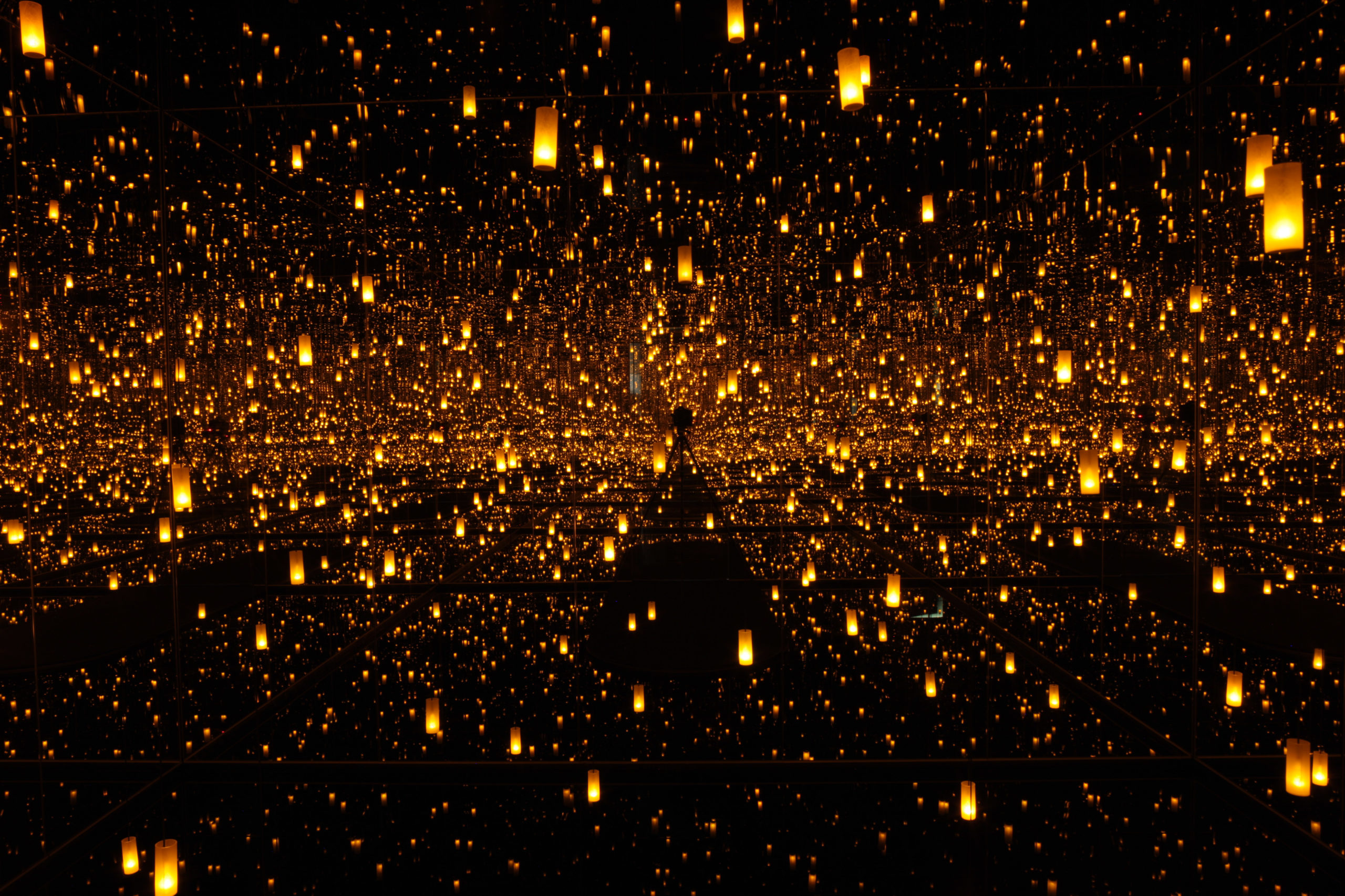
Kusama has gained worldwide fame for her enchanting infinity rooms: With mirrors covering the walls of the exhibits, the pieces make you feel as though you’ve stepped into the cosmos. The Hirshhorn’s exhibit will include both her early Phalli’s Field (1965/2017) and her most recent Infinity Mirrored Room—My Heart is Dancing into the Universe (2018).
“The interplay between two of Kusama’s iconic kaleidoscopic environments demonstrates how far the artist has pushed the concept of ‘infinity’ for more than 70 years,” says Hirshhorn assistant curator Betsy Johnson. “Building on the legacy of our 2017 exhibition, One with Eternity: Yayoi Kusama in the Hirshhorn Collection now takes one step further, aiming to bring people closer to the artist through an intimate, biographically focused presentation of Kusama’s five artworks in the Museum’s collection.”
Every visitor to the upcoming exhibit, whether they have any prior art knowledge or not, will gain something deeply personal in Kusama’s work, Johnson says.
“Kusama’s work, particularly her immersive environments, can often give us the sense that time and space have been paused, even if just for a moment,” Johnson says. “As a result, people often walk away from Kusama’s work with lifelong memories, feeling more connected to themselves and with the world.”
Born in 1929 in Nagano, Japan, Kusama has taken the traumatic experiences of her childhood and turned them into art. Abused by her mother and haunted by hallucinations, Kusama took what she saw and used it to create.
“The repetition that we see in Yayoi Kusama’s work today was inspired in part by the hallucinations the artist experienced from a young age. When you encounter her work, you will see how Kusama manipulates ‘infinity’ to allow you to consider how you perceive the world,” Johnson said.
Kusama studied Nihonga, traditional Japanese painting in Kyoto, and went on to move to New York City in 1958, where she would join the likes of Andy Warhol and Allan Kaprow as some of the most prolific avant-garde artists of the time.
With sexuality being a theme of much of her work, even portraying her own naked body in one of her pieces in 1962, Kusama solidified herself as a leading figure of the Feminist Art movement of the 1960s.
Kusama returned to Japan in 1973 and, two years later, sought help for her obsessive-compulsive neurosis, moving into a mental health facility. She has remained there ever since, continuing to create her art to this day. In the 1980s, Kusama added poetry and fiction writing to her artistic repertoire.
After her return to Japan, Kusama’s work began to lose prominence in the Western art world. Yet her work re-exploded in popularity after she represented Japan at the 45th Venice Biennale in 1993. She has retained her celebrity status to this day.
Since 1996, the Hirshhorn has been collecting Kusama’s art. Hirshhorn’s new exhibit will feature three new acquisitions and five of Kusama’s works from the Hirshhorn’s permanent collection, including two of Kusama’s acclaimed Infinity Mirror Rooms, sculptures, a painting from her early work, and a collection of photographs of Kusama.
The exhibit’s collection of Kusama’s sculptures will include Flowers—Overcoat (1964) and Pumpkin (2016), both hallmarks of her artistic collection. Pumpkins are a common theme in Kusama’s work, representing her enduring obsession with the fruit, stemming from her youth.
“Pumpkin will be somewhat camouflaged in a yellow gallery space covered in black polka dots, an exploration of scale and the artist’s fascination with self-obliteration. People should prepare to lose themselves,” Johnson said.
With the surreal nature of the 8-foot-tall Pumpkin and other works in the collection, visitors will be invited in to become part of the artwork, Johnson said.
Although her art is technically abstract, Kusama’s concerns are timely amid chaotic world events. Ahead of her 2022 Hirshhorn re-opening and amid the continuing Covid-19 pandemic, Kusama penned a poem titled “A Message from Yayoi Kusama to the Whole World.”
“Now is the time for people all over the world to stand up,” Kusama wrote, “My deep gratitude goes to those who are already fighting.”
One with Eternity: Yayoi Kusama in the Hirshhorn Collection will open in 2022.
For more stories like this, subscribe to our Things to Do newsletter.