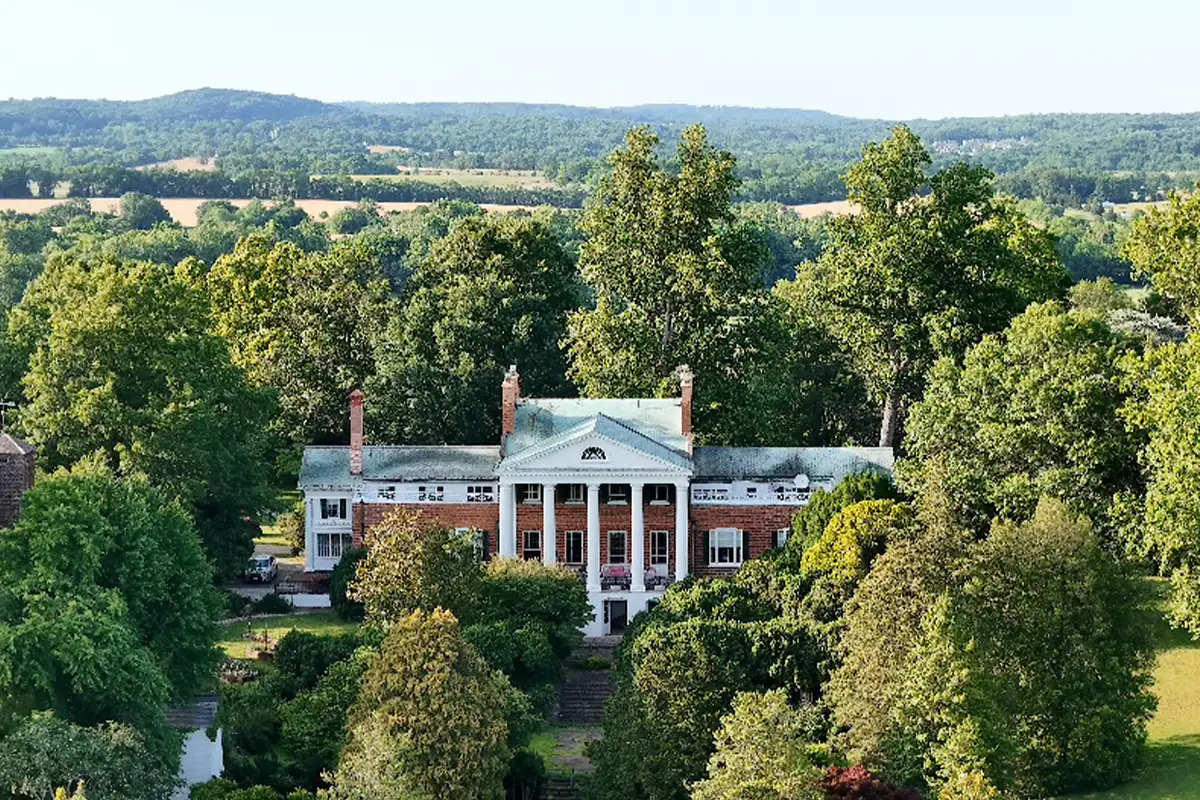
The Conservation Fund has acquired Oak Hill, the 1,200-acre estate of President James Monroe, the nonprofit announced today. This is the latest move in an ongoing effort to establish Oak Hill as a new state park.
The Loudoun County estate, where Monroe wrote the Monroe Doctrine in 1823, was the last privately owned estate of a founding father. The most recent owners, the DeLashmutt family, have maintained the 200-year-old estate for more than 75 years. They wanted to sell it — but they also wanted to help preserve its history.
“We’ve always recognized its history and significance reach far beyond us,” said Gayle DeLashmutt. “It means a great deal to know this place we’ve cared for so deeply is now in the hands of dedicated stewards who share our hope that Oak Hill’s story will continue to be honored, protected, and thoughtfully shared with others.”
The Conservation Fund began working with the DeLashmutts three years ago, with the goal of converting the property into a publicly owned state park. Loudoun County approved a $22 million grant for the project that, combined with $6 million in federal funds and a $2 million state grant, meant the park would not impact on the state budget’s bottom line.
Still, a measure to establish the new park failed in the general assembly earlier this year. Gov. Glenn Youngkin then introduced a budget amendment to save the plan, which lawmakers also rejected.
Acquiring Oak Hill
As a privately owned property, the land was at risk for subdivision and redevelopment, says Heather Richards, vice president and mid-Atlantic regional director at The Conservation Fund. “The property had no restrictions on it, so the family could have sold it to whoever they wanted to. And they’ve been approached by developers many, many times over the years.”
Using funds from the Loudoun County grant, The Conservation Fund purchased Oak Hill from the DeLashmutts for $20 million. A measure to establish Oak Hill as a state park under public ownership will return to the general assembly in early 2026.
“Loudoun County was fully behind us making this acquisition and supporting us until we can get it into the hands of the state,” Richards says. She’s optimistic that the measure will pass in the upcoming legislative session.
“We’ve had an entire year to educate legislators and decisionmakers in Richmond about the project,” Richards says. “We’re hearing tremendous support from both sides of the aisle. The two words that I hear most often from legislators that I’ve talked to this year have been ‘no brainer.’”
Until legislators approve the state park, The Conservation Fund will manage and maintain the property. The group has hired a property manager and security for the property, according to Richards.
Vision for the Park
If approved, Richards says she hopes that Oak Hill will be a place for people to learn about history — not only about Monroe, but also about the Black and Indigenous people who lived and labored there.
The park would also provide opportunities for outdoor recreation, including equestrian and hiking trails.
The park will need “relatively minor” improvements to make it publicly accessible, including the creation parking and trails, Richards says. Any more significant improvements or changes would be determined after the state park system takes ownership.
“This is a property that is our last chance to secure something this big in Northern Virginia that’s within a half-hour drive of more than three million people,” Richards says. “A day will come where we will be sad that we don’t have more open space. So we can’t miss this opportunity this time.”
Feature image of Oak Hill courtesy The Conservation Fund