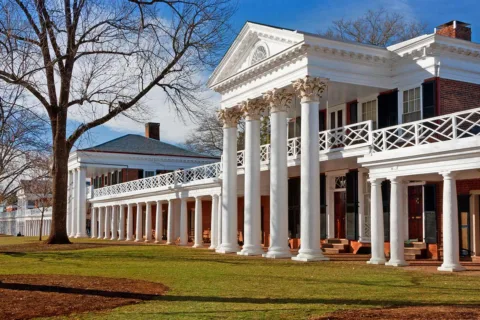
Virginia’s popular historic sites — including Old Town Alexandria, George Washington’s Mount Vernon, and Colonial Williamsburg — are a haven for people donning Colonial-style tricorn hats and petticoats.
And now, the country’s 250th birthday celebration has increased the demand for Colonial and Revolutionary War characters. Historic sites and museums are looking to bring authenticity to commemorative events by populating the grounds with be-wigged interpreters who put history into context.
Passion, Preparation, and Performance
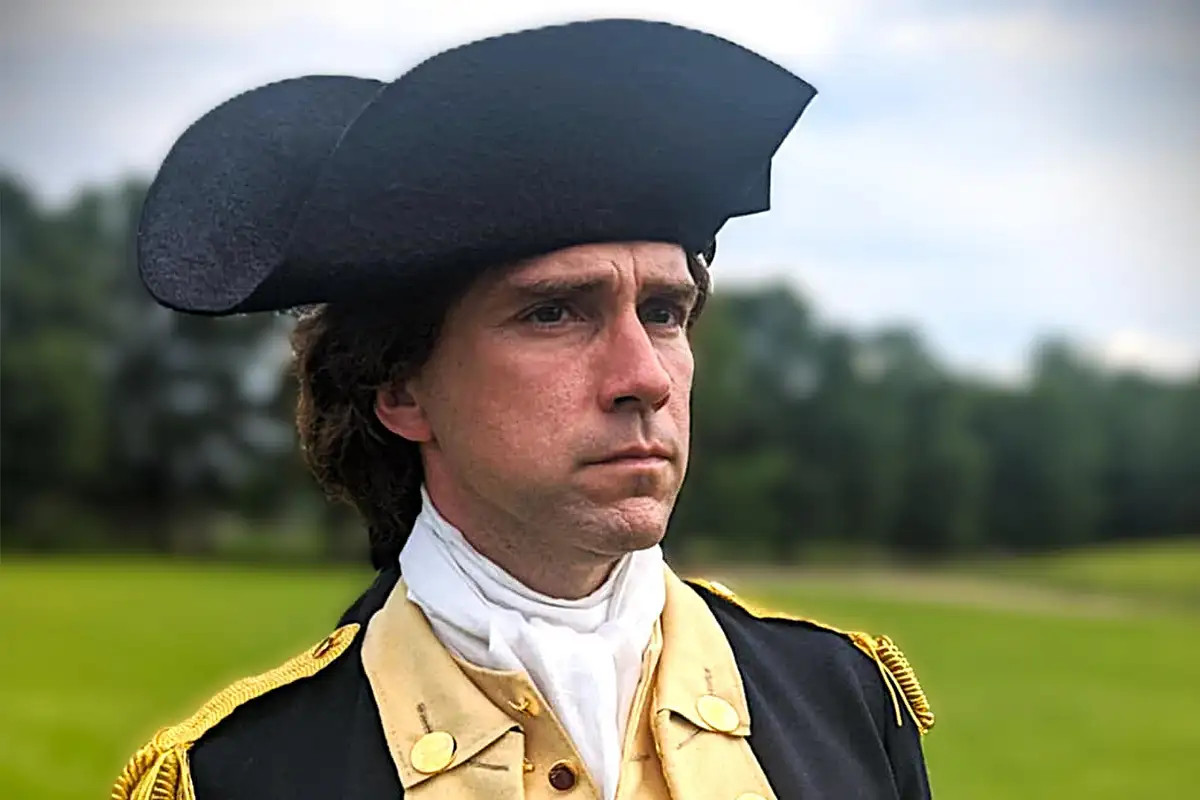
“I have been significantly busier than usual, and I’m grateful for it,” says Daniel Cross, who has been playing mid–Revolutionary War George Washington at locations up and down the East Coast since 2019.
Not content to only interpret the first president, Cross has expanded his repertoire to include several lesser-known characters who are Washington adjacent. These characters include Ireland-born Brig. Gen. Andrew Lewis, who served in the Continental Army, and Maj. Gen. Nathanael Greene, Washington’s designated successor. To talk with Cross, who lives in Alexandria, is to venture down unexpected rabbit holes of historical trivia, a trait that belies the passion he brings to his preparation and performance. The research for each character, he says, “is constant. You’re always learning, always refining.”
He builds performances from primary sources such as letters, documents, and firsthand accounts. Then, the facts mastered, he improvises for audiences.
“I spend about 90% of my research time in Washington’s own words,” he says. “Most of what I do isn’t scripted. I know the material, and then I respond in the moment.”
That improvisation is essential, especially when dealing with a curious public. Visitors don’t just ask about the 18th century — they often try to pull it into the present. “The hardest questions,” Cross says, “are when people ask what Washington would think about something today.”
In addition to assaying historical characters, Cross is the manager of living history at George Washington’s Mount Vernon. However, he does not play Washington at Mount Vernon. That falls to Doug Thomas, the longtime actor-historian who will be on hand for Mount Vernon’s Fourth of July festivities.
Mount Vernon’s interpretive history department features support staff, historians, tradespeople, a functioning Revolutionary War encampment, and a rotating cast of full- and part-time actors who portray people from the first president’s life.
Tom Plott, the interpretive performance manager at the estate, credits onsite historical costumer Kathrin Breitt Brown and her staff for creating the relentlessly authentic 18th-century wardrobes the interpreters wear.
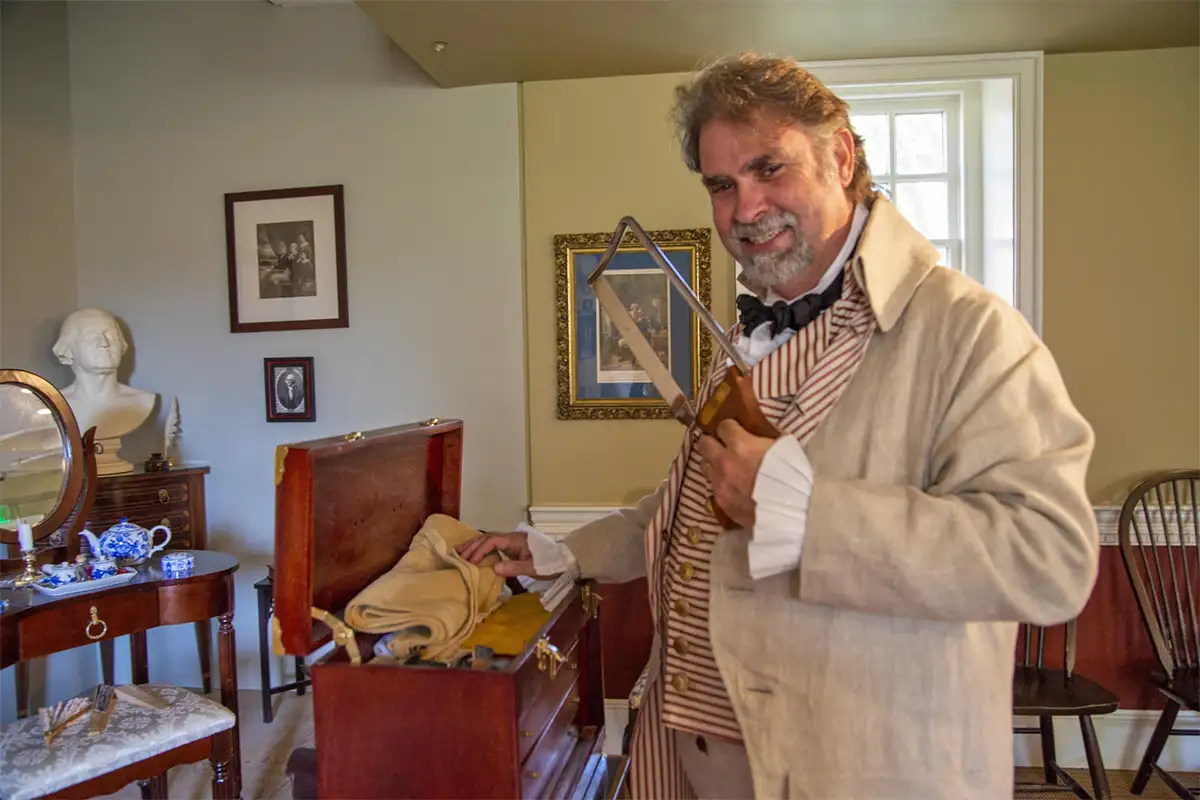
Plott is a beneficiary of Breitt Brown’s expertise: He interprets Dr. James Craik, Washington’s Scotland-born close friend and personal physician.
Character Study
“History isn’t dates,” says Mary Ann Jung. “It’s people.”
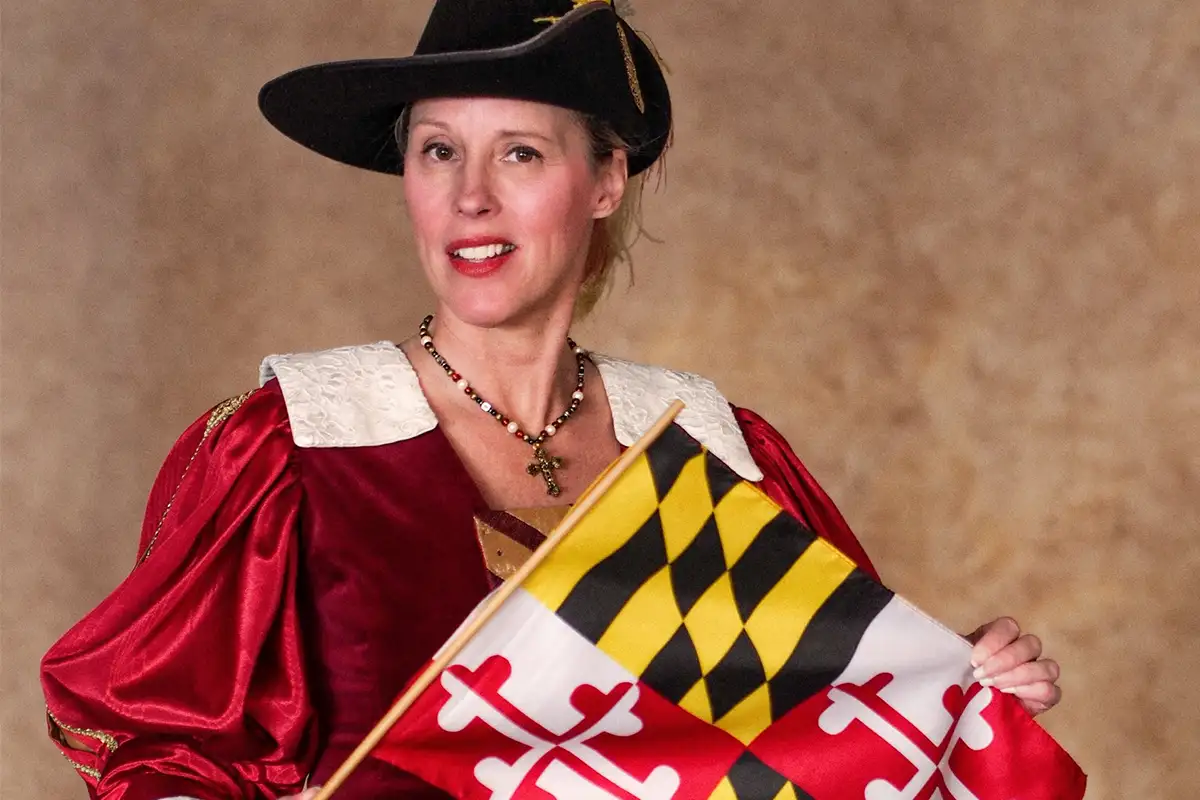
Jung describes herself as a Smithsonian scholar, a theater director, and an actress. She’s been researching and writing interactive shows depicting historical characters for 47 years. She began doing shows at the Maryland Renaissance Festival, where, as it happens, she met her husband, Mount Vernon’s Plott. She turned her passion into a business called History Alive!
“I come to it through a love of history first,” she says. “I’m always learning. I love people. I love entertaining, and I love history. I am so lucky.”
Jung’s cast of characters include Queen Elizabeth I, astronaut Sally Ride, chef Julia Child, Civil War nurse Clara Barton, and aviator Amelia Earhart.
“I wrote [the Earhart] show probably 30 years ago. I’ve met eight people who knew Amelia Earhart,” she says. “I have stories from them that are not on any TV show or in a book.”
As for Colonial characters, Jung brings to life little-known, England-born Margaret Brent, who once controlled some 13,000 acres spanning what is now Northern Virginia and Washington, DC.
“She owned everything from the Rappahannock to the Potomac,” Jung says. “She was the first female landowner, first female lawyer, and the first woman in America to demand the right to vote.”
Brent also raised a Piscataway chieftain’s daughter in southern Maryland, a strategic political favor. Everything she did, she did without a husband. In that era, that wasn’t just unconventional; it sidestepped the legal legitimacy most women were expected to rely on.
“So, in that one show, audiences are getting what it was like to come over on a ship, what it was like to be a colonist. And you learn about the Native Americans in this part of the country,” she says. “That’s really a wonderful one, because it’s all a surprise. She was a real pistol at a time when women weren’t allowed to do anything — and she did it all.”
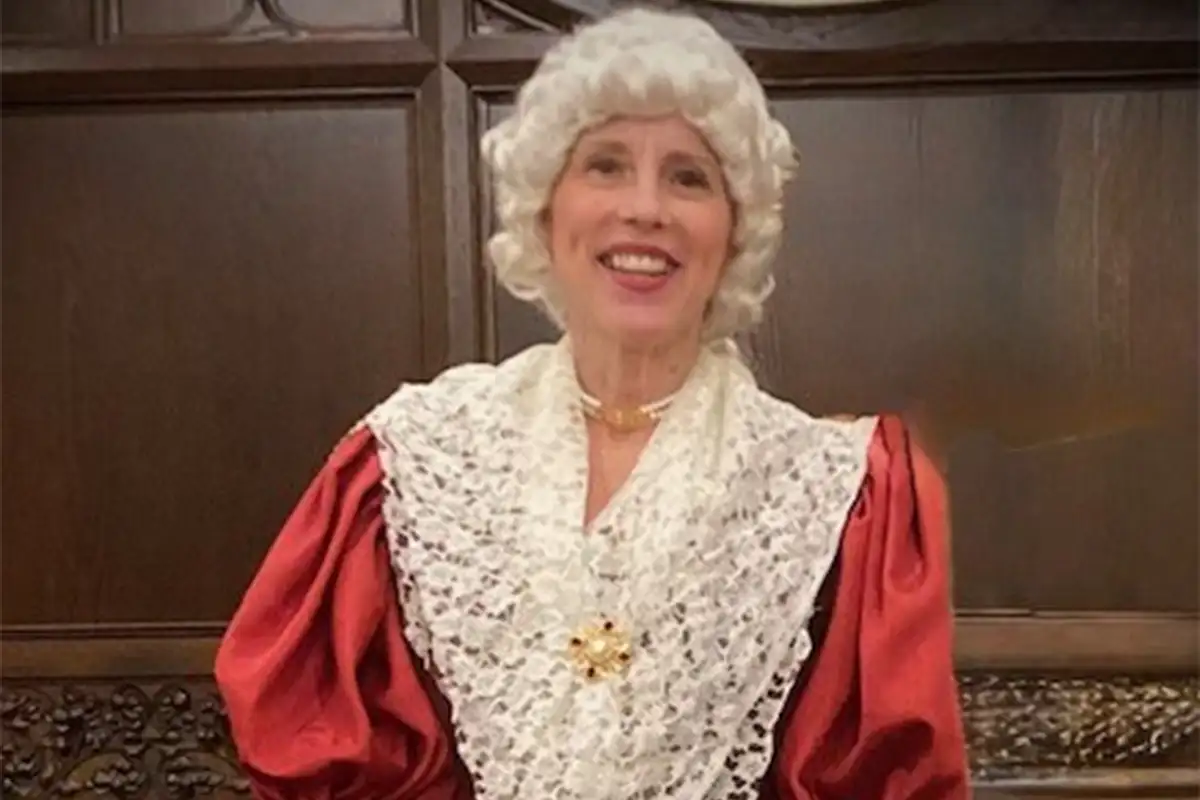
The newest character in her repertoire, just in time for 250 celebrations, is Martha Washington, which debuted in May.
Looking the Part
Jung’s gowns are professionally made and her details carefully chosen — but she draws the line at suffering for authenticity. “A [hobbyist] reenactor will be exacting down to their corsets and underwear. What I have is authentic, but I can’t wear an actual corset. I’ll have the right period costume on the outside, but I have to be comfortable. I have to be able to drive home.”
Cross had his George Washington costume crafted by an 18th-century specialist in New England. “It’s based off the [Charles Willson] Peale portrait from 1779 of the Battle of Princeton, down to the stitch,” Cross says.
It’s an elaborate mid-war military uniform, including a shirt with cufflinks, a neck-cloth tied in a specific style, summer wool breeches, cotton knee-high stockings, a belt under the waistcoat, a blue sash, and, in Cross’ case, a reddish-brown wig. Not because Washington wore a wig — he didn’t — but because Cross is, he admits, pointing to his head, “mildly follically challenged.”
Rabbit hole alert: Atop the wig is a beaver or wool “cocked hat” in a military style. It’s actually a round hat that’s folded, or “cocked.” The term “tricornered” to describe a three-cornered hat is an early 19th-century phrase.
After playing Washington since 2019, Cross says he can get dressed in about 10 minutes. “I can get the clothes on in about four-and-a-half minutes,” he says. “The wig is what slows me down.”
Feature image courtesy Daniel Cross
This story originally ran in our July issue. For more stories like this, subscribe to Northern Virginia Magazine.