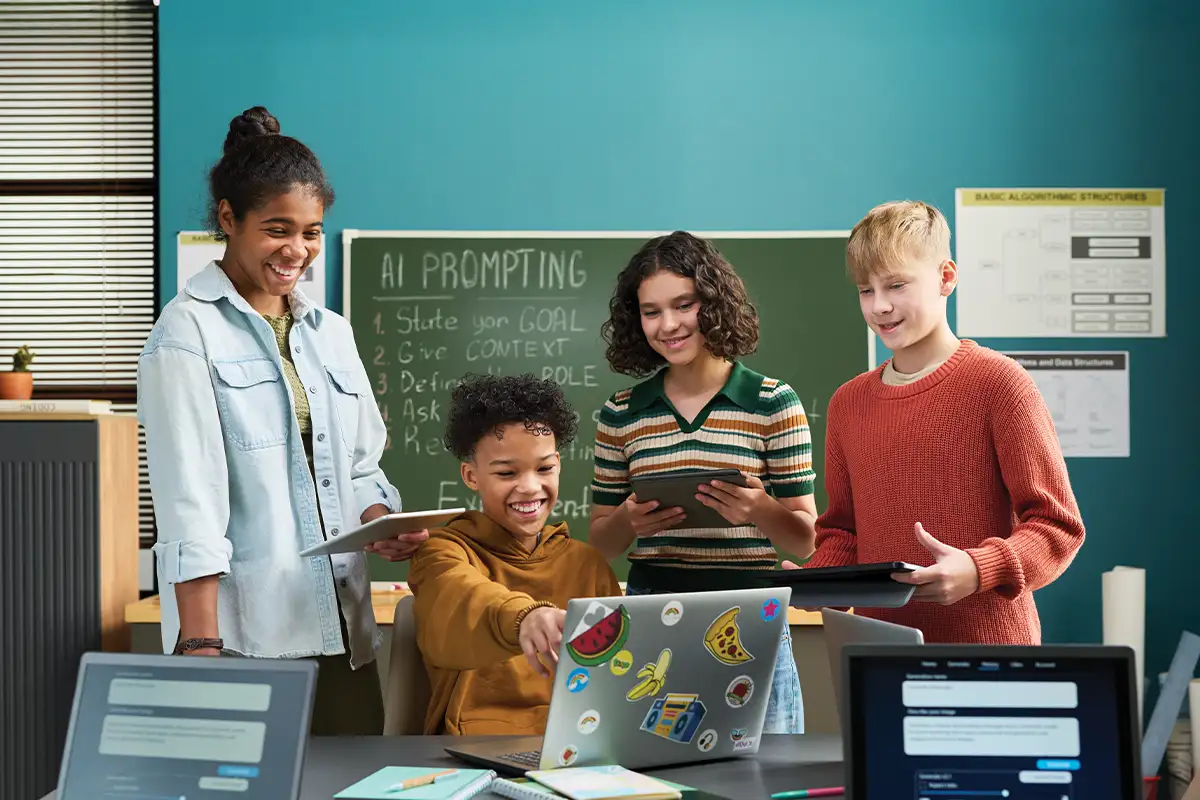
It’s become clear that generative artificial intelligence isn’t going anywhere. And, for school districts in NoVA, the technology is posing a big challenge: How do they incorporate AI in a way that embraces innovation but doesn’t compromise educational ethics and standards?
Fairfax County Public Schools Superintendent Michelle Reid says the challenge is keeping a step ahead of an evolving AI landscape. “We can’t look the other way at this point, because this is, in fact, a technology that’s impacting the entire planet,” she says. “We want to make sure that we take a measured approach to this new technology, because we know that we want to shape its use and not be shaped by it.”
A Tool for Teachers
One way schools are utilizing AI is with the implementation of ChatGPT for Teachers, a new program from OpenAI. In November 2025, FCPS and Prince William County Schools announced that they would be among the first to try out this new tech.
“I use it to modify lesson plans, activities, content, to make them more accessible for my students and more engaging for my students,” says Blake LoPresti, an English language arts teacher at Ronald Wilson Reagan Middle School in Prince William County. It can help translate district-provided rubrics into student-friendly language or break tasks down into manageable steps for students.
“I can do all of that on my own, but it takes time,” he says. “One of the biggest advantages of using AI in any profession is just speeding things up.”
Brittany Sudberry, an English teacher at Woodbridge High School, uses it to help execute creative lesson plans like an escape room–style activity in her classroom. “I fed it the goal and the outcome that I wanted, and then I asked it for suggestions of what kind of clues to give, where to hide the clues. And it gave me a ton,” she says. Or, she says, she may use it to make sure a book she wants to teach aligns with state standards or to pull out vocabulary terms.
This isn’t the first time teachers have been allowed to use AI — many have been using Copilot or standard ChatGPT for years — but this program more specifically caters to teachers’ needs. And, importantly, it has safeguards in place to protect student data. “When we have an enterprise agreement, the vendor commits to data privacy and ensures that the data that our teachers may put in there … [is] not used by the company to train their models or do anything else with it,” says Gautam Sethi, FCPS chief information technology officer.
Loudoun County Public Schools’ new AI guidance policy similarly limits faculty and staff usage to only district-approved programs. “Using our tools is like swimming with a lifeguard on duty. We have protections in place. … Using the free tools is really swimming at your own risk, and there’s a lot of danger inherent there,” says LCPS chief technology officer Aaron Smith. LCPS also has rules prohibiting faculty and staff from entering personally identifiable student information into AI tools to prevent Family Educational Rights and Privacy Act violations.
Fear of Misuse
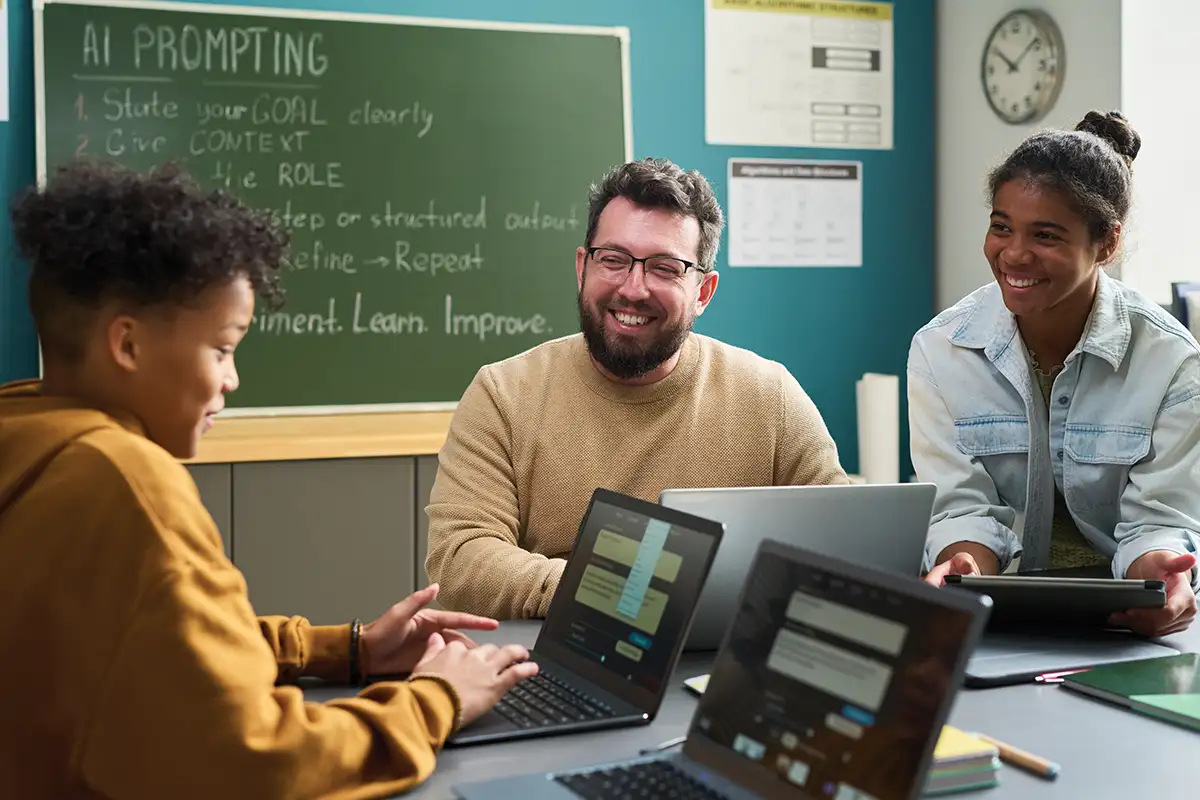
When it comes to students using AI, school systems are cautious. Beyond the data privacy concerns, educators fear that students may use it to cheat, or that they’ll come to rely on the technology instead of honing their own critical thinking skills. But there’s one fact that schools can’t ignore: Students are already using it. An October 2025 study from College Board found that 84 percent of high school students reported using generative AI for schoolwork.
“I think there is a very real possibility that if students over rely on tools like this, it will prevent them from thinking. … I think it’s also fair to say we now live in a world where this technology exists and so students are going to use it,” says Amy Allen, an assistant professor in the School of Education at Virginia Tech who has been studying AI integration in the classroom.
“The better thing to do is not necessarily to say, ‘How is this going to ruin our students’ critical thinking skills?’ but, ‘How can we use it in a way that may build their thinking skills? How can it be repurposed?’” Allen says.
Teachers will still need to be vigilant about students using AI in inappropriate ways, like turning in assignments fully written by AI or that use AI-generated information as primary sources. Luckily, Sudberry says, it’s normally easy to spot it when that’s the case and redirect students.
“The ways that they use it to cheat, it doesn’t produce good work. It really doesn’t,” Sudberry says. Her first step when AI is misused is a conversation with the student. “It’s nice being able to show them ‘Alright, so you used AI for this. Let’s put it in front of you and show you exactly why that’s bad. And now here’s how you can brainstorm your own things, and now [you can] use it properly.’”
In some cases, teachers are even using those experiences to adjust their assignments. If students are taking assignments, putting them right into ChatGPT, and turning them in without thinking, then “maybe those assessments were not that good to begin with, if a machine can quickly give you the output,” Allen says. “Maybe we need to rethink big ideas about assessments and how we’re evaluating what students do.”

Establishing AI Policies
With those hesitations in mind, school systems are cautiously taking steps to allow students to access AI tools. As schools craft policies, Allen says she would advise against unilaterally banning AI. “Students are going to try to learn it and use it anyway,” she says. “If we ban it, then now they’re just using it without the benefit of having a teacher to help them navigate it.”
PWCS high school students got access to Copilot in February and took a training program to learn how to use it, Sudberry says. An online graphic gives students a roadmap of how they can and can’t use the technology.
“Now that we know how the tool can be used, we’ve been using it for healthy things like researching and asking questions,” she says. For example, it can be a good way to get clarification on topics you didn’t understand in class or to brainstorm topic ideas for a research assignment.
So far, Loudoun County has blocked generative AI programs from student computers as educators got a better feel for how the programs worked. The “high-level goal” is to roll out a program for students this year, Smith says. “We want to make sure we have the appropriate student monitoring and supports in place before we enable a tool for students,” Smith says. “A lot of the classroom use has been the teacher using the tool … and then the teacher interacting with the students, so they’re kind of the go-between.”
In FCPS, the school board is in the process of developing a district-wide policy for AI use, Reid says. A multidisciplinary staff team and the school board are considering how to craft the policy, and the district has been doing outreach to hear thoughts from parents and other community members.
“One of the things we’ve heard very clearly from our community, our parents, and our staff is they absolutely want this to be a measured approach that maintains privacy and safety for our students and staff,” Reid says.
“No technology has moved as quickly as AI, and at this point, we’re trying to understand its impact,” Sethi says. “We’re trying to measure its challenges. We want to make sure that we are protecting for all the things that we need to, but also enabling opportunities for our students.”
Feature image, stock.adobe.com
This story originally ran in our April 2026 issue. For more stories like this, subscribe to Northern Virginia Magazine.