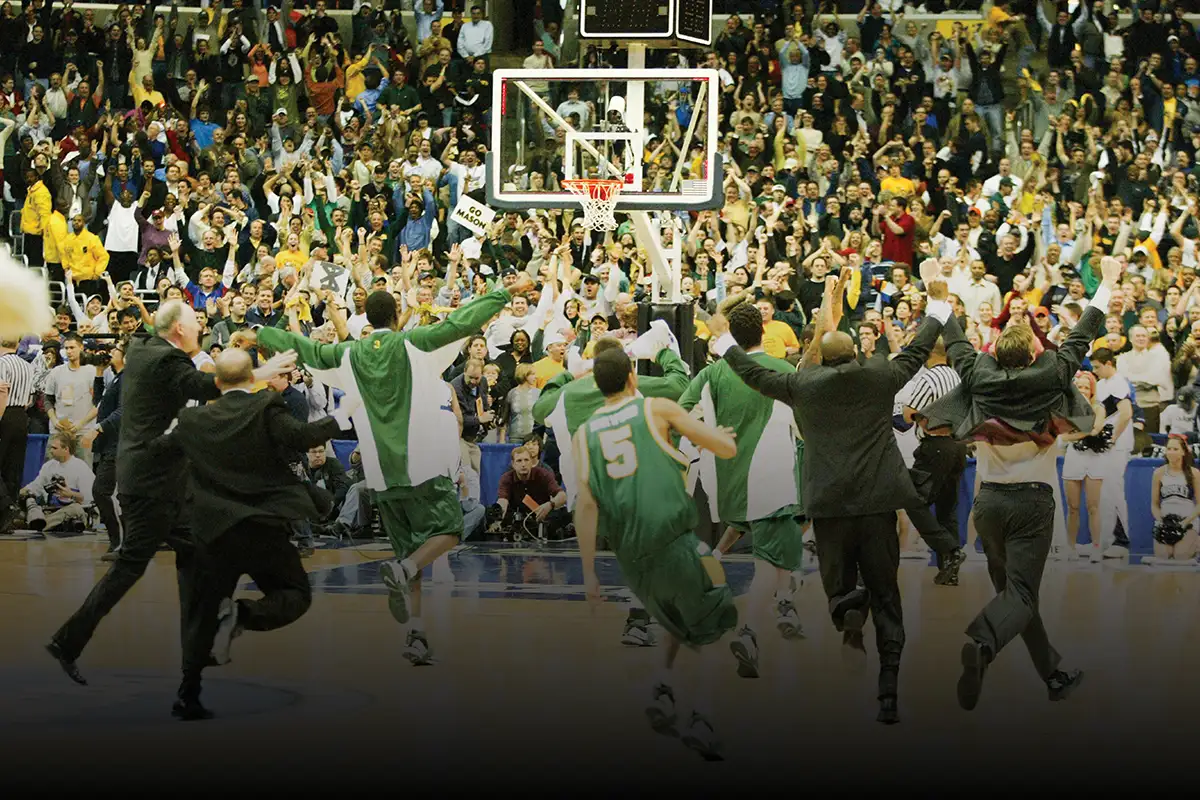
Twenty years ago, George Mason University’s men’s basketball team defied odds, toppled giants, and created a legacy that continues to reverberate in the college sports world.
The fairy tale goes like this: A mid-major basketball program entered the NCAA men’s basketball tournament as an at-large No. 11 seed and emerged as the longest-shot ever to reach the vaunted Final Four.
Fans were thrilled to watch a low-profile team take on not one, not two, not three, not four, but five powerhouse programs with better recruiting, larger budgets, and far more national exposure. The George Mason Patriots painstakingly detonated brackets around the world without making anyone feel bad about it (unless you had money on the games). The excitement was palpable well beyond Fairfax.
How the Cinderella Story Unfolded
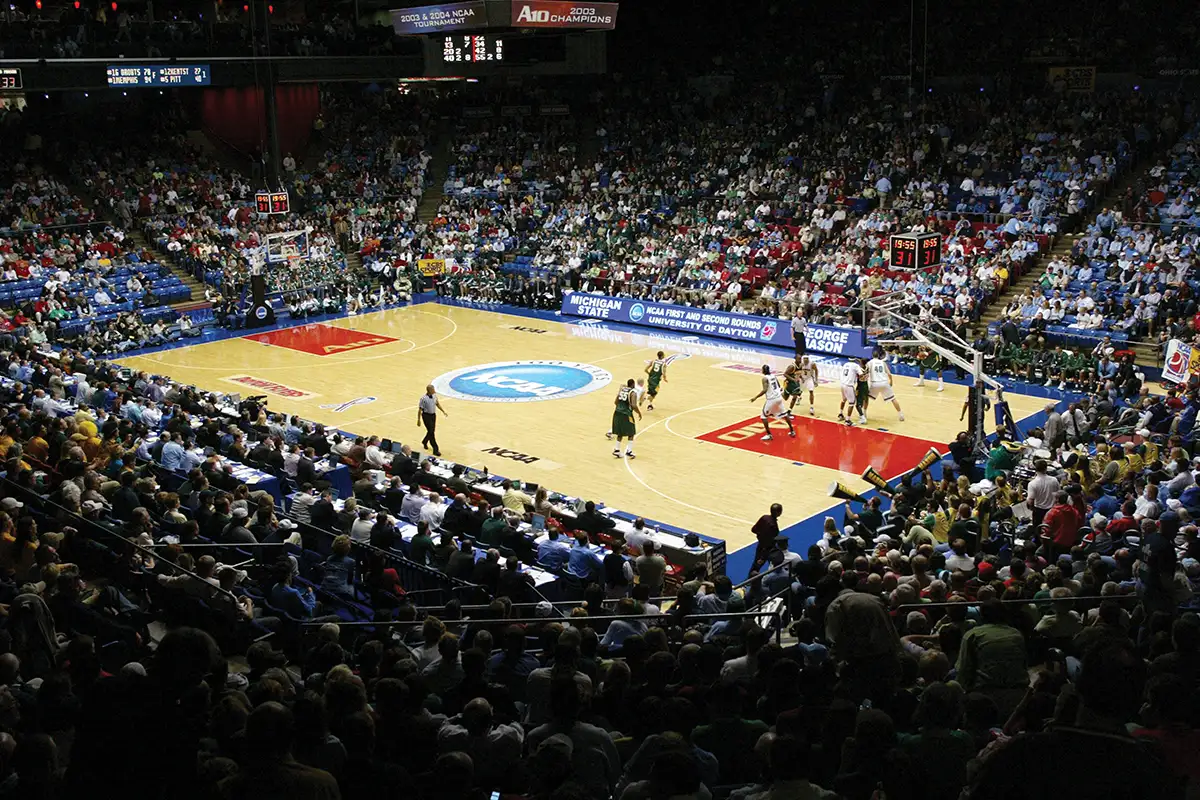
Despite failing to win the Colonial Athletic Association conference championship, George Mason was awarded an at-large bid by the NCAA selection committee to join 64 other teams in the Big Dance. Expectations were modest for the No. 11 seed, which meant they would play higher seeded teams first. History did not serve the Patriots well: Three previous March Madness appearances — in 1989, 1999, and 2001— resulted in early-round bounces.
Not this time.
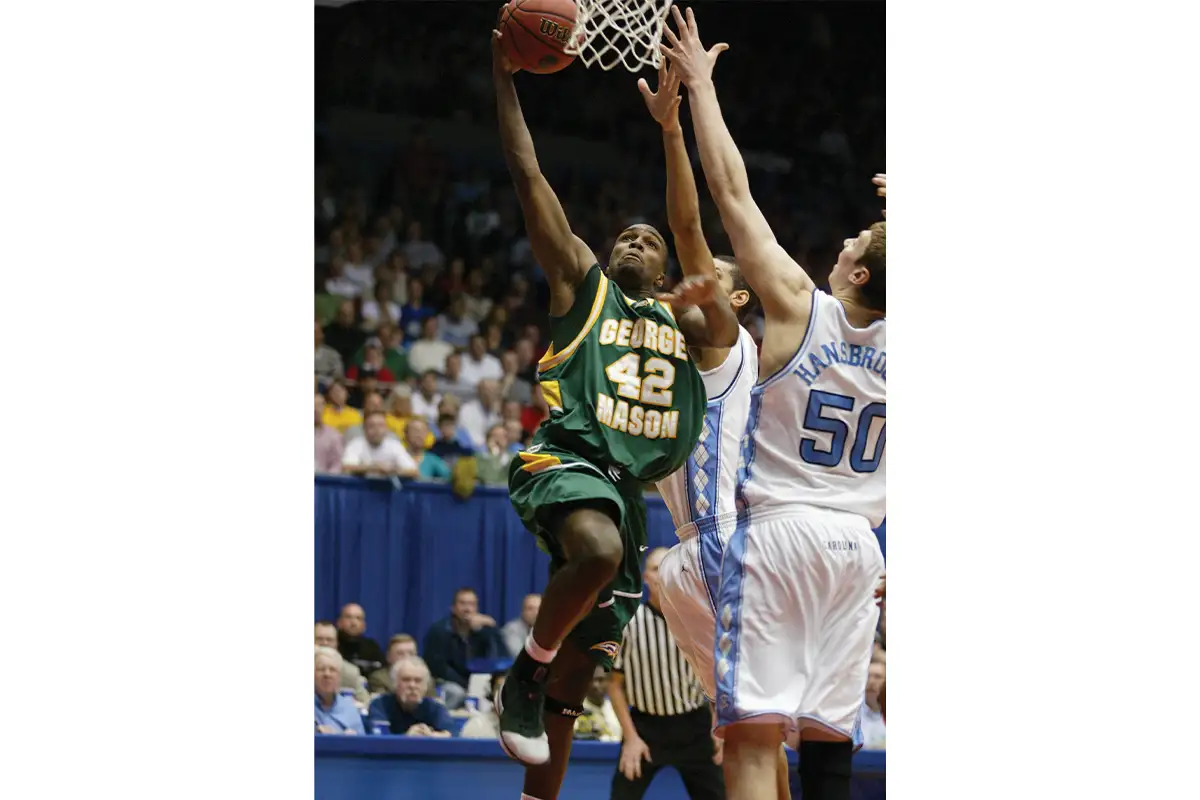
The Patriots dispatched No. 6 Michigan State 75–65. No. 3 North Carolina fell next, 65–60. No. 7 Wichita State followed, 63–55.
Those 64 teams dwindled to the Elite Eight, and as luck would have it, George Mason played it as a virtual home game in DC’s Verizon Center (now Capital One Arena). They faced the No. 1 seed and tournament favorite Connecticut Huskies as 8-point underdogs.
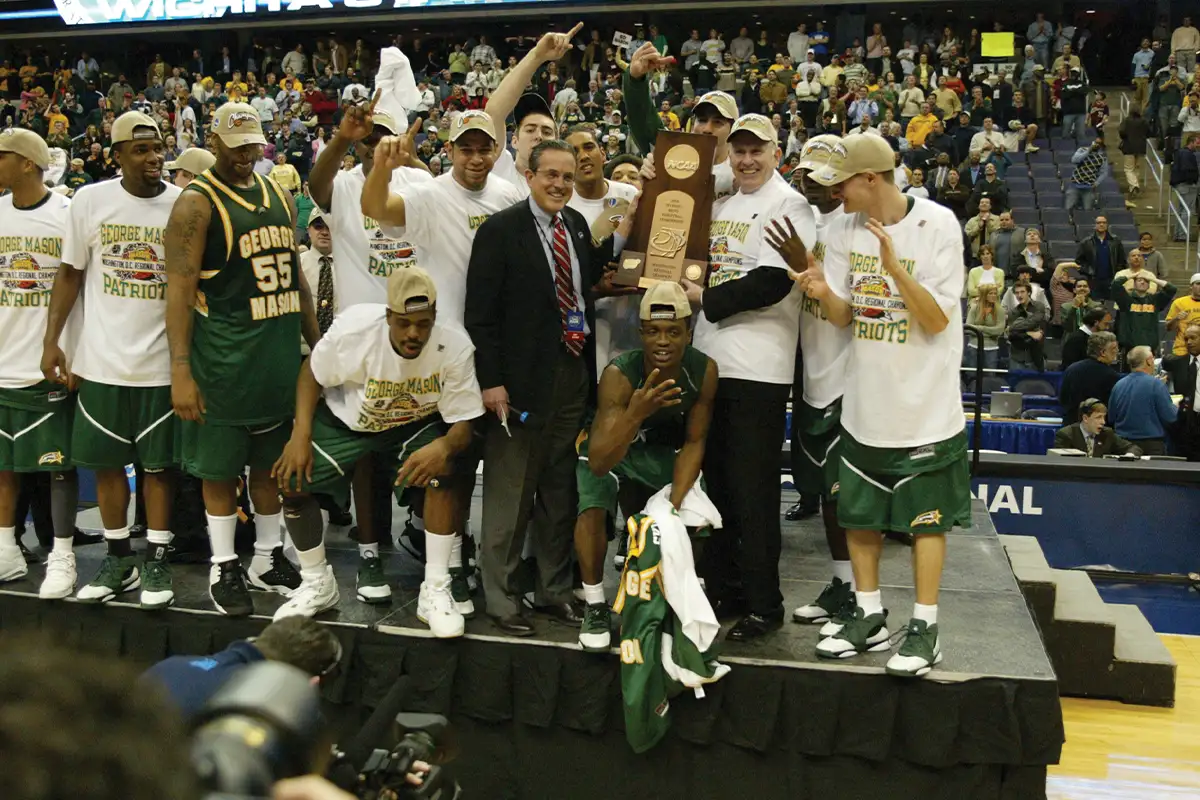
Bring in the glass slippers. As it happened, the Patriots prevailed 86–84 in one of the most thrilling overtime games in tournament history. Ask anyone who was there. I was, and my ears are still ringing.
Cinderella’s slipper finally fell off in the final round when Florida delivered a convincing 73–58 defeat. But it took Florida’s four future first-round NBA draftees to do it. Florida went on to beat UCLA for the national championship.
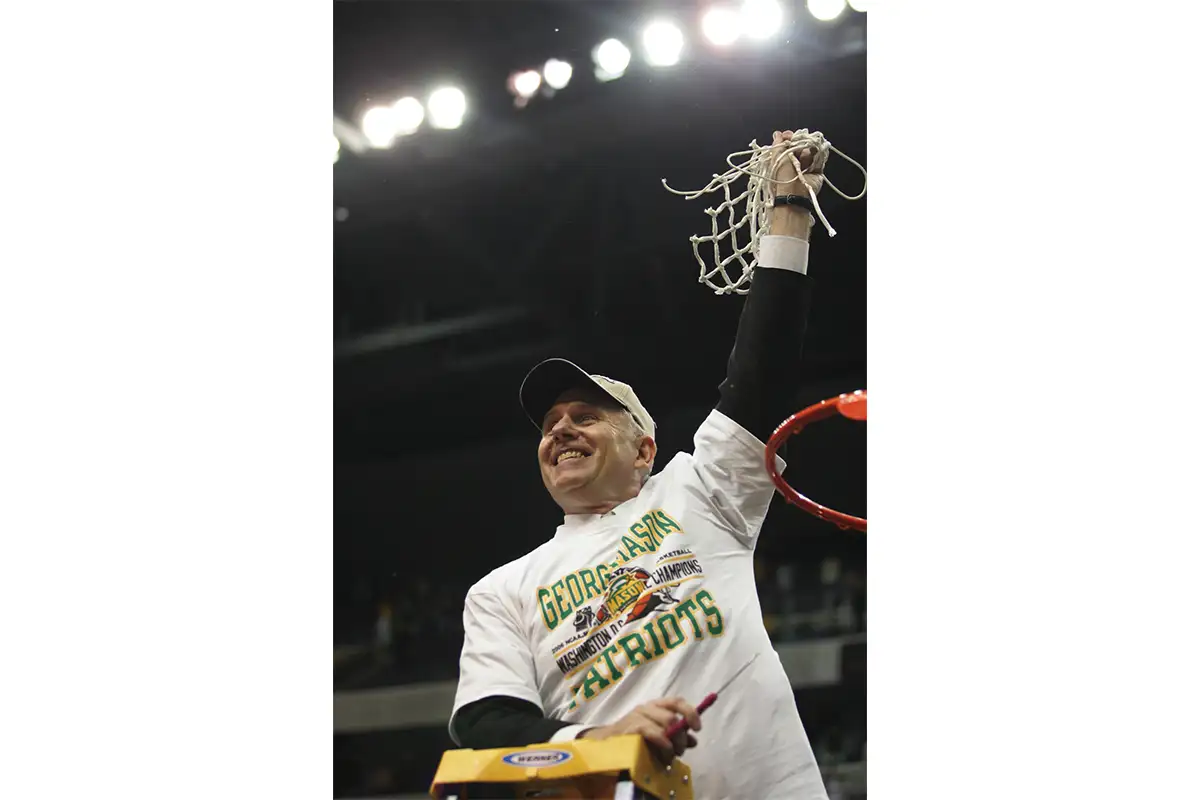
Looking back, how did the Patriots pull it off? “We believed in ourselves,” head coach Jim Larrañaga said ahead of a December 2025 reunion celebration. “We weren’t hoping to win. We believed we would win.”
A School on the Rise
Now an employee at the school, I first came to George Mason as a freshman soccer player in 1973, one year after the college broke away from the University of Virginia to become an independent institution. The student population was 4,000, and the Fairfax campus had six buildings.
By the Final Four year of 2006, the student body had swelled to nearly 30,000, and the campus was deep into a major expansion. Two decades later, the university now enrolls nearly 42,000 students across campuses in Fairfax, Arlington, Manassas, and South Korea.
“If you watch the [tournament] playback now, you hear [CBS commentator] Jim Nantz say, ‘this little school in Virginia,’ and it sounded like a tiny rural school centered on athletics,” says Andrew Flagel, president and CEO of the Consortium of Universities of the Washington Metropolitan Area. “This was not a school that’s tiny, and it’s not a school that’s rural.”
In 2006, Flagel was George Mason’s dean of enrollment and had a courtside seat to the Final Four’s institutional impact. While the millions of dollars in free publicity and two weeks of nonstop national exposure undoubtedly had an effect, he says the school was already charting its own path. “We were on this tremendous trajectory of growth before the Final Four under [former school president] Alan Merten’s leadership,” Flagel says. “We tripled the number of out-of-state students, raised the academic profile, and had a huge surge in the size of the freshman class and the transfer class between 2001 and 2006. If you map it out, there is no Final Four spike.”
However, the university did report an 800% increase in website traffic. Admission inquiries — not necessarily applications — rose by 350%; out-of-state applications rose by 40%. The university bookstore — which typically averaged $11,000 in weekly sales — made just shy of $1 million in the 10 days leading up to the Final Four.
The basketball team’s success also gave university leadership leverage to advance long-desired initiatives. Among them are the Washington Scholars Program, which launched the Washington Youth Summit on the Environment, and the Washington Journalism and Media Conference. Those two programs continue to bring hundreds of high school students from across the country to Fairfax each summer.
The university also created the Military and Veteran Services Office, expanded degree-accelerator programs with Northern Virginia Community College, and built partnerships with National Geographic, the Smithsonian Institution, and the National Press Club.
“The Final Four,” Flagel says, “was a catalyst for an enormous range of energy and change.”
Doc Nix and the Green Machine
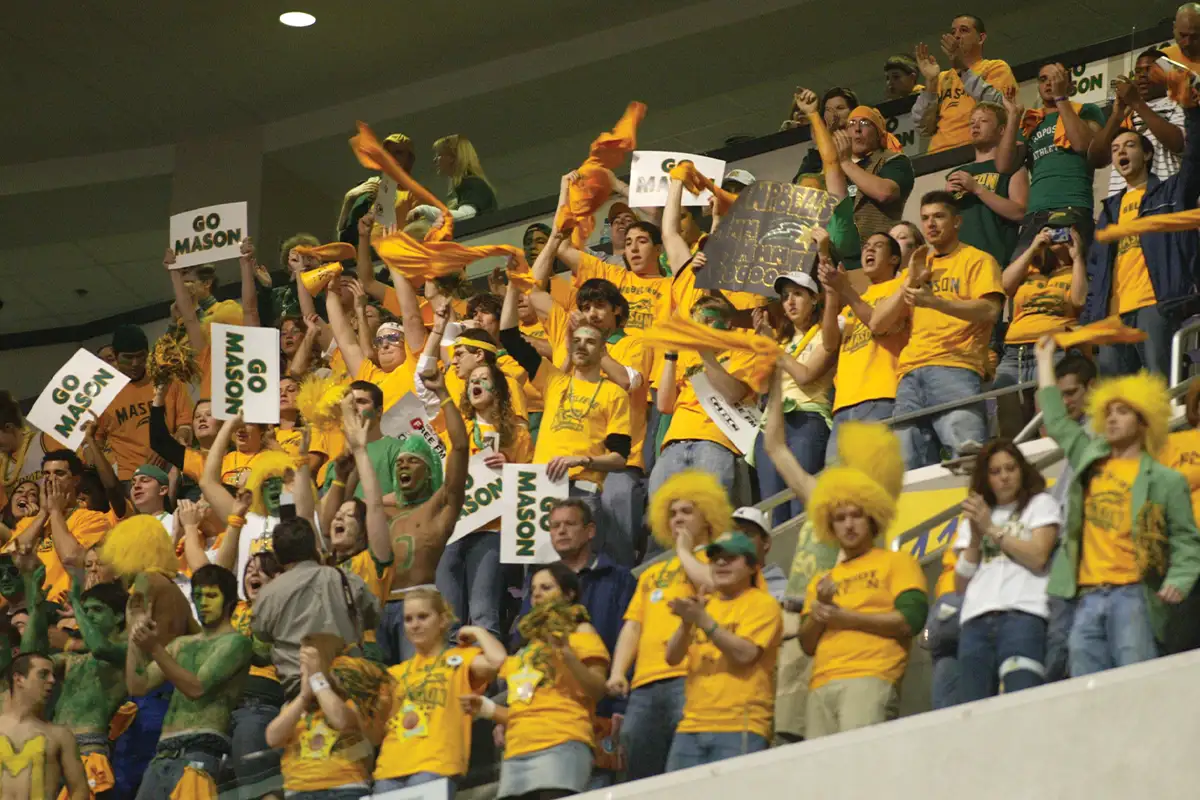
Also in the wake of the Final Four, George Mason tapped a tuba professor to energize the school’s pep band after national attention exposed areas for improvement.
Michael Nickens, who arrived at George Mason in the fall of 2006, debuted the newly christened Green Machine that October. The student-driven band immediately elevated the game-day experience at the Patriot Center (now EagleBank Arena).
Nickens’ flamboyant conductor alter ego — the unmistakable Doc Nix — became a campus icon, leading the band through unlikely numbers such as Bon Jovi’s “Livin’ on a Prayer,” A-ha’s “Take on Me,” and Outkast’s “SpottieOttieDopaliscious.”
Their 2011 stadium medley of Rage Against the Machine’s “Bulls on Parade” and “Killing in the Name” went viral, racking up millions of views. They’ve since been declared the No. 1 pep band in the country by the NCAA and the sports website Bleacher Report.
Merch Madness
Another beneficiary of the Final Four glow is Mike Ickowitz. Mike and his wife, Tanya, operate Patdome Promotions. Patdome — the name is an homage to the Patriot Center — is a Knoxville, Tennessee, custom merchandise company that began in 2006 when, according to Mike, George Mason Final Four T-shirts could not be found in all of Northern Virginia.
The 2003 communication graduate saw an opportunity. He rapidly ramped up an e-commerce site, GMUGear, to make affordable George Mason swag.
Today, Patdome produces Hawaiian shirts, drawstring bags, foam fingers, and bobbleheads for universities, businesses, and government agencies around the world. Twenty years on, the Ickowitzes are still creating what Mike calls “the tangible part of the Mason spirit.”
The Men’s Basketball Program
Hired in 1997, Larrañaga led the team to the NCAA tournament in 1999 and 2001 before the magical run in 2006.
“We went back in ’08 and then again in ’11,” says Jay Marsh, who joined the athletic department in 1974 and retired in 2021 as senior associate athletic director for events and facilities.
The Final Four didn’t immediately transform the basketball program, Marsh says, aside from the debut of the Green Machine. Eventually, a new locker room appeared, but that was already in the works, according to Marsh. Otherwise, it was business as usual.
Larrañaga resisted overtures from power-conference programs and received a five-year contract extension with incremental raises after 2006. After 13 consecutive winning seasons, he left for the University of Miami in 2011 and stayed there until his retirement midway through the 2024 season.
As for the athletes, every Final Four player graduated on schedule, a point of pride for both the university and the team.
“Yes, we all did,” confirms Lamar Butler, the Patriots’ all-time leader in three-pointers and now the program’s director of player development. His former backcourt partner, Tony Skinn, is currently in his third season as the team’s head coach.
All five starters — Butler, Skinn, Jai Lewis, Will Thomas, and Folarin Campbell — played professionally overseas. Lewis briefly detoured into football, signing with the New York Giants as an undrafted free agent in 2005 before returning to basketball in Europe.
For Butler, who made the cover of Sports Illustrated ahead of the Final Four, the legacy of the fairy tale has evolved.
“It was cool, but now as I get older, your life begins to shift to the other guys, the guys you coach,” he says.
“We were a humble group, never boastful. I use what I learned from that experience to help these players,” he says. “It’s about life lessons. That’s what motivates me to be the coach that I am today.”
Current-Day Coaching
Speaking of coaches, current head coach Skinn was the emotional lynchpin of the 2006 George Mason Patriots team. His 2023 hiring was no nostalgic stunt; he paid his dues in the college coaching ranks before returning to Fairfax. In just his second season, he was named Atlantic 10 Coach of the Year after setting school records in conference play. As of press time, this season has followed a similar script.
“At the end of the day, a team’s personality is normally dictated by their coach,” Skinn says. “I think these guys understand the history, the tradition, and they’ve been so coachable — but these games are hard to win.”
Can March Magic strike again?
“The landscape is so much different” than in 2006, he says. “I felt we deserved to be an NCAA tournament team last year. But we weren’t even in the conversation, and this after winning 15 conference games and at one point having the longest winning streak in the country.”
However, he remains optimistic that his team is a strong one. “We’re playing well, and we’ve shown the balance we have on the roster. It’s just about controlling what you can.”
Feature image courtesy George Mason University
This story originally ran in our March 2026 issue. For more stories like this, subscribe to Northern Virginia Magazine.