George Mason University in Fairfax is celebrating its 50th anniversary this year. But it has faced adversity in its first 50 years. Northern Virginians and outsiders alike have seen Mason transform into a hub for technology, politics, and more — and they’ve seen Mason transform the region along with it.
Mason originally began as a branch college of the University of Virginia, small in size and scope. The branch college, placed in a former elementary school in Bailey’s Crossroads, served students for a couple years before they transferred to UVA’s main campus in Charlottesville.
Originally given the moniker of a “cow college” because Fairfax County once brimmed with dairy farms, the school faced challenges in getting support from outsiders. Bob Vay, Mason’s university archivist, noted that those who wanted to preserve the legacy of UVA and Virginia Tech — like the state legislature in Richmond — pushed back against Mason’s growth the most.
“There has always been this difference of opinion between folks in Northern Virginia on how things should run and folks downstate. And early on, that was really a thing,” Vay says.
Russ Banham, journalist and author of The Fight for Fairfax, which details how Mason first fought to become an independent university and its journey thereafter, says that difference of opinion prevailed throughout the university’s journey.
University President Gregory Washington sees the same thing today. While there aren’t as many tensions between the university and Richmond, he says Mason students don’t see the same financial support that students at other universities in Virginia do. Since Mason gets state appropriation per student as an institution, there are less economic resources, like scholarships, available for these students.
“We’re in the area … with the largest preponderance of tech companies, which [are] providing quite a big economic benefit to the rest of the state,” Washington says. “We want the graduates in that region to be not only treated fairly, but to be given the same opportunities as a student in another part of the state.”
But this hasn’t stopped the university from growing — and it hasn’t stopped Mason students from performing, either. And it’s because of this that the university continues its expansion across Northern Virginia — including the creation of a new facility on its Science and Technology Campus in Manassas.
This growth is something that’s notable not just to Northern Virginians, but to outsiders, too. Banham recalls traveling to Fairfax County in the mid-2000s, then coming back more than a decade later.
“I was astonished about everything in Northern Virginia. The Metro reaching more deeply into Fairfax County. It was one stop on the Metro back then — it was just Tysons,” he says. “And then seeing all of those little communities … multiuse, mixed-use communities that sprang up around each of the train stops. That was shocking.”
Banham says this wouldn’t be possible without Mason and credits the university’s move into technology with putting Northern Virginia on the map. He points to the success of the Northern Virginia Technology Council, which started thanks to Mason’s board of visitors and now serves over 1,000 companies in the technology sector.
Banham refers to Fairfax County the “Silicon Valley of the East,” a name he picked up from past Mason President George Johnson. What was once the “cow college” has now become a nucleus for technology.
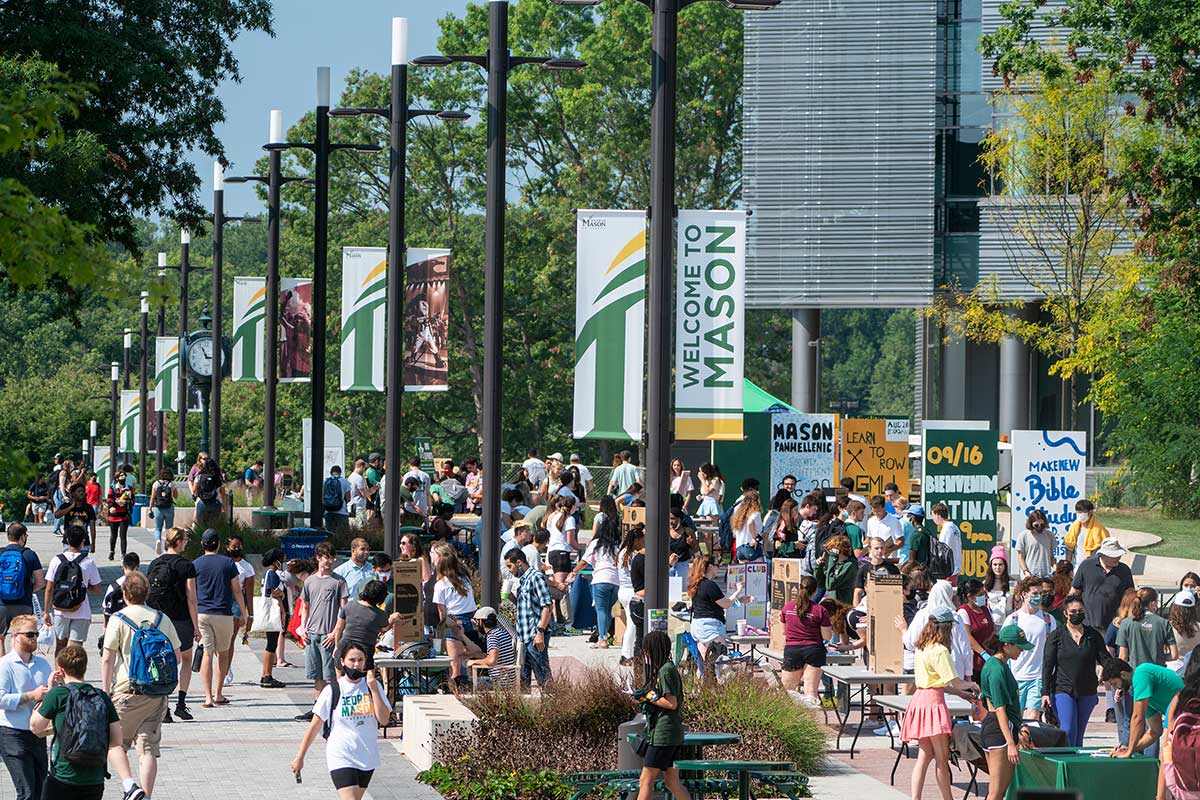
Feature image courtesy George Mason University/Creative Services
For more stories like this, subscribe to our Education newsletter.