An art scientist and arts center collaborate to put art in STEM programs at four Fairfax schools.
Since the late 20th century, education in the United States has predominantly concentrated on promoting STEM—science, technology, engineering and math. Yet in the process of stressing these hard-logic subjects, creativity and artistry were arguably pushed aside. Now, in the 21st century, research and advocates assert for an amendment of the acronym: in an effort to enhance learning by integrating science and art, schools around the country are making the shift from STEM to STEAM.
In 2013, STEAM programs took off in approximately 60 Fairfax County Public Schools (FCPS). These programs, while suitable starting points, maintained a scientific core (think robotics and Lego league) and struggled to fully incorporate art as an integral component. That is, until Rebecca Kamen acted on an idea.
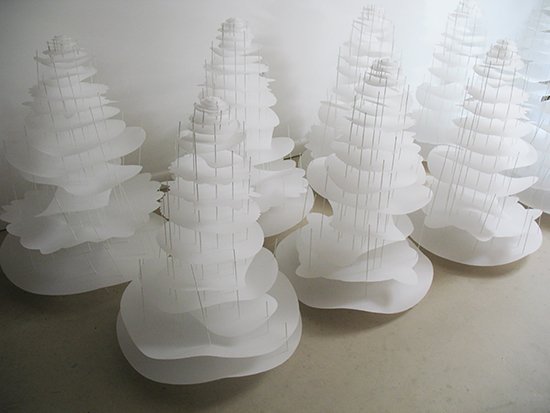
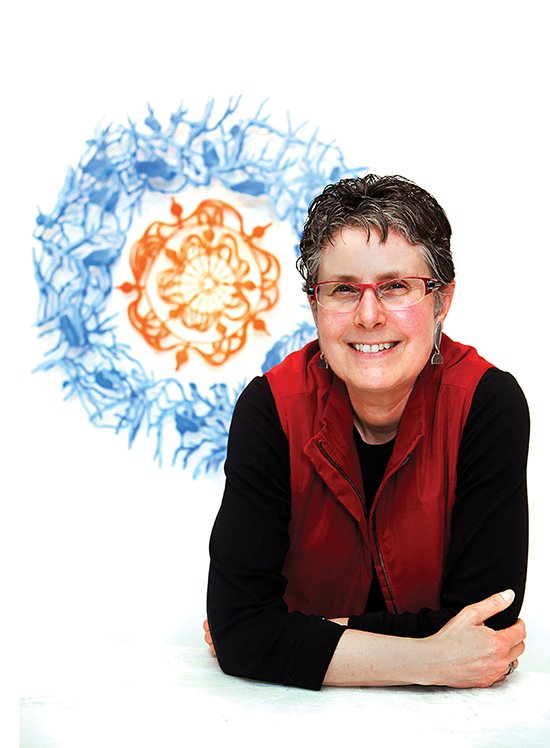
A self-proclaimed art scientist, Kamen gained significant recognition of artfully showcasing science through her “Divining Nature: An Elemental Garden” exhibit at the Greater Reston Arts Center (GRACE) in 2009. Her 83-piece display depicted the naturally occurring elements of the Periodic Table as ethereal white “flowers” whose petals represented the orbital patterns of their electrons. The garden was arranged in a Fibonacci’s spiral, a shape that is both natural and aesthetic, and included a musical composition by Susan Alexjander derived from the radio waves of atomic nuclei.
The success of “Divining Nature” sparked Kamen’s interest in spreading knowledge of the relationship between art and science. She has recently retired from 35 years of teaching at Northern Virginia Community College in order to travel and promote the message of STEAM.
“What I’m trying to do with this work, this art science work in the schools, is to get the students to expand their realm of knowing and realizing that disciplines don’t have to be siloed,” Kamen says. “If you start seeing science through the eyes of art … it makes for seeing things in new ways.”
For the pilot programs at FCPS, Kamen approached GRACE, an arts center that already works closely with FCPS to promote creative learning. Along with GRACE Art, which is in several elementary schools, and the Emerging Visions show for teens, GRACE now performs as the facilitator and resource for teachers involved in the pilot STEAM programs. These programs operate at Oakton, Falls Church and Langley high schools as well as Cooper Middle School.
According to John Adams, director of education at GRACE, the new programs at FCPS focus on the four Cs: creativity, communication, collaboration and critical thinking. These pilot programs should also teach students how to problem solve in creative ways.
“Our focus is really going to be on how we teach the creative process … but we’re just taking it another step further. We’re trying to give the students some framework for creative thinking,” says Adams.
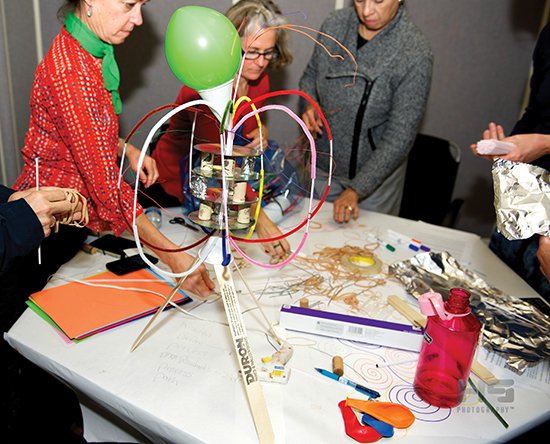
After an initial lecture from Kamen, the science and art teachers involved with the STEAM initiative will collaborate to create projects for students that demonstrate scientific learning in artistic ways. Adams and others from GRACE will continue to offer assistance throughout the process, which is individualized by school. At the end of the school year, the students’ scientific artwork will be presented as an exhibition in an arts center, thus promoting students to share their knowledge and creativity. —Bailey Lucero-Carter
(December 2014)