
How does a quick flight from Manassas to downtown Manhattan sound? It’s in the works. Electra.aero, a next-gen technology aircraft company based in Manassas, is changing the face of aviation with a mission to open new air transportation markets and help decarbonize aviation.
“There’s no company that we know that is yet doing exactly what we’re doing, which I would define as the hybrid-electric blown-lift for this particular market,” says founder and CEO John Langford.
And the aviation industry is taking notice. Electra’s pre-order sales last January hit over 2,000 for its innovative hybrid-electric short takeoff (eSTOL) and landing aircraft with a market value exceeding $8 billion. Not bad for a startup that launched in 2020.

“We have been overwhelmed by the market reception to this,” says Langford. “The customer response has proven now that the market is there commercially. The thing that we have to do is develop the ability to produce it at scale because with over 2,000 orders really without even trying — the product hasn’t even officially been unveiled yet — our big challenge is figuring out how to produce it at rate.”
The general public can benefit from Electra’s aircraft aspirations, which may offer new transportation options. The company is positioned in a market all by itself, not competing against regional jets, which require larger airport runways to take off and land. Nor does it wish to compete against vertical takeoff and landing aircraft. Hybrid eSTOLs like the ones Electra will manufacture only need one-tenth of the space for takeoff and landing that conventional aircraft require. This enables access to locations that today only helicopters can reach and opens up new, smaller airport possibilities like Manassas.
“We are really focused on this ability to operate off extremely short spaces, to open up markets that do not exist and cannot be served any other way,” Langford says.
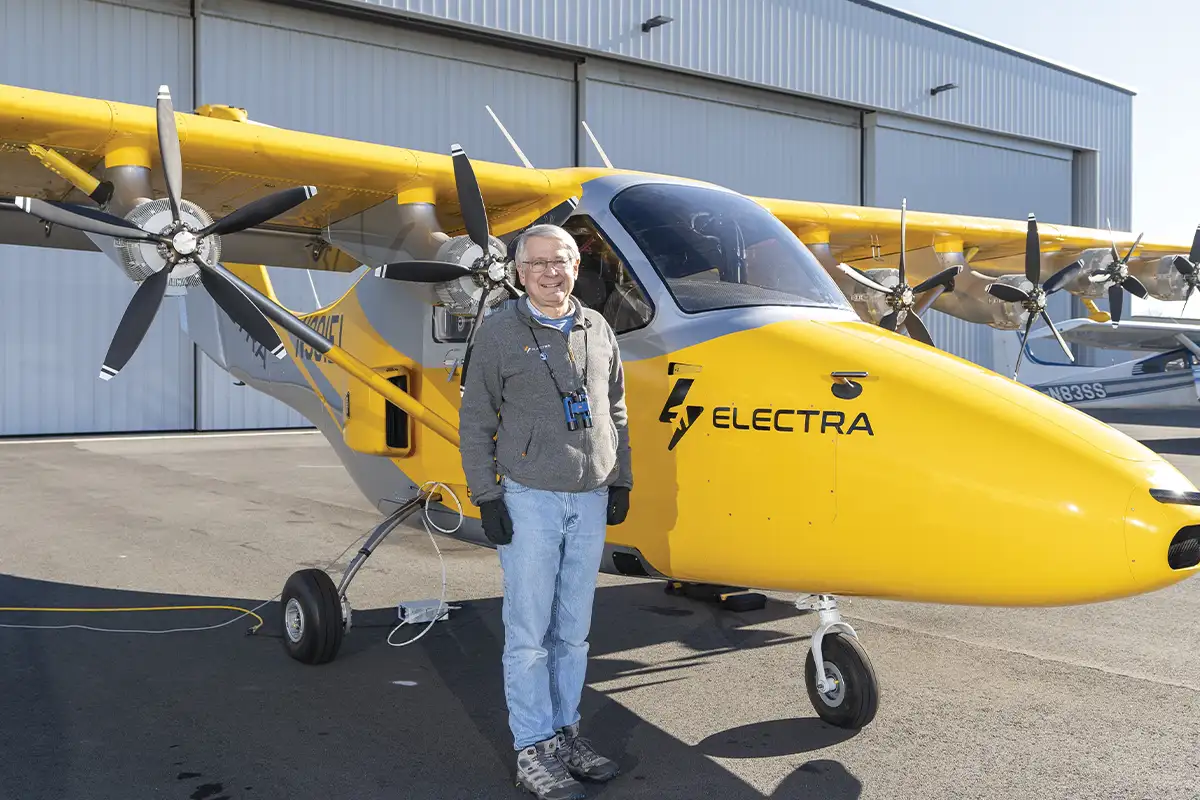
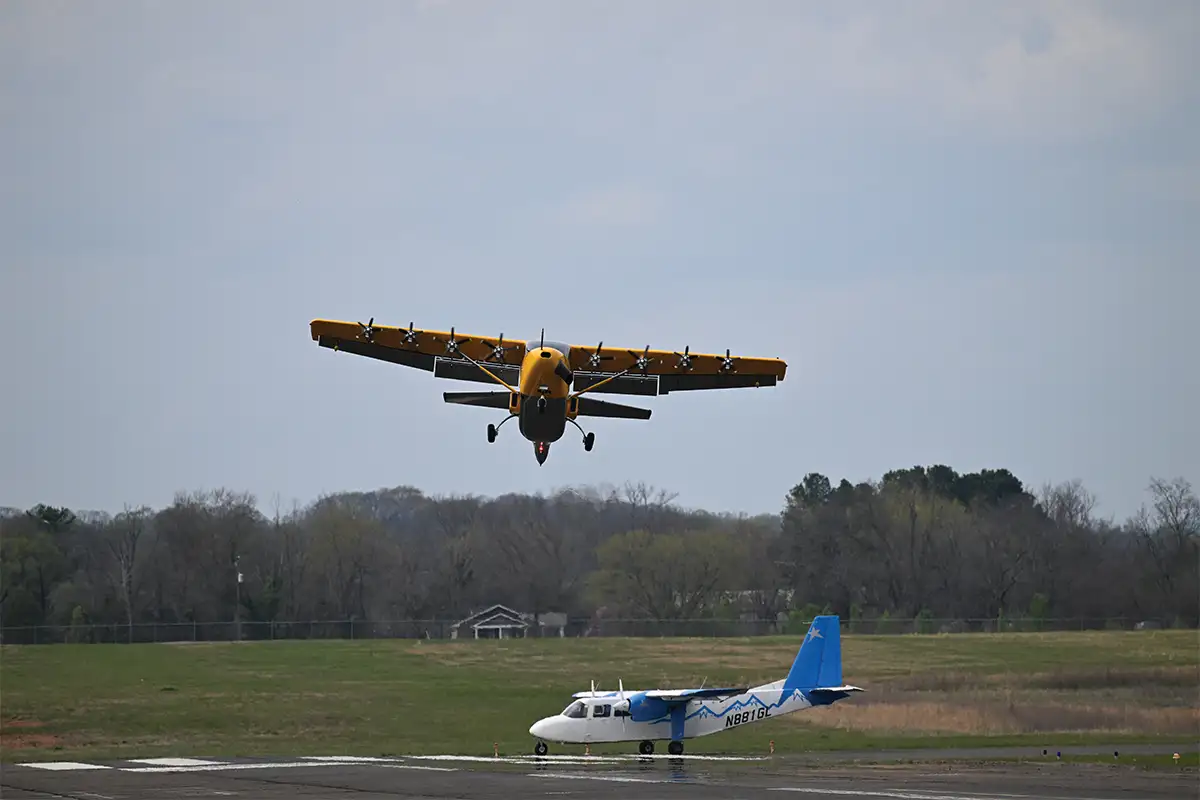
Electra needs only about 150 feet on the ground for takeoff and landing, which it has successfully demonstrated in its EL-2 Goldfinch airplane during extensive test flights. The existing term “short takeoff and landing” typically is defined as 2,000 feet or less but generally means 1,000 to 2,000 feet, Langford says. He likes to say that the “e” in eSTOL refers to “extremely” in addition to hybrid-electric, accentuating his company’s niche.
Military Interest
The military may find use for eSTOLs. In fact, the U.S. Navy awarded a contract to explore use of Electra’s aircraft as a logistical aviation solution in a contested environment.
In the study, Electra will work with Navy stakeholders to define specific contested logistics use cases and conduct a conceptual design study to evaluate how its eSTOL aircraft can help address specific Navy capability gaps. A national security interest topic, contested logistics involve moving personnel or supplies in areas the Navy finds challenging to reach or support.
The eSTOLs make sense in a military setting.
“The military likes it, obviously, because they can go into remote areas, it’s a lot less noisy than traditional aircraft,” says Juan Rivera, Manassas Regional Airport director. “There’s definitely a market for it — it’s an interesting company, and they’re really on the cutting edge of technology.”
The Future of Flight
There are other bonuses too: Quiet electric motors dramatically reduce noise and emissions for community-friendly operation, and the hybrid-electric power provides long-range capability without the need for ground-based charging stations. It all fits with Electra’s mission to decarbonize — and improve — aviation.
“We view ourselves as pioneers in this next frontier of aviation,” says Langford, who holds a doctorate from MIT’s Department of Aeronautics and Astronautics. “The goal behind Electra is to be part of the decarbonization of aviation, which I really have become convinced is the next big frontier of aviation. It’s not going faster. It’s not about hypersonic flight. It’s not about supersonics. It’s really about how we decarbonize aviation.”
Its eSTOLs are big news for industry insiders. The relatively new company is gaining tremendous exposure internationally.
“Aviation will be transformed by having transportation closer to population centers with flight operations being performed more quietly, cleaner than ever,” says Tracy Tynan, director of the Unmanned Systems Center for the Virginia Innovation Partnership Corporation. “Electra’s team has an impressive pedigree; experience they’ve accumulated by solving technological challenges is practically unequaled in their industry among small aircraft developers.”
‘Runway Independence’
In addition to decarbonization, Electra endeavors to operate outside traditional airports. The company plans to manufacture its aircraft for airlines and fleet operators, and the short takeoff and landing lends itself to opening doors to new, less traditional airport experiences. Langford predicts that eventually passengers will be able to untether from large airports.
“That sort of ‘democratization’ of air travel is another big trend we’re going to see in the future,” Langford says. “And the first step to doing that is you have to be able to operate outside of only the traditional airports. Electric airplanes can operate beautifully out of traditional airports — and they certainly will — but they can do a lot more than operate out of a traditional airport. We call it runway independence.”
Electra’s aircraft could feasibly travel from the Manassas airport to New York’s Downtown Manhattan Heliport, located at Pier 6 on the East River. Lower Manhattan is perfectly within its acceptable travel range. The eSTOL’s sweet spot, regarding its travel range, is 25 to 250 miles, with a maximum range of 500 miles.
“We think by going directly into Manhattan with an airplane like what we’re doing, you can cut that travel time in half,” Langford says. “So, you know, two hours to and from Manhattan makes a one-day round trip much more palatable than a four-hour trip.”
Data and insights gained from the company’s flight test program are helping with the design of its in-the-works nine-passenger commercial hybrid eSTOL aircraft, with entry into commercial service (under the Federal Aviation Administration Part 23 regulations) targeted for 2028. The test flights went on for over six months, starting in November 2023, at Warrenton-Fauquier Airport, taking off and landing in under 170 feet. The company plans to fly a protype next year.
More Jobs to Come
Electra’s surge in aircraft orders is good news for jobs in the commonwealth. Langford says the company is targeting 2028 to have operational aircraft, at a cost in the “low millions” per unit. He says somewhere between 1,000 and 3,000 jobs could be created at its manufacturing plant.
“I don’t think I’m telling you any secrets; there are a lot of states that would love to have facilities that create a couple of thousand jobs and create state-of-the-art manufacturing in green technologies,” Langford says. “We would like to stay here, and we’re looking for ways to stay in the area.”
As the company grows, the buzz about Electra increases, and industry experts believe Langford is the game changer to lead the hybrid-electric charge.
Says Tynan: “John’s willingness to accept opportunities to solve challenging problems has led to countless aeronautical breakthroughs and a distinguished career that is poised to yet again transform aeronautics as the world currently knows it.”
Colleagues from the American Institute of Aeronautics and Astronautics, where Langford served as president from 2018 until 2020, say his background will help him make regional air mobility more accessible for everyone.
“John is a visionary and a pioneer in aeronautics,” says AIAA CEO Dan Dumbacher. “Over his career, he has led the creation of three successful aerospace companies that are advancing technologies in robotic aircraft and sustainable aviation. He is an influential leader within the great aerospace community, especially on STEM education topics and national R&D policy.”
Feature image courtesy Electra
This story originally ran in our August issue. For more stories like this, subscribe to Northern Virginia Magazine.