“It was,” says Sarah McCracken, “the freakiest day I had ever lived, weather-wise.”
The Sunday after Thanksgiving, December 1, 1974, the weather in Northern Virginia was as brutal as it was bizarre. “It rained, then we had sleet, then it snowed, and then thunder and lightning,” McCracken recalls. “It was like we were under attack.”
McCracken’s husband, Terry, was a deputy sheriff for Loudoun County. With the county sheltering in place, Terry didn’t have much to do but wait for the violent weather to subside. That quiet would not last long.
The Crash
At 11:10 a.m., the unthinkable happened. The storm forced Washington National Airport (now Ronald Reagan Washington National) to close and air traffic controllers diverted TWA Flight 514 to Dulles International Airport. The Boeing 727 coming from Indianapolis and Columbus, Ohio, had 85 passengers and seven crew members on board.
As it was making its landing approach to Dulles, something went horribly, historically wrong.
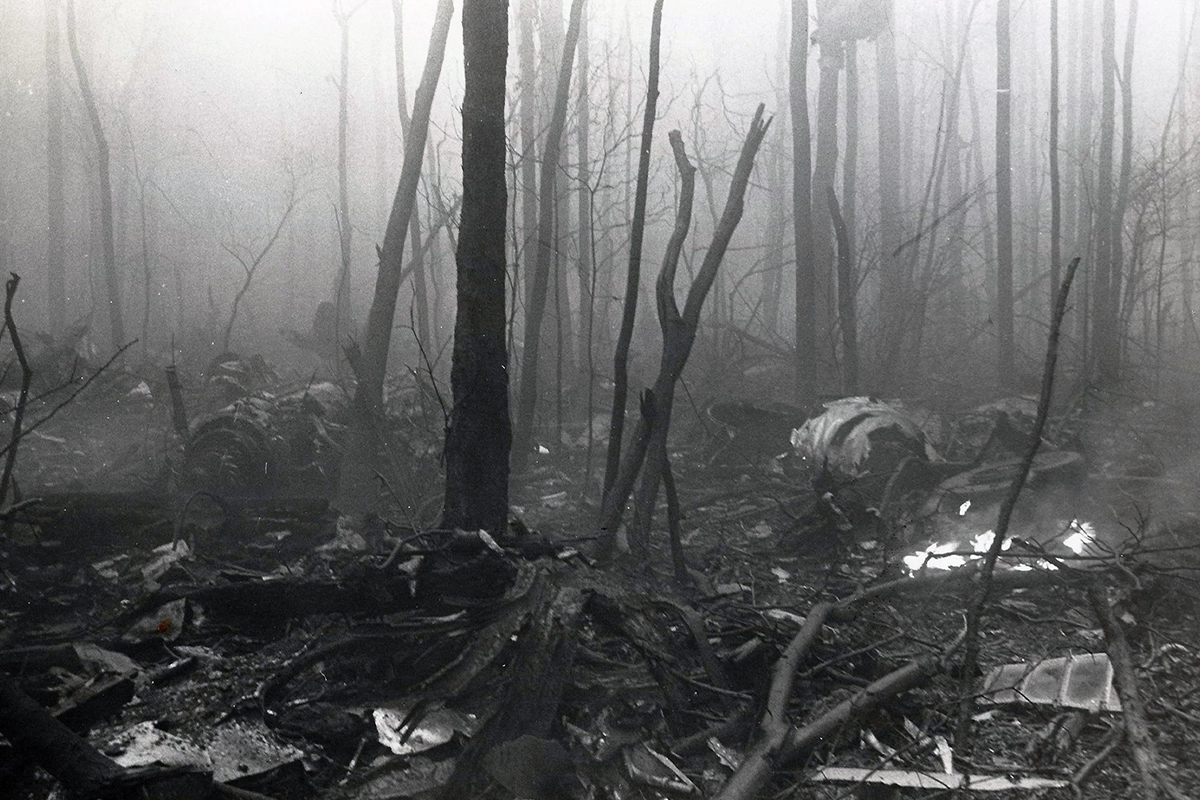
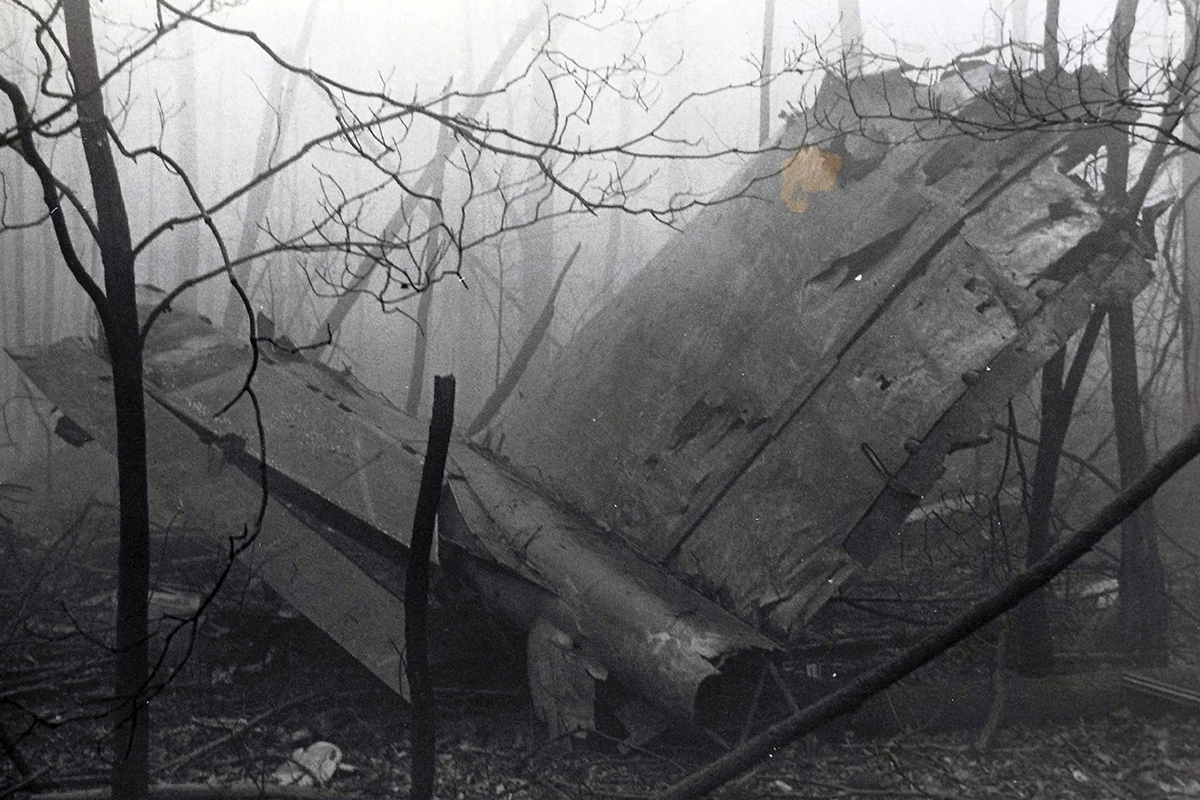
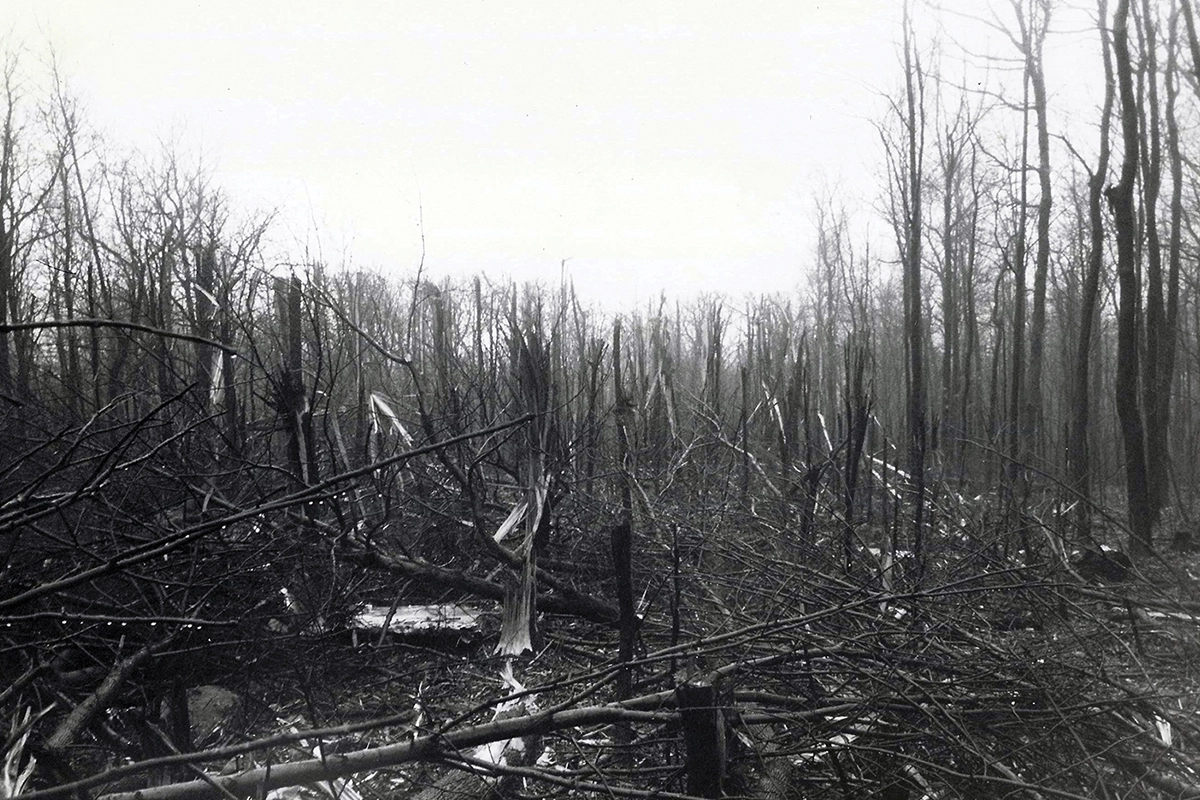
The plane crashed into a mountain in Bluemont, shearing off 380 feet of trees at 265 mph. Instantly, the plane disintegrated. All 92 on board were killed.
As it happened, I was on the plane behind it.
First Responders
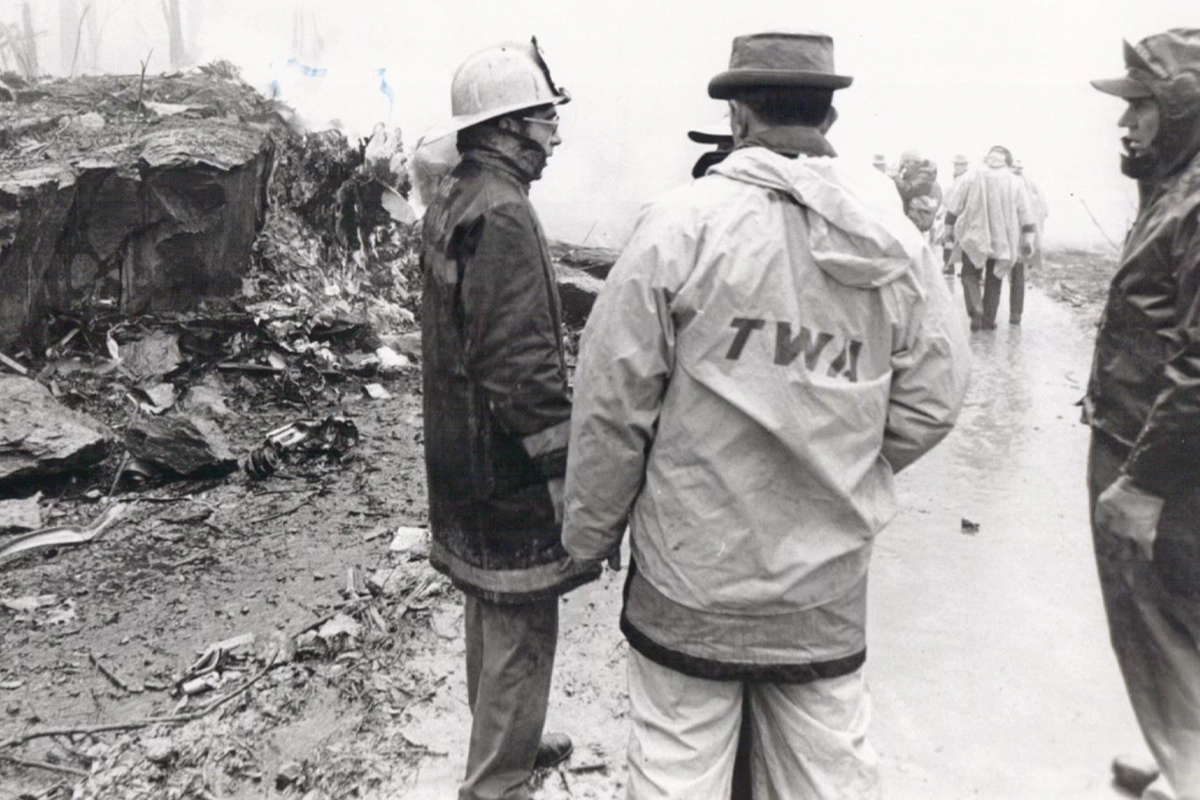
Bluemont farm agent Jack York was the first to arrive on the crash scene. He drove his truck up Route 610 to where he suspected the storm hit powerlines that knocked out his house’s electricity.
What York found — twisted metal and small fires on the forest floor — made him think a tanker truck had exploded. He rushed home to call the Leesburg fire department. They told him they had received a message from the airport that a plane was missing near the mountain.
York had found TWA Flight 514.
Deputy Sheriff McCracken was the first responder to arrive on the scene. His wife, Sarah, recalls her husband returning home from the debris field in the late afternoon. He had spent the day at the TWA Flight 514 crash site helping the recovery as best he could.
Treacherous Weather
And that weather was otherworldly. “The weather was treacherous not only in Delmarva but throughout the mid-Atlantic to the Great Lakes,” says McCall Vrydaghs, an Emmy Award–winning former chief television meteorologist who now works with the nonprofit Keep America Beautiful. She reviewed historic weather records for the day of the crash, verifying the thunderstorms, wet snow, light rain, and easterly winds gusting up to 50 mph at National Airport. “The weather at Dulles was not much better,” she says. “Low clouds and fog would have made for a difficult landing.”
“Given my understanding of weather and the data I reviewed from that day, I’m shocked that a flight landing was even attempted under those conditions,” she says.
Grim Reports
The aftermath of that landing approach was grim. In his 1977 book about the crash, Sound of Impact, reporter Adam Shaw quotes Loudoun County medical examiner George Hocker as saying the volunteers working at the scene were instructed to, somehow, “keep the pieces of the bodies together.”
That would not be easy. “There were pieces of arms and legs wrapped around trees,” said Oliver Dubé, the chief county fire marshal, in the book. “I saw one leg embedded in a tree.” Sarah McCracken remembers her husband telling her, “They didn’t need ambulances. They just needed body bags. They were identifying people by fingers.”
Close Call
For a while, Route 601 was closed from U.S. 50 to Route 7, an order issued by the federal government. The highly secure Mount Weather Emergency Operations Center, the federal relocation facility for civilian and military officials in cases of disaster, is a mere 1.5 miles away from the crash.
Had the plane crashed farther up the mountain into the classified campus, there would have been additional casualties. Also, the country’s continuation of government operations would have been compromised for who knows how long. The disruption would have given Cold War adversaries an opportunity to take advantage of an outage of the nation’s emergency systems.
The crash caused the country to be without its Emergency Broadcast System (now the Emergency Alert System) briefly. This is the national alert system the president uses within minutes of a crisis, such as a nuclear attack.
The Bluemont Community House, now the Bluemont Community Center on Snickersville Turnpike, was turned into a makeshift morgue. Hocker ordered the heat turned off and all the windows opened. Body bag No. 1 was delivered, handled by TWA employees, volunteering “as if in a ritual of atonement,” wrote Shaw. They stacked the bags beginning against the back wall until the temporary mortuary couldn’t handle the volume. The overflow was kept in a refrigerated truck parked outside.
Dentists around the country rushed to provide dental records. But even finding teeth was not easy, according to witnesses.
The plane itself was fragmented beyond comprehension. “There were pieces all over the mountain, and they weren’t very big pieces,” said Sterling Park rescue squad volunteer Bill Peters, in the book. Sarah McCracken, who visited the site a few days after the crash, confides, “I seriously doubt they got it all.”
The Aftermath
The crash and the use of the popular community center for the macabre aftermath “really, really rocked our community,” says McCracken. “The drama, the hysteria — an accident of that magnitude in our backyard?” She takes a breath. “But the community came together to make the situation a little less gruesome.” It seemed everyone wanted to pitch in, in whatever way they could, by supporting the workers and volunteers.
Meanwhile, the National Transportation Safety Board’s “go team” searched the site for the cockpit voice recorder and flight data recorder — the “black boxes” — in hopes of discovering the magnetic tape that would provide crucial data in reconstructing what happened.
Remarkably, the recorders were intact. The data investigators found on them resonated throughout the global airline industry and in the halls of Congress.
Lawsuits
Months before the crash, the Virginia legislature passed a wrongful death statute that puts no ceiling on the dollar amount juries and judges could find for victims of mental anguish, sorrow, and the loss of companionship and comfort. TWA Flight 514 was the inaugural case for the new law.
Relatives of the victims could take TWA — which accepted full responsibility for the deaths — to court and ask for any desired amount in damages. And they did, testing the strength of the new law to extremes. The lawyer representing the family of 25-year-old federal worker Annie Mozelle Killingsworth asked a jury in U.S. District Court in Alexandria for $10 million, about $65 million in 2024 dollars. It was an astronomical sum, but the jury members didn’t blink.
Still, they did not award $10 million. The final settlement was $90,760, the $760 representing the cost of Mozelle Killingsworth’s funeral; the remaining sum was divided into five-figure amounts to family members, including $40,000 to her mother, Essie English. Once the lawyers were paid their one-third fee, English said she had no funds left for an appeal.
Elizabeth Wright, who perished in the crash, was a theater student at Marymount College of Virginia — now Marymount University — in Arlington. Her parents grudgingly settled with TWA without going to court for an undisclosed amount, using some of the funds to establish a Marymount scholarship in their daughter’s name. (The scholarship has since expired.)
Findings
For several days in a meeting room at the Crystal City Holiday Inn in January 1975, the NTSB convened an examination of what went wrong. TWA, the Airline Pilots Association, the Federal Aviation Administration, and the air traffic controllers union studied reams of data-driven testimony. They wanted to determine what occurred to make sure it never happened again, anywhere.
A panel determined the crash was caused by miscommunication between the air traffic tower and the pilot. The air traffic controller told the pilot he was “cleared for approach,” even though the flight was 44 miles from the airport. The pilot thought the controller was monitoring his altitude, while the controller thought the crew members were responsible for their own navigation. The flight crew “was not aware that they were at a very low altitude with respect to the local terrain,” according to the NTSB. The federal report said the crew’s “decision to descend was a result of inadequacies and lack of clarity in the air traffic control procedures which led to a misunderstanding on the part of the pilots and of the controllers regarding each other’s responsibilities during operations in terminal areas under instrument meteorological conditions.”
The NTSB’s findings, including a lack of universal terminology between air traffic controllers and pilots, resulted in massive changes in the airline industry to improve safety. As a result of the findings, the FAA required all U.S. airlines to install ground proximity warning devices in all planes by December 1975. Air traffic control procedures also were modified, and controllers now receive alerts when planes deviate from predetermined altitudes.
Connection
The plane behind TWA Flight 514 was returning to Dulles from St. Louis. Members of the George Mason University soccer team were coming home after playing — not well, the record will show — in the National Association of Intercollegiate Athletics’ soccer Final Four.
I was 19, a fullback on the George Mason squad, and it was my second time on an airplane. The first time was the flight to St. Louis a few days earlier, which, now I know, was uneventful. The return trip, not so much. Our airborne rollercoaster was terrifying, and we could not land fast enough.
The captain announced that we were not landing at Dulles at noon after all — I don’t recall him saying why — and that we were being rerouted north to Friendship International Airport, now Baltimore-Washington International Thurgood Marshall Airport. Happy to be on the ground, even at the wrong airport, we were told the buses required to take us to Dulles, where our cars were parked, could not travel in the weather. We had to wait until it cleared.
Home
We slept for hours on airport benches, exhausted from the weekend of soccer and the prolonged journey home. I finally arrived at Dulles at 2 a.m. on December 2. My cassette tape answering machine in my Annandale apartment had a message from my mother that began with an upbeat, “Hi, did you guys bring back the big trophy? Call us and tell us how many you scored.”
The next message was less upbeat. “Hey, we heard something happened at the airport. Give us a call.”
After that, the 20 or so messages on the 30-minute cassette echoes the chilling sound of a heart breaking — my mother’s.
“God, please call us. Please. Please call.” Over and over and over.
I called as fast as I could, at 3 a.m., with tears of joy and relief shed on both sides of the telephone.
As an enduring result of the crash, before I enter an airplane, I perform a small, private ritual, a non-descript gesture invisible to other passengers that I hope keeps us safe on our flight.
One other enduring legacy from the crash: Sarah McCracken says people sometimes report seeing “someone or something,” a spectral figure, walking at odd hours on Route 601, the road that bisects the crash site.
She says the locals call it the ghost of Flight 514.
Feature image courtesy Robert Dubé
This story originally ran in our November issue. For more stories like this, subscribe to Northern Virginia Magazine.