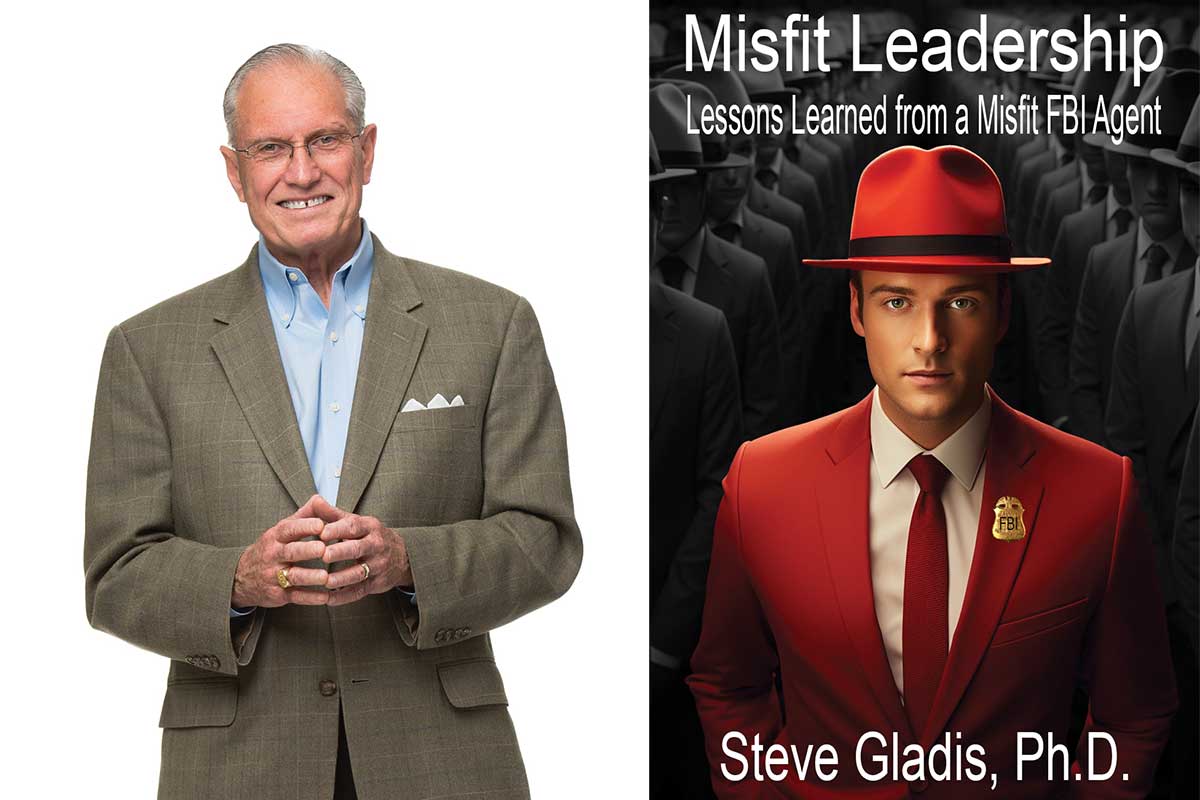
Nonconformist Steve Gladis spent 23 years in the FBI, but he knew he didn’t fit in. Despite that, he led several top departments, thanks to thinking differently. Gladis, now an executive coach in Fairfax, talks about his recently released part memoir, part business book, Misfit Leadership: Lessons Learned from a Misfit FBI Agent.
How were you a misfit at the FBI?
Most FBI agents are very analytical. I was very unlike them in terms of the way I approach the world. I’m not a logical processor. I can’t find stuff. I was bad on search warrants. I could never find stuff. They would come into the room and say, “Hey, did you find anything?” I’d say, “No.” And they’d say, “What about the bloody knife over there?” or “What about the diary over there?” … I was a misfit, really. I approached everything differently.
You leveraged your oddball way of thinking to teach at the FBI Academy and move up the career ladder, didn’t you?
What happened to me is I actually got promoted, you know. I was a speechwriter for the director. I kept getting bounced back to Quantico, which is the island of misfit toys in the FBI. If you’re kind of a little bit intellectual and you’re a little bit offbeat, it’s like a game preserve for animals that can’t make it in the wild.
Your book is about leadership, but it didn’t start out that way, did it?
I’ve rewritten it a number of times. I saw it as kind of a funny autobiography that I would give my kids and a few friends. And then I give it to my editor, and she read it and said, “You know what? There’s a lot of really good leadership stuff in here. You should make this a leadership book.” And I said, “You’re kidding me,” and she said, “No, I really think you should.” She caused me to really re-look at it. … I never saw it as a leadership book.
What should today’s bosses take into account when it comes to diversity and any workplace generation gap?
What does this person bring to the stone soup? Everybody brings something, and oftentimes the guys with the most outlandish viewpoints bring something, an angle that you would have never ever thought of. Managers need to let people speak up. Most people just want to be heard.
Any advice for when a workplace misfit needs to leave?
When it’s hard getting up and going to work. Listen, if you celebrate on a Friday afternoon, and you’re dreading six o’clock, seven o’clock Monday morning, you’re in the wrong place.
You ran a lot while in the FBI. How did that help you?
Running was my Prozac. I had to get the anger out. Not just anger, but the frustration. I also wrote a lot on my off time. I volunteered. I got involved in the community. I did all the stuff on my off time that I wish I was doing full time. Nobody ever gets really good working on their weaknesses. They only get great working on their strengths. The good to great happens when you’re working on your strengths.
Feature image courtesy Steve Gladis
This story originally ran in our December issue. For more stories like this, subscribe to Northern Virginia Magazine.