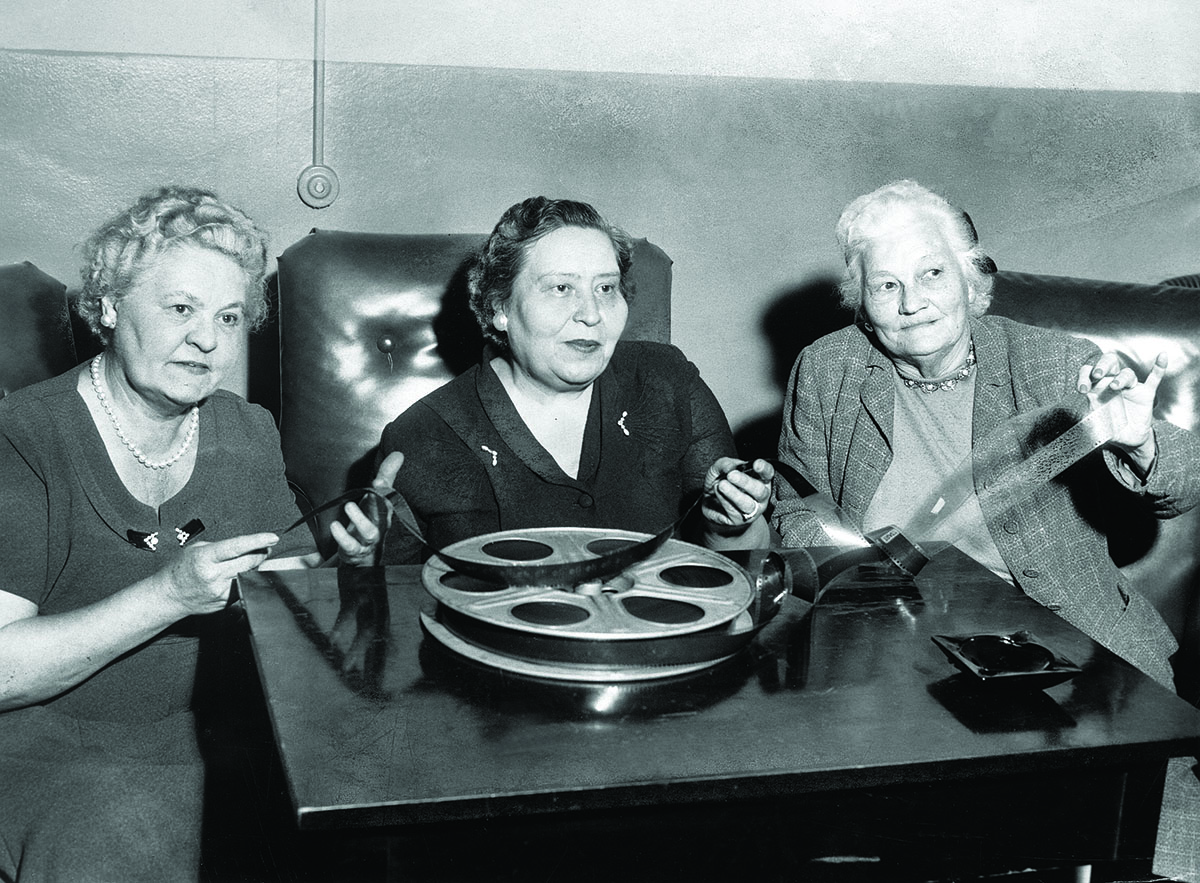
When you think of the silent-film era, your mind might go to images of classic Old Hollywood glamour, or maybe a mustachioed Charlie Chaplin. But 100 years ago in Virginia, the “flickers” that thrilled the masses suddenly came under intense scrutiny, sparking a struggle for racial equality and freedom of speech that was bigger than the screen.
Even with the cultural influence that motion pictures held at the time, the Supreme Court ruled in 1915 that they were merely a matter of business, not of free speech, and thus held no claim to First Amendment protections. That opened the door for states to make their own decisions about what could and couldn’t be shown in their movie theaters. In total, six states set up censorship boards, including the Virginia State Board of Censors, which the General Assembly established in 1922.
Each state board had its own set of principles, but censors mostly watched for the things you might expect, like sexual content, profanity, and violence—anything they believed might have a bad influence on society. Virginia’s board stood out in one big way: Its standards included regulations heavily based on racial segregation.
This was happening during Jim Crow, that era of de facto segregation implemented through laws intended to keep Black Americans oppressed. State governments, particularly in the South, were working to maintain segregation by any means possible, and films that showed any potential for racial equality challenged that. In a 2001 academic paper titled “Patrolling the Boundaries of Race: Motion Picture Censorship and Jim Crow in Virginia, 1922-1932,” scholar J. Douglas Smith wrote, “the Virginia Board of Censors deemed as likely to ‘produce friction’ any scene or subtitle that exhibited contact, whether intimate or threatening.”
So any interaction between the races couldn’t be too friendly, but it couldn’t be too unfriendly, either—and most of all, it couldn’t be anything even close to miscegenation.
As a result of those limits—and a surge of anti-Black rhetoric spurred by the landmark 1915 film Birth of a Nation, now notorious for its white-supremacist themes—films of the time tended to portray Black people only in cartoonishly simple and degrading ways.
Black filmmaker Oscar Micheaux was one of the pioneering forces in combating these stereotypes. Rather than casting African Americans in one-dimensional roles, Micheaux wanted to make films that showed the reality of being Black in America and portrayed his characters with dignity.
In some cases, as with his movie Birthright, Micheaux boldly refused to submit his films to the Virginia board at all, circumventing the process and getting them shown in theaters without approval—making him an enemy of the censors.
This face-off between Black filmmakers and white censors carried on for years. Micheaux died in 1951, a year before the Supreme Court decided that films counted as free speech after all, and the Virginia State Board of Censors officially met its demise in 1966. With that, moviemakers were finally able to create art freely—no matter how much “friction” it might produce.
Feature image courtesy The Richmond Times-Dispatch
This story originally appeared in the January issue. For more stories like this, subscribe to our monthly magazine.