This summer, people around the globe watched the billionaires-in-space race unfold. But when Amazon founder Jeff Bezos and Virgin Galactic founder Richard Branson took suborbital flights just nine days apart from each other in July, they represented more than just rich guys playing space cowboys—they hinted at what might one day become the everyday. By the time Elon Musk’s historic SpaceX flight took off on September 15, with four non-astronauts inside a capsule built and launched by private industry, space exploration took a giant leap toward becoming just another day in the life of a new generation of space travelers.
While the national eye has been on launches from Texas, New Mexico, and Florida, Jeff Bezos might want to consider bringing his space company to Northern Virginia, right along with Amazon. Space tech startups are taking off all over our region—often literally.
The Wallops Flight Facility, a NASA site on the east coast of Virginia, near Chincoteague Island, has launched 16,000 rockets since opening in 1945. It’s an important magnet for new space companies, having positioned itself as providing low-cost access to low-Earth orbit for small payloads such as satellites.
“I think that is part of our value,” says David Pierce, director of Wallops. “Wallops is really going to be a center point for a lot of these small companies to come in and do their first launch, prove out their systems, do it safely, and be able to provide that FedEx [style of] delivery that you hear about of rapid and agile delivery of payloads to orbit. That is definitely where I see Wallops going in the next three to five years.” Rocket Lab, a small rocket manufacturer based in Long Beach, California, opened its second launch facility at Wallops in September 2020, and is on pace to do twelve launches a year there.
It’s that kind of potential for rapid growth from local space companies that could determine NoVA’s role in the future of the space industry. What NASA requires for new space missions—critical technologies like computing, nanotechnology, biotechnology, communications, networking, robotics, and materials—is the exact kind of work that has been fueling NoVA’s modern tech economy, led by the companies that flocked to Northern Virginia in a post-9/11 defense-technology boom.
As a result, the latest innovations in space exploration and tourism are taking off in the state. Which leads to one question: With all the assets and tech resources that have come to Virginia, and the concentration of space-tech companies growing in Northern Virginia, can this state find a place alongside the Gulf Coast as a new “space coast?”
“I very much agree with that,” says Pierce.
What Changed Everything
The success of private space-tech companies is just what NASA envisioned when it decentralized itself after the shuttle program ended, hoping to draw in private tech businesses that would accelerate space development.
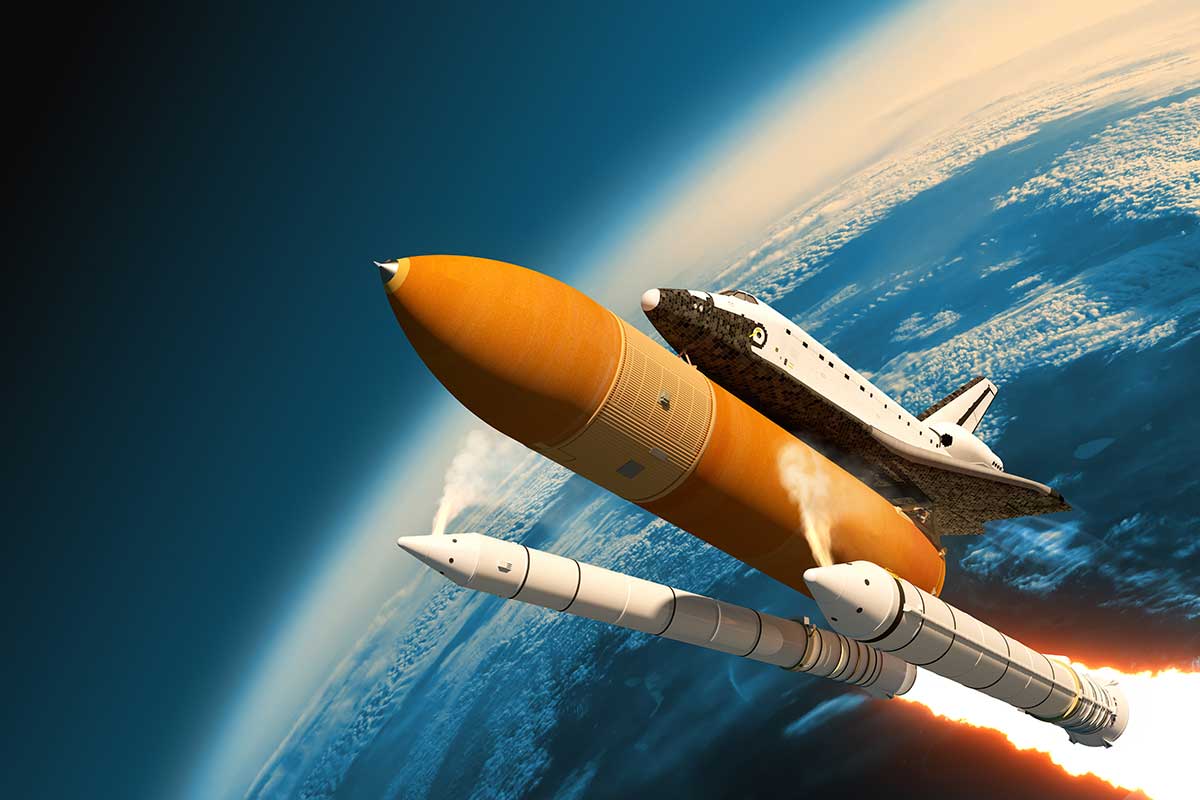
After the last shuttle landed in 2011, with Atlantis touching down at Kennedy Space Center in Florida, NASA lost its way. The era of a centralized government agency getting abundant funding from Congress to advance space exploration was over. NASA envisioned a faster, more efficient, more economical way of getting around space. It needed a reboot. It needed direct access to American ingenuity. So it began engaging private industry as a key to achieving its vision for the future of spaceflight. Starting in the mid-2000s, NASA began using cost-plus contracts (in which the government agency shouldered all the economic risk of investing in space) to fixed-price contracts (in which risk was distributed between the agency and its contractors). Because of private companies’ greater tolerance for risk, this shift catalyzed a burst of activity in the sector.
It was the start of an era called “new space.” Today, NASA is probing all the options of working with tech companies here and elsewhere in order to get to the moon, to Mars, and beyond.
Much of the development that’s accelerating exploration is coming from this state, as the space industry realizes NoVA is the perfect launchpad.
Built for Success
The commonwealth has long been a crucial place for developments in space exploration. The NASA Langley Research Center has been in operation at Hampton, Virginia, since 1917. It’s still one of NASA’s top research facilities, with a $2 billion annual economic impact on the U.S. according to market-research company Wessex Group, Ltd. Exploring Mars with robots and building one of the world’s most powerful rockets for space launch are just a couple of examples of what’s going on right now at Langley.
Iridium Communications, Inc., based in McLean, was one of the true pioneers of space technology. Engineers there created the first global communications satellite network, which was famously initiated when Vice President Al Gore called the great-grandson of Alexander Graham Bell, Gilbert Grosvenor, in November 1998.
Today, significant private space-tech companies exist all over the DMV. According to the U.S. Census, there are just over 180,000 people working in the DC metro area in defense and aerospace occupations—in cybersecurity, engineering, information technology, space systems, management, contract administration and more. Much of that tech-business is concentrated in Northern Virginia. Fairfax County alone is home to seven Fortune 500 aerospace and defense companies. Boeing’s space division headquarters are in Arlington. Northrop Grumman, the company that built the lunar lander for Apollo Moon missions, has its global headquarters in Falls Church. Recent new and expanding space tech businesses in Northern Virginia include Airbus in Loudoun County, Ball Aerospace and Technologies Corporation in Fairfax County, and Aurora Flight Sciences Corporation in Manassas, which in July 2018 had a $14 million expansion in its research and development division, bringing with it 135 new jobs—and opportunities for new companies, according to Bryan Hartin, an executive vice president for Iridium. That creates a growth cycle that fuels new companies.
“The fundamental core part of our strategy is to provide enabling technology to new and existing companies,” Hartin says. “So we are eager to attract startups.”
Such companies are indeed making space their place, including Aireon, a McLean-based 2011 tech startup that partnered with Iridium to provide the first global air-traffic surveillance system, using a space-based network, to the aviation industry. Spire Global, founded in 2012 in Vienna, delivers maritime and weather data through a constellation of 50 small low-Earth orbit satellites. Small businesses in Fairfax County were awarded over $55 million in aerospace and defense innovation development in 2020, according to the Fairfax County Economic Development Authority.
Virginia Is for Space Tourists
All that tech infrastructure isn’t just bringing in money. It could lead to Virginia hosting the flashiest component of the industry: space tourism. In fact, it’s already happening.
Northern Virginia resident and University of Virginia graduate Eric Anderson co-founded Space Adventures in Vienna in 1998. From 2001 through 2009, Space Adventures clients flew over 36 million miles in space on eight separate missions to ISS.
The company uses a Russian rocket launching from the Russian spaceport Baikonur Cosmodrome to take clients into space. “We focus on multi-day stays at the International Space Station, and potentially going outside of the ISS and doing a spacewalk,” says Tom Shelley, president of Space Adventures. “It’s been an interesting year. There are a lot of people who are starting to see spaceflight as a real possibility, and trying to understand what their options are.”
NASA’s plan is working. And as all the components the agency sought to fuel coalesce in NoVA, the institution that started it all is deepening its connections in the DMV.
One major NASA project is DAVINCI+, a multi-spacecraft mission centered around a probe that is just over three feet in diameter and operates like a flying rover. It will soar through the entire atmosphere of Venus and eventually come to rest on a Venusian mountain. DAVINCI+ would be the first U.S. exploration of Venus since the Pioneer Venus Orbiter mission in 1978. The mission is centered at the Goddard Space Flight Center in Greenbelt, Maryland, according to Jim Garvin, the Center’s principal investigator for DAVINCI+.
Flight experiments of the probe were done at Wallops. But Garvin says there is more space-tech help needed from private industry. “Now that we’re funded as a selected flight mission by the agency,” he says, “the selection of sub-partnerships, all the way down to the supply chain, is happening.” If and when he gets what he needs, it’s increasingly likely to come from NoVA.
“Virginia,” says Rick Davis, NASA’s assistant director for science and exploration, “is becoming a space hub.”
Feature image, 3DSculptor/stock.adobe.com
This story originally ran in our November issue. For more stories like this, subscribe to our monthly magazine.