
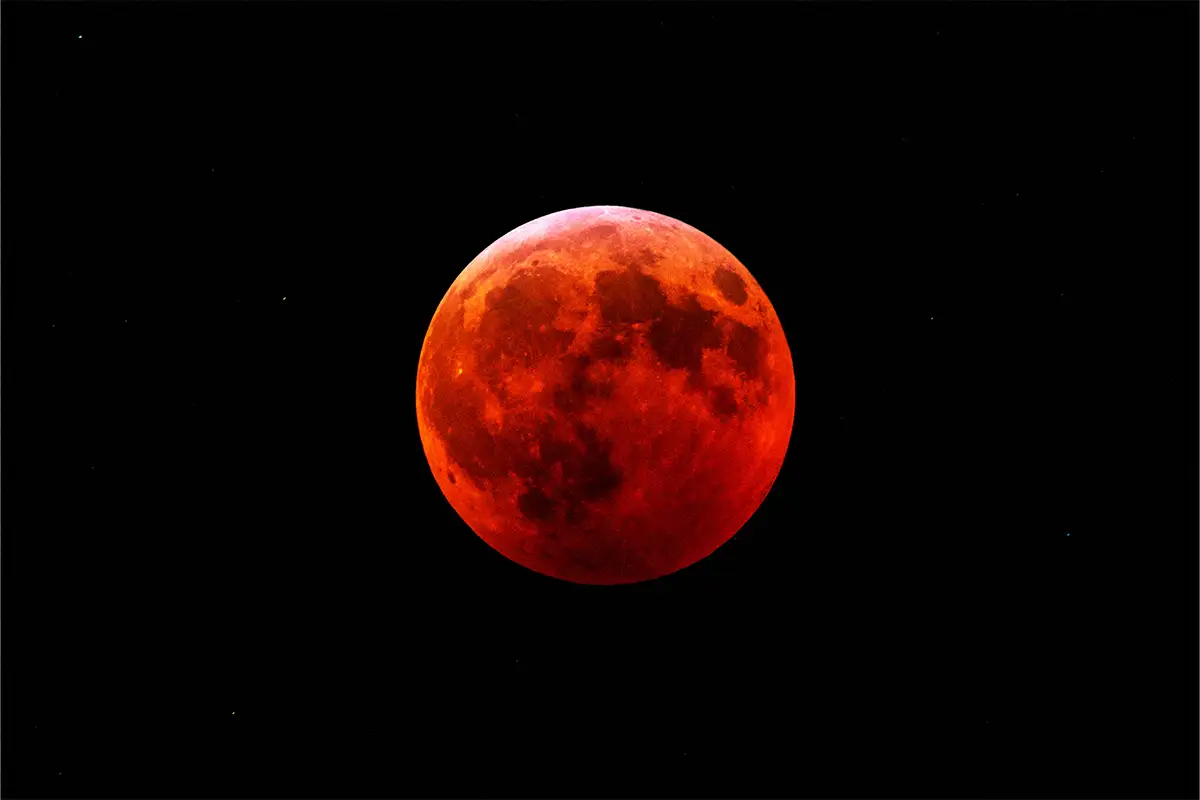
We may be in for a stellar treat in the wee hours of Tuesday morning. If skies are clear, you could see a total lunar eclipse create a “blood moon,” named for the moon’s reddish hues during the event.
A total lunar eclipse happens when our planet passes directly between the sun and moon. This casts a shadow across the lunar surface. It can only occur during a full moon phase. The next total lunar eclipse won’t occur until December 31, 2028.
The “blood moon” is caused when the Earth blocks most of the sunlight from reaching the moon. The light that does reach the moon’s surface is filtered through a portion of the Earth’s atmosphere. “It’s as if all of the world’s sunrises and sunsets are projected onto the Moon,” according to NASA.
In Virginia, the partial eclipse will begin at 4:50 a.m.; totality occurs at 6:04 a.m. The eclipse will be over by 9:23 a.m.
You can observe the lunar eclipse without any special equipment. All you need is a line of sight to the moon. For better viewing, go to a dark environment away from bright lights. Binoculars or a telescope can also enhance your view.
NASA also points out that, during the eclipse, as Earth’s shadow dims the lunar surface, constellations may be easier to spot than they usually are during a full moon. At the time of the eclipse, the moon will be in the constellation Leo, under the lion’s hind paws.
On Sunday, March 8, NASA says to “look for a ‘conjunction’ of Venus and Saturn. The two planets will appear close to each other in the sky (though they’ll still be very distant from each other in space).”
Feature image, stock. adobe.com