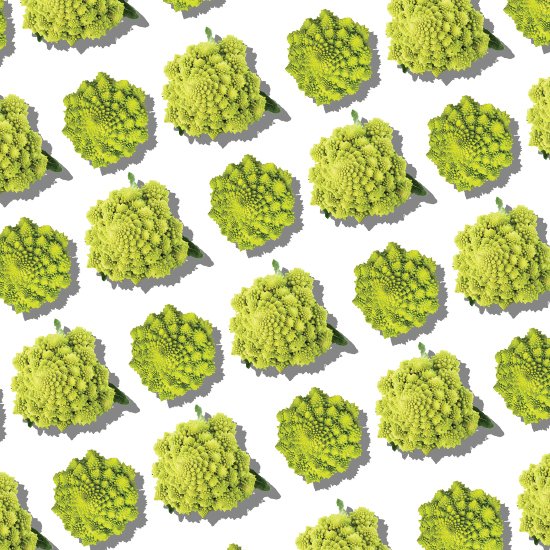
Broccoli? Cauliflower? Either way, this member of the brassica family adds a hypnotic appeal to any dish.
By Mia Fineley
MAGNIFY
fibonacci floret
Each stem of romanesco is an example of a natural fractal, a set of unending proportionate shapes built upon each other. “Fractals are often found in nature, like lightning bolt patterns and leaves with branches and sub-branches, but romanesco forms spirals,” says Raphael Rosen, author of “Math Geek.” “In theory if you look at any of those mini cones, each of those have little mini cones on them and so on and so forth following the Fibonacci numbers—
0, 1, 1, 3, 5, etc.”
COOK
preserve the beauty
“It looks like the love child of cauliflower and broccoli,” writes Laura B. Russell of romanesco, in “Brassicas: Cooking the world’s healthiest vegetables.” She preserves the cone-shaped florets with a quick blanch or saute. “If you want something to mix into a sauce, stick with cauliflower. These are too beautiful to blend or crumble,” says Russell. Instead, she suggests using romanesco in a salad tossed in a lemon-mustard vinaigrette with red onions, red peppers, capers and dill. When shopping, says Russell, look for a tight head and slight cabbage smell.
LEARN
homophone-ish
With northern Italian origins traced to the 16th century, “botanists and gardeners alike have debated whether romanesco is a broccoli or cauliflower,” writes Doreen G. Howard in “Heirloom Flavor.” Broccoflower, a hybrid from Holland, is often equated with romanesco for its similar green hue, but it lacks the signature spirals. Other names not to be confused for this vegetable include an Italian heirloom zucchini, costata romanesco, a Spanish sauce of red peppers and almonds, romesco, and a Spanish melodic tune, la romanesca.
(September 2015)