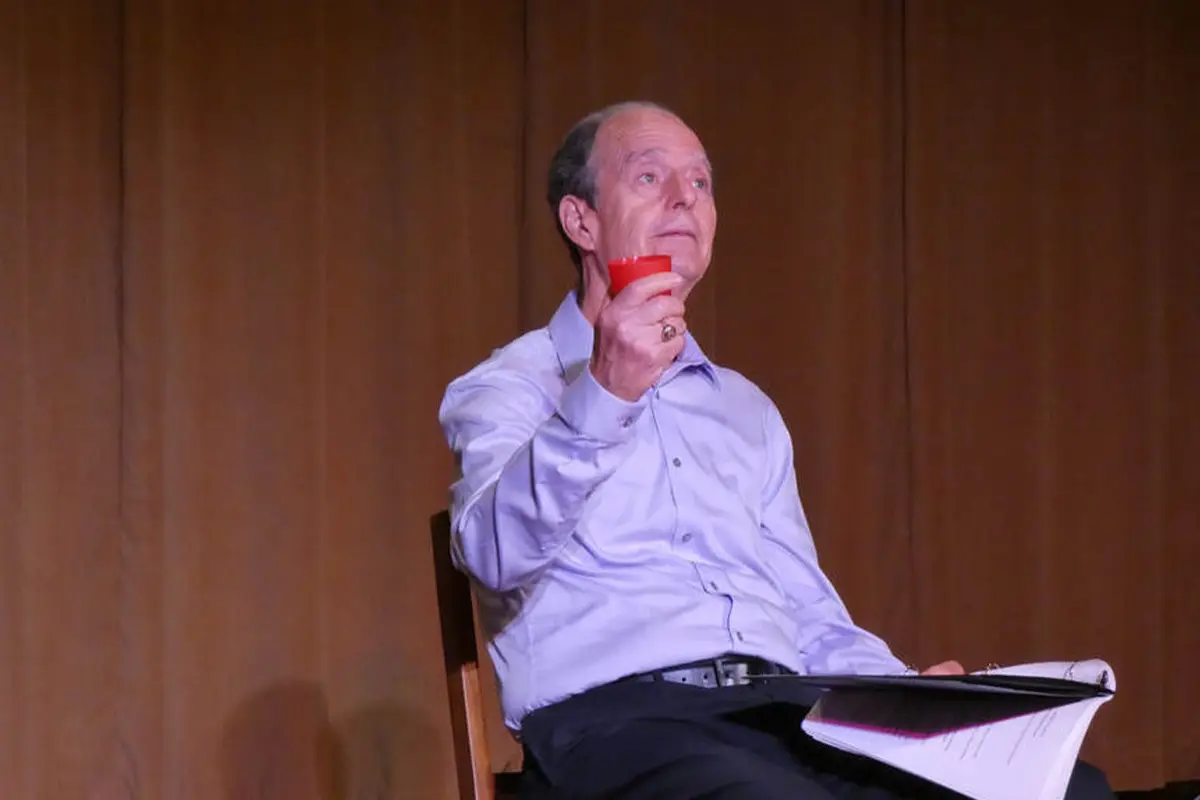
Samuel A. Simon is proud to be a “Dementia Man.” The 79-year-old McLean resident is fighting to increase awareness of the degenerative, memory-robbing condition he was diagnosed with in 2021 — and the stigma associated with it.
“Dementia is a condition, not a disease,” says Simon, who wrote and stars in Dementia Man, An Existential Journey, an hourlong one-man play. “I want America to accommodate people with this disability, just like they do physical disability. … I want the same level of accommodation for folks like me. In the play, I imagine that there are cognitive navigators as available as curb cuts,” the ramps that connect sidewalks to streets.
‘I’ll Be Someone, Not Something’
Dementia is a general term for memory loss, with Alzheimer’s disease being the most common cause, according to the Alzheimer’s Association. It’s also a very common condition. “The number of U.S. adults who will develop dementia each year was projected to increase from approximately 514,000 in 2020 to approximately 1 million in 2060,” according to a new report published January 13 in Nature Medicine.
Simon first performed Dementia Man at the Capital Fringe festival in Washington, DC, in July 2023. He says he’s done it more than 50 times since. His next performance is February 2 at George Mason Regional Library in Annandale; tickets are free.
Through his show, Simon is working to reframe how people think of not just the condition, but the word “dementia.” He wants it renamed to a major neurocognitive disorder, which is the medical term for dementia. He says when people hear “dementia,” they think of the end state of the progressive illness. “They picture the person staring with a blank face,” Simon says, adding that there might come a time when he does that, but “I’ll be someone, not something.”
Simon stresses that after diagnosis, “You can live a meaningful life,” he says. “Life with this disease is worth living. … We have all sorts of things in our lives happen, and you can’t change them, so you have to learn to embrace them.”
‘I Think I Was Almost Born to Do This’
A Texas native who owned his own public affairs firm, Simon was a founding member of Nader’s Raiders, a public interest group Ralph Nader started to examine the Federal Trade Commission.
In 2000, his wife of 59 years, Susan, was diagnosed with breast cancer. A longtime theater lover, Simon commuted frequently to his job in New York City. He joined Artistic New Directions, an improv group known today as A&D Theater Company. It was through an exercise with this class that he got the idea for his first play: The Actual Dance, Love’s Ultimate Journey Through Breast Cancer. Writing and performing it provided an outlet for processing his stress.
“It’s like a life gift,” Simon says of playwriting and acting. “It’s like going through most of your life and purpose finds you. … I think I was almost born to do this.”
After his own diagnosis, Simon decided to write Dementia Man.
And Susan is always at his side holding his scripts. “He knows a lot of it from doing it so much,” she says. “I have to judge whether, if he skips a part, I should just whisper the line or let him go on because it’s not that important.”
It’s all part of her role as a “cognitive navigator,” Susan says. She helps to jog his memory or regain his train of thought. Susan also worked at an assisted living facility and explains that “You want to keep (people with the disorder) as independent as you can. It’s more of knowing when to step in. I wait a little bit to see if there is a word, or he gives me a hint of what he’s trying to think of, rather than (jump in).”
Simon began noticing memory problems about five years ago. When he was performing The Actual Dance via Zoom during the pandemic, he began needing Susan to provide cues. Then one day, he was driving home from a doctor’s appointment. “Pulling out of there, people were honking at me,” he says. “I didn’t understand I was on the wrong side of the road.”
‘I Could Almost See Myself Floating in Nothing’
A couple years later, he lost what he calls cognitive awareness. He was leaving McLean Family Restaurant, a place he visited weekly with his friend. “It was as if I looked to the right in my head and there was just infinity, as if I could almost see myself floating in nothing,” Simon says. “It’s a big part of the play, the sense of being in infinity and floating in nothingness.”
More recently, Simon says he’s experiencing what he terms “time clips,” in which something will pop into his mind and then immediately disappear. “It just popped up a few weeks ago, and it’s happening more and more,” he says.
As for the play, he says he will do it for as long as possible. He will also continue to participate in treatment trials. Although there’s no cure for Alzheimer’s, federal research totals almost $4 billion, according to the Alzheimer’s Association.
“I’m in a drug trial … in hopes of adding a few more years of my life and being a help to others,” Simon says. “Maybe there’s some one little thing that could shorten the time to a cure by a day, a minute.”
Feature image courtesy Samuel A. Simon