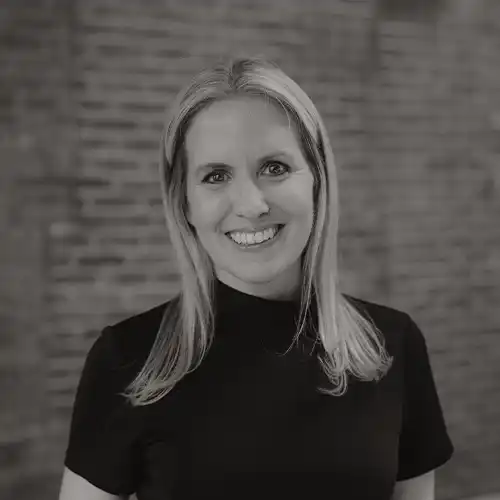

When 36-year-old Virginia Beach resident Natalie Wingfield found out she had stage 1 breast cancer, it came as “a total surprise.” She had no family history, no risk factors, no abnormalities in her genetic testing. But the licensed professional counselor knew what she wanted to do: Get a mastectomy to remove the cancer, followed by direct-to-implant reconstructive surgery, sparing her nipples and keeping whatever feeling could be salvaged in her upper body. She wanted to experience the sensations of giving a hug, holding a baby against her chest, even spilling a cup of coffee on herself — ordinary things we don’t think about until we’re faced with losing them.
So Wingfield says she did “a deep dive” into her options. She scoured online forums and joined several Facebook groups dedicated to breast cancer information and advice. The Breasties Community was a favorite.
“I got a lot of opinions,” she says. “I think I met like three or four breast surgeons and maybe four or five plastic surgeons,” but none in Virginia Beach offered what she wanted. Through The Breasties, Wingfield discovered Dr. Anne Peled, a San Francisco–based surgeon and breast cancer survivor who performs Resensation, a new surgical technique that helps restore sensation during or after a mastectomy.
Wingfield considered traveling to California, but when she found out that there were Virginia-based doctors trained in Resensation, she only had to travel to Fairfax, where Drs. David Weintritt and Alex Mesbahi worked as a team at Inova Health System. Weintritt, founder of the Alexandria-based nonprofit National Breast Center Foundation, performed the mastectomy and Mesbahi, the reconstruction and Resensation technique.
“I wanted to feel comfortable in my own skin,” Wingfield says. “I was scared that I was going to be uncomfortable forever.” Three months post-op at the time of our interview, and eager to educate others on the benefits of Resensation, she says, “I’m already feeling pretty close to normal.”
No Longer Numb
While the idea of using a nerve graft, a procedure that repairs and reconnects damaged nerves with functioning ones, to reestablish sensation in parts of the human body isn’t new, its application to the breast is relatively new. A mastectomy generally results in numbness of the breasts and partial or complete numbness of the chest. All sensations can be lost, including those that can help you protect yourself, like the ability to feel burning.
Mesbahi, a renowned, board-certified breast reconstruction specialist with the National Center for Plastic Surgery, was first introduced to Resensation when Axogen, the company that developed the breast neurotization technique, contacted the McLean-based doctor.
“Just before the pandemic, they had started reaching out to high-volume surgeons that do complicated breast surgeries and reconstructions to start talking about doing this nipple sensation procedure,” Mesbahi says. But, when he was scheduled to meet with the company at a symposium, “the pandemic happened” and it fell through. However, curious about the technique, he flew out to San Francisco to meet with “a husband-and-wife team out there that really first started doing it and published data on the technique.”
The technique works regardless of the reason behind the mastectomy — whether it’s to remove existing cancer or prevent the occurrence of it. And it works regardless of whether the patient opts for implants (as Wingfield did) or flap surgery, which involves taking tissue from another part of the patient’s body (typically the abdomen) and using it to reconstruct the breast.
Mesbahi was on board, and says he was the first doctor in Virginia to perform breast reconstruction using Resensation, in 2022 at Inova Fairfax Hospital.
“A willingness to take on more complex and advanced procedures is what makes them [Inova] stand out, I think, from a lot of other hospitals,” Mesbahi says.
One of the first Virginia patients whose surgery included Resensation is Dr. Catherine Seangio, 51. She underwent flap surgery and reconstruction under Weintritt and Mesbahi in 2022. “I was lucky because I did wake up with some sensation, and it’s just gotten better,” Seangio says. “Women have a lot more options in breast cancer treatment now that will make you feel like your normal self. And after surgery, I was very fortunate to embrace that new normal.”

The Emotional Impact
A mastectomy, like many major surgeries, doesn’t just affect a patient physically. The psychological impacts can be significant. Research has shown that patients can experience depression, anxiety, body image issues, struggles with sexuality, and a sense of disconnection from their bodies. One alarming 2018 study published in the Journal of the National Cancer Institute found women with breast cancer were 37 percent more likely to commit suicide than women in the general population.
“I think when patients learn that, you know what, not only are they going to look normal after the procedure that we do, but also potentially feel normal again, that really is is very comforting when thinking about undergoing this type of surgery,” Mesbahi says. “We know that, just from the literature, there are a lot of psychological benefits to doing reconstruction. That’s both from a body image standpoint, from a sexuality standpoint. So, again, being able to add another component to that body image and potentially sexuality is really significant.”
Seangio says the technique offers women courage.
“It’s hard enough that women have to go through cancer treatment, and they lose sensation in their breasts, and it makes you feel less of a woman, but then if you’re able to do this procedure, it brings that confidence back,” Seangio says. “It doesn’t take too much away from you.”
Feature image, stock.adobe.com
This story originally ran in our October issue. It has been corrected here to clarify that the company Axogen pioneered the Resensation technique. For more stories like this, subscribe to Northern Virginia Magazine.