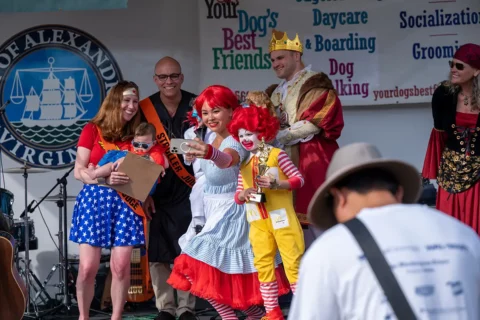
The Synetic Theater has always achieved more with less, receiving rave reviews, full audiences, and prestigious awards while avoiding one thing most theaters build their existence around—the spoken word. (For those not in the know, the physical movement- and pantomime-driven Synetic Theater is completely devoid of dialogue.) It’s celebrating its 20th anniversary this year, and they’re doing it with free, public performances of founder Paata Tsikurishvili’s signature The Magical Miraculous Balloon show throughout Arlington this summer and fall.
It’s a critical inflection point for the theater, which navigated the lockdown period and has begun the process of returning to in-theater shows in a lingering pandemic. But if any theater can succeed in harsh conditions, you’d be smart to bet on the Synetic.
Doing more with less has been the nature of Tsikurishvili since the very beginning of his career. Tsikurishvili faced down discrimination in the Soviet Union, made his way to Germany from war-torn Georgia, and has built a burgeoning theater dynasty in the States from the ground up. And at the most critical junctures of his career, he’s relied on only one small prop: the single red balloon used for The Magical Miraculous Balloon.
The decision to return to in-person shows with this particular show makes a lot of sense, once you understand what this little balloon show has accomplished.
A Constant Companion
Tsikurishvili was only nine years old when he began training in pantomime in Georgia. The Magical Miraculous Balloon was his first staging, a pantomime consisting of spectacular physical movement around a single red balloon, placing the audience’s focus purely on the performer’s skill.
Tsikurishvili’s expert performance of it helped his career grow exponentially, despite facing artistic repression and discrimination because of his Georgian ethnicity in the Soviet Union. Tsikurishvili was named the top youth performer of physical theater in the Union, and went on to stage carefully crafted and coded critiques of the government through classical tales, particularly relying on Shakespeare.
“We constantly used to be hunted,” Tsikurishvili says of his time in the U.S.S.R. “Many painters and artists were executed at the time. So we had to be very careful. Everything we were doing was more metaphorical, with hidden agendas, hidden subtext…We kept in mind our dictators during the production, but it was not obvious, so it was not easy to accuse you.”
Despite his growing fame, he began training with local Georgian fighters to take part in the Georgian civil war that occurred post-Soviet collapse, ready to combat oppression through both art and physical action.
It was at this time that Tsikurishvili’s friends insisted that his best value was not as a warrior, but as an artist. They instructed him to go out and spread Georgian culture, using physical movement to transcend language barriers.
“I lost my friends left and right standing next to me from the bullets,” Tsikurishvili says. “After two years, I was encouraged by my friends to get out of the guerilla movement, the war movement. I was not a war fighter; I’m an artist. And I had to take my skillset outside of my country and be an ambassador of Georgian culture.”
Tsikurishvili had success traveling through Europe, but the vastness and cultural differences of the United States overwhelmed him. But even in the ultra-competitive entertainment empire that is the U.S., he could rely on what he calls his “business card”–the red balloon. He’d simply pull it out, and start performing in the street, in a public performance space, even on tables.
The show served him here, just like it did in the U.S.S.R. Tsikurishvili was invited to perform at the Kennedy Center, where he caught the attention of the theater world. It wasn’t long before he had enough attention and resources for him and his wife to found the Synetic Theater.
The Silent Generation
The Synetic now uses the Miraculous Magical Balloon to teach local schools about movement-driven performances. It’s also a home for physical actors from across the world, thanks to the fact that it does away with speech. Some of its actors are escaping from dangerous situations at home to spread their culture, much like Tsikurishvili once did.
The Synetic Theater’s evolution isn’t over. During the lockdown, the Synetic took a new interest in film as a way to bridge the physical divide and continue performing. Its visually driven performances fit the medium and are a way to engage with a new Tik Tok generation who seem naturally drawn to physical movement. Plus, cinema’s lack of boundaries is a way for Tsikurishvili to come closer to achieving his dream of spreading Georgian culture across the globe.
And yet, there’s no replacing live shows. Tsikurishvili is also eager to get back to in-person performances, combining both indoor and outdoor stagings to make it happen. So once again, Tsikurishvili is turning to his trusty red balloon. And if the history of his career is any indication, The Magical Miraculous Balloon could lead a strong return for the Synetic Theater.
Feature image courtesy Synetic Theater
For more of what’s happening around NoVA, subscribe to our Things to Do newsletter.