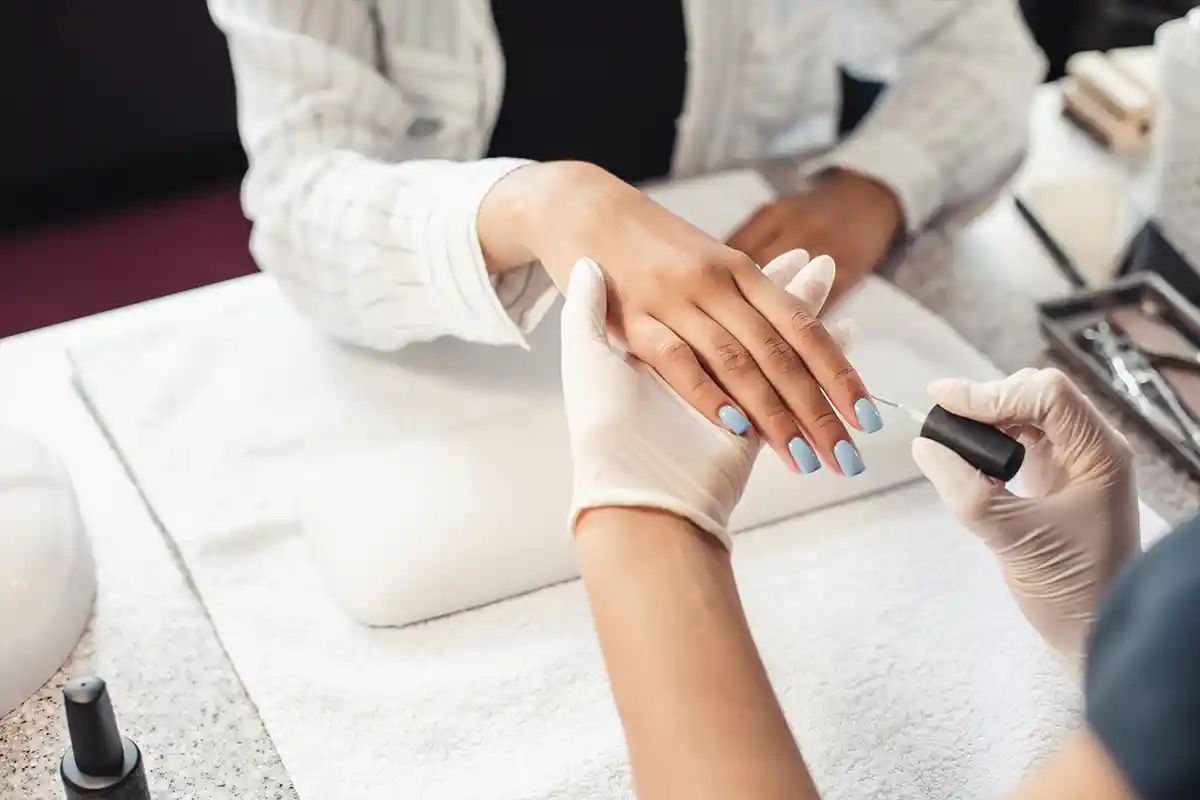
It might seem enticing to take part in the funky nail art and services that have been popularized by social media. However, it is vital to understand the risks involved, including potential infection, and how to take part in these trends safely.
Do Your Research
First and foremost, you should verify that the business you are going is properly licensed, and the nail technician is trained and certified to do your manicure or pedicure, notes Dr. Randa Khoury, a dermatologist at Kaiser Permanente in Falls Church.
Sterilization Is Key
Before getting services, make sure that every guest is receiving his or her own set of sterilized tools, Khoury says. They should open the individual packet of tools right in front of you.
“Seeing them take an instrument out of a drawer or bin should immediately be a red flag,” notes Khoury. “If it has been used on a guest before you, there is a strong chance of cross contamination or infection.”
Also keep in mind that soaking tools in a disinfectant such as Barbicide is not sufficient, she adds.
“If they are not single-use tools, then they should be properly sterilized between customers,” Khoury says.
Be Wary of Jetted Pedicure Tubs
While pedicure tubs with massaging chairs may appear tempting, if they have jets, a chance of infection may be lurking inside.
“Even if a new plastic liner is being used for each customer, that is not protecting you from the organisms that could be living in the actual jets themselves,” Khoury explains.
The only way around this would be for the salon to properly sterilize the jets in between each guest by running a bleach solution with warm water through the jets for at least 10 minutes.
“I would advise against these pedicures unless you are confident that they sterilize their jets,” Khoury says. “Or look for a salon that uses a stationary bowl instead.”
Use Caution with Gel Manicures
Gel manicures are one of the most popular services at nails salons today, however, you need to be aware of the ultraviolet light (UV) in the curing lamps, Khoury says. “They are sometimes marketed as LED/UV, but as long as the UV component is in there, it is not safe,” she explains. “There is no such thing as a safe amount of UV exposure.”
If you can’t part with the gel manicures, you should use something that can block the UV light from touching as much of your skin as possible, Khoury advises. “There are actually fingerless UV blocking gloves that you can get, but these would still be leaving your fingertips exposed.”
Dip Powder Can Be Unsanitary
Another popular nail service is dip powder made from acrylic compounds, which makes it very similar to what is used in an acrylic nail service.
However, Khoury says, this method is applied by dipping your finger into a jar of powder, and standard practice in many salons is to use the same jar for all clients requesting that color.
“This is a significant infection risk as yeast, bacteria, and fungi can grow in those pots into which many recently-manicured hands are dipped,” she explains.
If this is the method you prefer, one way to make it safer would be to purchase a few color options and bring them along with you to the salon. “That way, you can ensure that this jar has never been used on anyone else,” Khoury says. You can ask the nail technician to decant your own powder into a small, clean bowl.
Should You Get a Russian Manicure?
Khoury strongly advises against Russian manicures, a popular, yet risky trend that has been popular on social media recently.
With a Russian manicure, a drill is used to file down any existing nail polish or lift up the cuticle instead of the typical sterilized manicure tool set. These manicures are often billed as “healthier” because it does not use the tools that require sterilizing.
This technique is also popular because there is a longer time before you start to see nail growth due to the cuticle being more aggressively filed down than with a traditional manicures. “This can cause a lot of problems, particularly with pushing and flipping back the cuticle,” notes Khoury. “The cuticle exists to seal the growing, healthy part of the nail and protect it from infection and damage. And when you use a drill to disrupt that nail, you have essentially removed that guard.”
This can even cause permanent damage to the nail matrix — the part of the nail apparatus that creates a new nail, Khoury adds.
Press-On Nails Are Back
Press-on nails are back in style, but are they safe?
While they seem to be a quick and more affordable alternative to salon manicures, the primary concern is the glues being used to adhere the artificial nail to yours, Khoury notes. The compounds that are used in the glue can cause an allergic reactions.
Khoury recommends doing a nail or two as a test and leaving it on for three days to make sure you don’t have a reaction. “If you don’t have any type of reaction after those three days, then you should be fine to give them a try,” she says.
It’s also important to make sure that you are properly removing the nails.
“When it is time to remove them, soak them, and be patient,” Khoury says. “Do not to pry or tear them off of your natural nail.”
Feature image, stock.adobe.com
For more stories like this, subscribe to Northern Virginia Magazine’s Wellness newsletter.