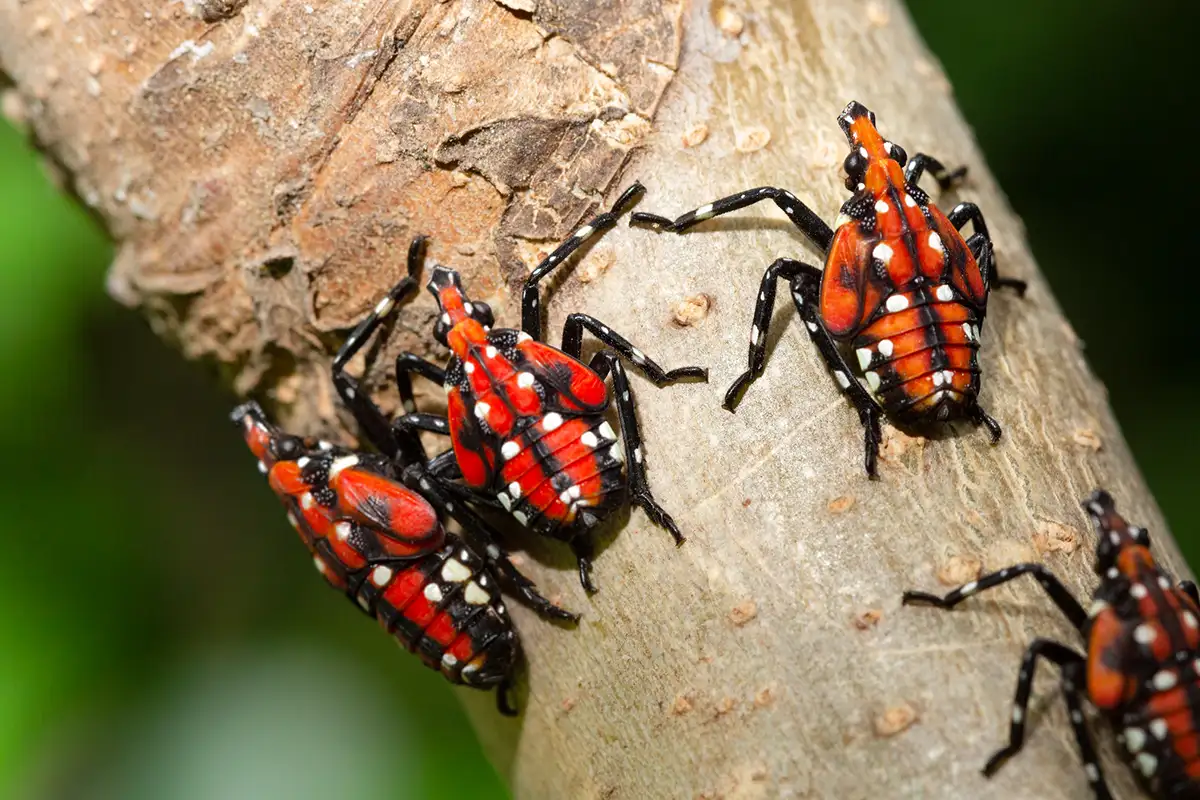
Have you noticed red, spotted bugs around your yard lately? They could be spotted lanternfly nymphs.
Earlier in the season, many people in NoVA spotted small, black-and-white bugs that were identified as young spotted lanternfly nymphs. Now, those invasive insects have begun to shift into the next stage of their life cycle. In this phase, they’re a little bigger, and have traded their black exteriors for vibrant red.
Lanternfly Identification
The invasive spotted lanternflies have four nymphal stages before they molt into the winged creature you may recognize. In the first three stages, they are black with white spots and can be anywhere from around the size of a tick to about the size of a black bean, said Jules Amanita, the spotted lanternfly field supervisor with the Virginia Department of Agriculture and Consumer Services.
In the final nymphal stage, they turn red with spots and are about the size of a stink bug. Those red nymphs have begun emerging in Northern Virginia, so you might start spotting them around your yard.
If you see a bug and you’re not sure if it’s a lanternfly or one of its lookalikes (at this stage, it may be mixed up with a boxelder bug or a milkweed bug), look at the angle at which it’s standing. While most bugs are parallel to the ground, lanternfly nymphs sit at about a 60-degree angle and walk at about a 30-degree angle.
What’s Next?
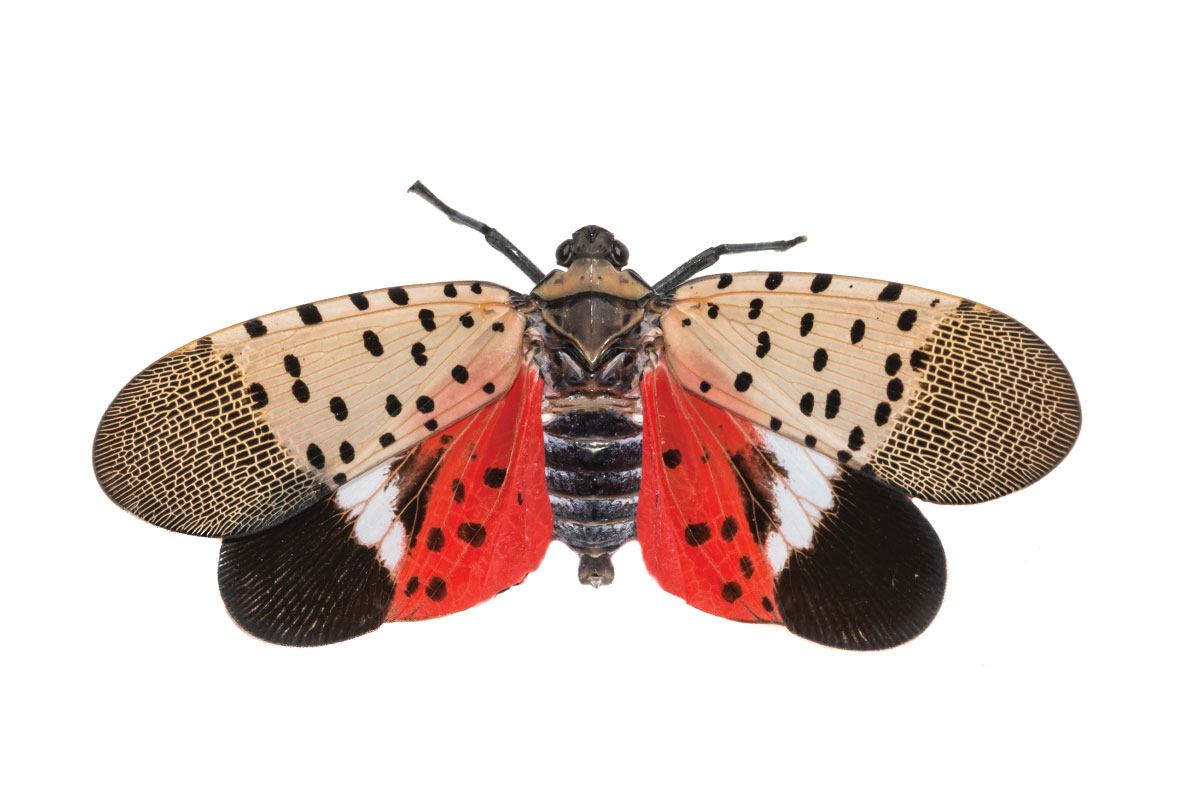
After this phase, they’ll start shifting into their adult form, the larger winged bug. The adults are roughly an inch long and a half-inch wide, with a yellow abdomen, the USDA says. They have brown forewings with black spots at the front and a speckled band at the rear. Their hind wings are scarlet with black spots at the front and white and black bars at the rear.
In NoVA, adult lanternflies could start appearing in July, guidance from Fairfax County says.
Lanternfly Management
Spotted lanternflies are not physically harmful to people or pets, but they are an environmental threat to agricultural crops and other plants.
To treat them, you can build your own circle trap to catch them. Another method is vacuuming them, either with a household vacuum or through a pest control service. That method is “somewhat effective for the older nymphs, more so for the younger nymphs, and it’s really not very effective for the adults, because the adults are much too fast,” Amanita says.
There are options for contact insecticides, which kill the bugs directly. Or, systemic insecticides treat plants, which then kill the bugs when they feed on an impacted plant. With any insecticides, it’s essential to read and adhere to all label instructions, including where to apply it, to avoid environmental harm.
Home remedies are discouraged; household products can cause significant environmental harm. Sticky traps are another no-no because they can unintentionally catch and kill other wildlife.
The VDACS website and the Virginia Cooperative Extension have additional resources for the identification and management of spotted lanternflies.
Feature image, USDA-ARS photo by Stephen Ausmus