May is National Bike Safety Month, and it’s up to everyone — drivers, bikers, even scooter riders and pedestrians — to share the road safely. Here are some tips to navigating the roads safely when bikes are in your vicinity.
Bike Safety Means Sharing the Road
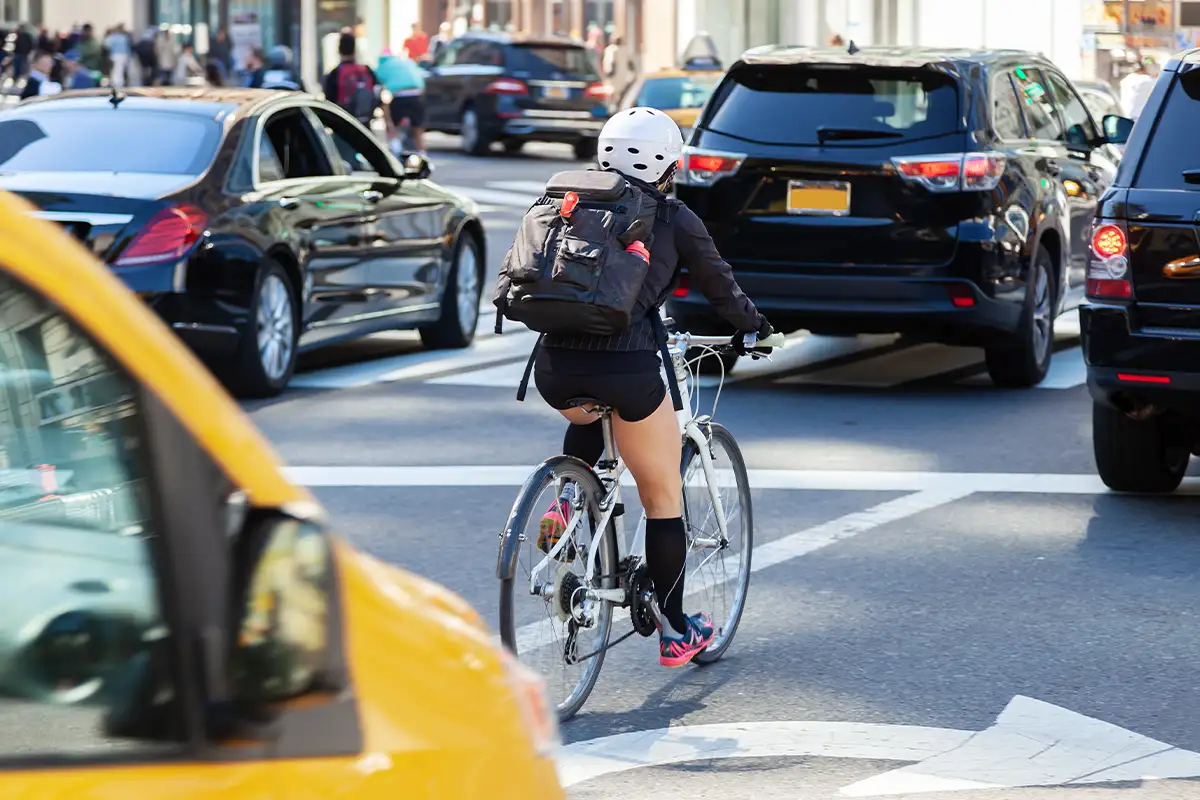
You may wonder why a cyclist in riding on the road as opposed to on the sidewalk or in a bike lane. Cyclists have the legal right to occupy the road just as much as cars do.
In Virginia, cyclists are supposed to ride on the right side of the road, in a bike lane when applicable. When there isn’t a bike lane, they ride in the road with cars. In fact, it’s not recommended for bikes to ride on the sidewalk because it creates an unsafe environment for pedestrians.
“Streets are for more than just cars — bicyclists, scooter users, folks have the right to take up space in the road,” says Sydney Sotelo, education director at the Washington Area Bicyclist Association.
There may even be cases where there is a bike lane and the cyclist is still in the road. This could be for several reasons: They could be getting ready to turn left, or there could be cars or other obstacles in the bike lane. Whatever the reason, they have the right to use the road.
“[Drivers] need to recognize that bicyclists have the right to drive or to ride in the road, so they should not be tailgating. They should not be passing people within any less than three feet. They certainly shouldn’t be antagonizing bicyclists or harassing them while they’re on the road,” Sotelo says.
Give Them Space
One of the most crucial things to know is when it’s safe to pass a cyclist on the road. The law dictates that drivers must leave at least three feet of space between their car and the biker. On multi-lane roads, drivers should wait until it’s safe to change lanes, then move over to give the cyclist space. If it’s single-lane traffic, slow down behind the bike, wait until nobody is coming the opposite direction, and pass when it’s safe to do so.
“The more space you can allow, the better. And if you’re questioning whether or not you are giving them three feet of space, then you’re probably too close,” Sotelo says.
The rule is the same for when there’s a large group of cyclists on the road. In these cases, it may be necessary to practice patience as you wait for an opening to safely pass.
Stay Aware
It’s also important to keep an eye out for cyclists when driving, even when you’re not expecting to see one.
“If a driver doesn’t see a bicyclist, the potential to cause serious harm, or, you know, even fatalities, is very, very significant, and unfortunately, there’s a very high rate of vehicular crashes of bicyclists in our region,” Sotelo says.
For drivers, that means slowing down and carefully checking your mirrors and blind spots before turning, changing lanes, or going through an intersection.
And for cyclists, that means driving predictably — such as using turn signals, riding on the right side of the road, and stopping at red lights — and wearing high-visibility clothing and lights.
Watch Your Doors
Another unexpected risk for cyclists is “dooring,” which is when a driver opens their door into the path of an oncoming biker. “This can cause a lot of injury, especially when it happens unexpectedly,” Sotelo says.
To prevent it, you can do what Sotelo calls the “DC reach,” by opening the car door with your right hand instead of your left when you’re on the drivers’ side. This will cause your body to twist so that you look behind yourself and in the side mirror, making it more likely that you’ll spot an incoming cyclist than if you were looking straight ahead.
For cyclists, Sotelo says that if a bike lane is next to a parked line of traffic, it’s safest to ride further to the left to keep away from doors.
To learn more about bike safety, WABA has online resources and also hosts classes on bike basics, including safe cycling practices.
Feature image, stock.adobe.com