Lagom means “just the right amount.” It’s the hottest Swedish design concept, and it’s driving the final nail into the cozy, cocooned, sheepskin-lined hygge coffin we’ve been calling home.
However simple the definition, applying a concept to a space can definitely be a challenge. Michael Cook, of Northern Virginia–based architectural and interiors company Cook Architecture, is an expert on Scandinavian design and concept. The firm has designed midcentury-modern homes in the neighborhoods of Hollin Hills in Alexandria and Holmes Run Acres in Falls Church, among others. Here, Cook’s advice for doing lagom right:
What is lagom?
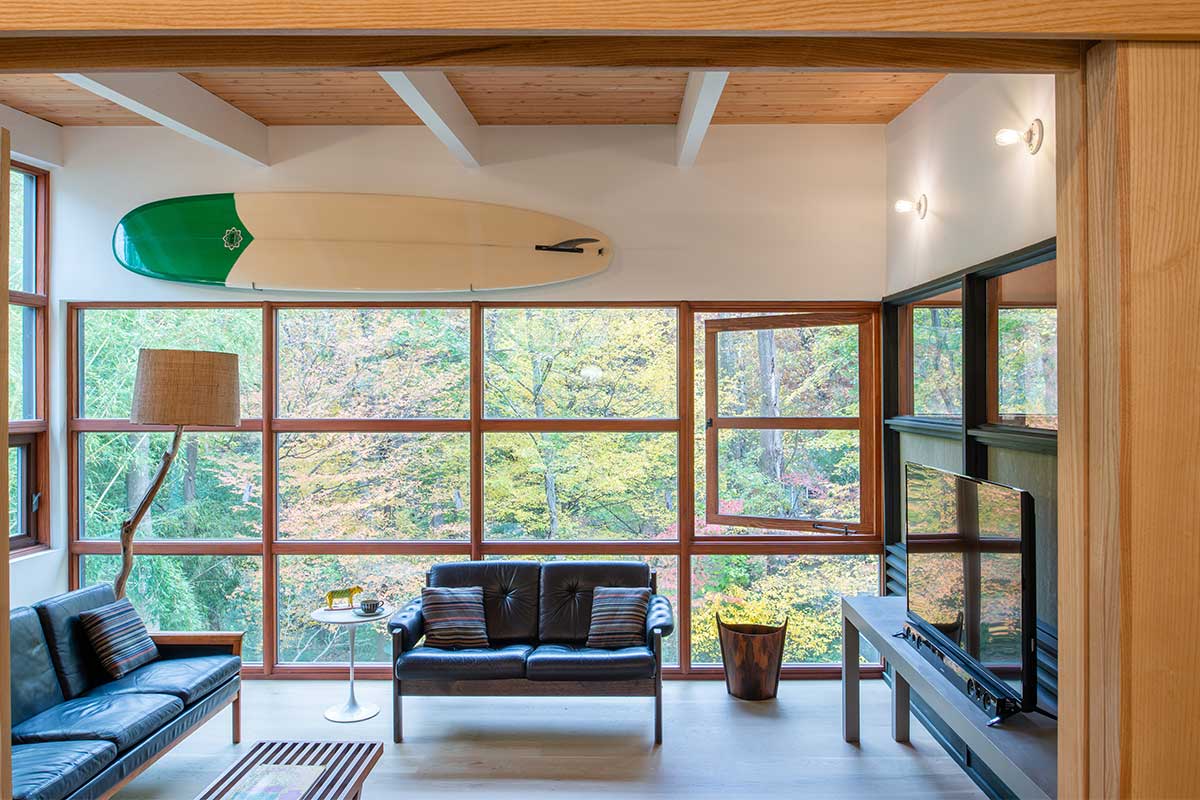
A home that has lagom (pronounced LAH-gum) will “connect elements of nature to elements of the house, in the spirit of organic design,” says Cook. Metaphorically speaking, it’s less about where a window is placed and “more about catching the view of a fantastic magnolia tree. That’s where we want our focus.”
Think function over form.
Cook recommends thinking in terms of how a piece of furniture works, how a certain fabricfeels, and how an object fills a specific space. If you focus too much on what each thing looks like, you’ll accidentally create a themed room in your own home, which is the opposite of lagom. “Lagom is more about quality and long-lasting design, and less about trends,” he says.
Make the most of the light you have.
Start with the natural light in a room, and work with colors that will reflect it into the space rather than absorb it. White or pale gray walls and woods like ash or oak bounce the light back into the rest of the room, unlike mahogany and other dark woods. Cook also recommends the strategic placement of light fixtures, rather than grid or central lighting. “Position adjustable lights to illuminate a piece of artwork and reflect [the light] back off the artwork into the space to illuminate other things,” he says.
Create space with purpose.
Organization means much more than a trip to The Container Store—it creates color and interest in a specific space, says Cook. That becomes a challenge when a space is wasted because it’s being used to conceal a massive pile of Tupperware lids. “You don’t need 50 different types of the same thing,” says Cook. “Limit, and focus on quality, and you can actually get away with spending less.” And when you have designated spaces to display things, it’s wise to invest in nice things that are functional, which you can enjoy and use to reflect who you are.
Forget perfectionism.
A by-the-numbers approach to arranging each photo in a picture wall or each piece of furniture in a room often results in disappointment. “If you’re stuck in a symmetrical, organizational mode, you’re predicting what you’re going to see when the project is done,” says Cook. Instead, he advises, display your personality. “If people are into collecting California pottery, family photographs, or interesting objects, let those things and the way they’re arranged describe your personality and what’s important to you,” he says.
And a word on cozy kitchens…
Cook has definite thoughts about hygge kitchens. “When you apply ‘cozy’ to kitchens, you get upper cabinets,” he says. “They’re constantly in your face. Upper cabinets are deeper than lower ones, and you have this box right at eye level, crowding your workspace. You need to not cramp your space, but enjoy it.”
Instead of cabinets, Cook would prefer to see more nooks. “We love to see a little built-in space that’s centered on one single function, like a shoe bench with hat storage in an area that used to just collect shoes,” he says. “Design based on function—that’s what lagom is.”
Feature image by John Cole
This story originally ran in our September issue. For more stories like this, subscribe to our monthly magazine.