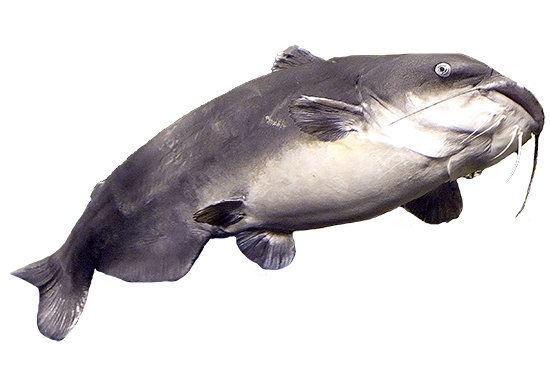
Rocky Rice couldn’t help but notice the growing number of blue catfish eating their way through the Potomac River he’s fished since boyhood. He first started seeing a few small catfish in his crab pots and then noticed the bigger ones gaining their run of the river, including the 70-pounder he once netted.
Crabbing and catching rockfish used to account for almost all of Rice’s income until this whiskered heavyweight came to town. About half of his catches are now catfish, sold to the growing number of markets aimed at eating them to oblivion.
“I’m not a scientist, but I think they’re here to stay,” Rice says. “I don’t think there is such a thing as ever getting rid of them.”
The transplant species made its way from the river basins of Ohio, Missouri and Mississippi to the waters of Virginia in the 1970s, when the state’s Department of Game and Inland Fisheries decided local fishers needed something new to catch and released them here.
As the story goes with nonnative species that have no natural predators, the catfish’s numbers have been ballooning ever since.
These Ictalurus furcatus, now settled into Virginia’s waters, can weigh up to 100 pounds, live 20 years and eat just about any and everything in its path, from insects and worms to the babies of those beloved and beleaguered blue crabs.
Their voraciousness is bad news for the ecosystems they’re crashing along the way, and the only ones who eat them are humans. Therein lies the bright side.
For Rice, blue catfish’s sudden overabundance in the Potomac River became an opportunity.
“The demand was there, and the supply was there, so why not try to fill it?” he says of his decision three years ago to start catching catfish for commercial markets.
He started spotting the blue cats in the Potomac more than a decade ago, but recent efforts to market the intruder as a good-for-the-bay buy have created an irresistible market for fishers like him. The best way to beat back their growing numbers, it turns out, is to fish them and to get more people eating them.
The story of such a win-win protein also proved alluring to local restaurateurs, who can be stymied by the changing tides of sustainable seafood sourcing.
Bart Farrell, director of food and beverage for Clyde’s Restaurant Group, says it was that story, first told by his seafood supplier Congressional Seafood Co., that got blue catfish onto their menus in 2014. Still, he was surprised at how well it sold to an increasingly informed audience of eaters.
“The backstory of it being an invasive species in the Chesapeake Bay really resonated not only with our staff but also our customers,” he says. “The fact that the product is delicious doesn’t hurt.”
After starring in a pair of specials last year—cornmeal-crusted with field peas, baby kale and a smoked ham hock broth and in a creole-flavored po’boy—the white fish’s flaky, malleable flavor earned a permanent spot on Clyde’s menus.
When those specials ran in April 2015, Farrell says the restaurants sold 9,500 entrees at about $15 apiece and 4,100 sandwiches at $13 each that month. “For catfish, that’s a pretty impressive number,” he says.
Farrell says he’d like to see the fish on more of his competitors’ menus, too, where the “boring” seafood options of salmon, shrimp and tuna still reign supreme.
For executive chef Adam Stein, sourcing a seafood option with strong Northern Virginia ties—not only does it come from local rivers but eating it also improves them—made sense when opening Red’s Table in Reston last fall.
“Rather than bring in catfish from somewhere else, we decided to use the local blue catfish to help out,” Stein says.
He fried it in a cornmeal breading and paired it with stone-ground grits and Old Bay jus. Though the preparation is decidedly Southern, the local fish’s flavor comes across as cleaner, without the muddy undertones typically associated with catfish.
That’s in part because, unlike their Southern counterparts, the apex predators eat at the top of the food chain here rather than digging through the mud for their next meal.
Home cooks recognize the potential of this latest catfish offering as well. Wegmans Food Markets Inc. started selling blue catfish fillets at area stores in March 2015 at distributor JJ McDonnell’s suggestion.
Wegmans’ seafood category merchant Mark Fromm says the wild blue catfish sold better than the other farmed catfish species and, at $7.99 a pound, began replacing them at stores. (Other wild white fish can reach $20 per pound.)
“To be able to offer this wild catfish that’s great tasting at the same retail—and then the added benefit of getting rid of an invasive species, or doing what we can to help—it just made sense all around,” Fromm says. Wegmans moved 23,000 pounds of blue catfish in 2015.
But consumers have yet to plumb the depths of this fish’s population, which now makes up three-quarters of the biomass in one Virginia river.
Looks like it will be on the menu for a while.