Archi Marrapu’s life changed last July when her grandfather suffered a series of strokes.
“It was really terrifying, but those small pills kept him going,” says Marrapu.
Overnight, her grandfather became dependent on a small pharmacy of medications, with pills of all shapes and sizes, colors, and timeframes. Some had to be taken at very specific times.
Marrapu, a 17-year-old junior at Thomas Jefferson High School for Science and Technology, began to worry her grandfather might forget to take one of his medications. She already needed to remind her father to take his diabetes medication every morning, but if her grandfather missed even a single dose of his medicine, she said it could be fatal.
Marrapu decided to look for a solution to help her family and others. Every year, it’s estimated that nearly 125,000 people in the U.S. die from medication nonadherence, according to the National Institutes of Health.
That inspired the ambitious teen to design a piece of biomedical technology that would help people track their medications.
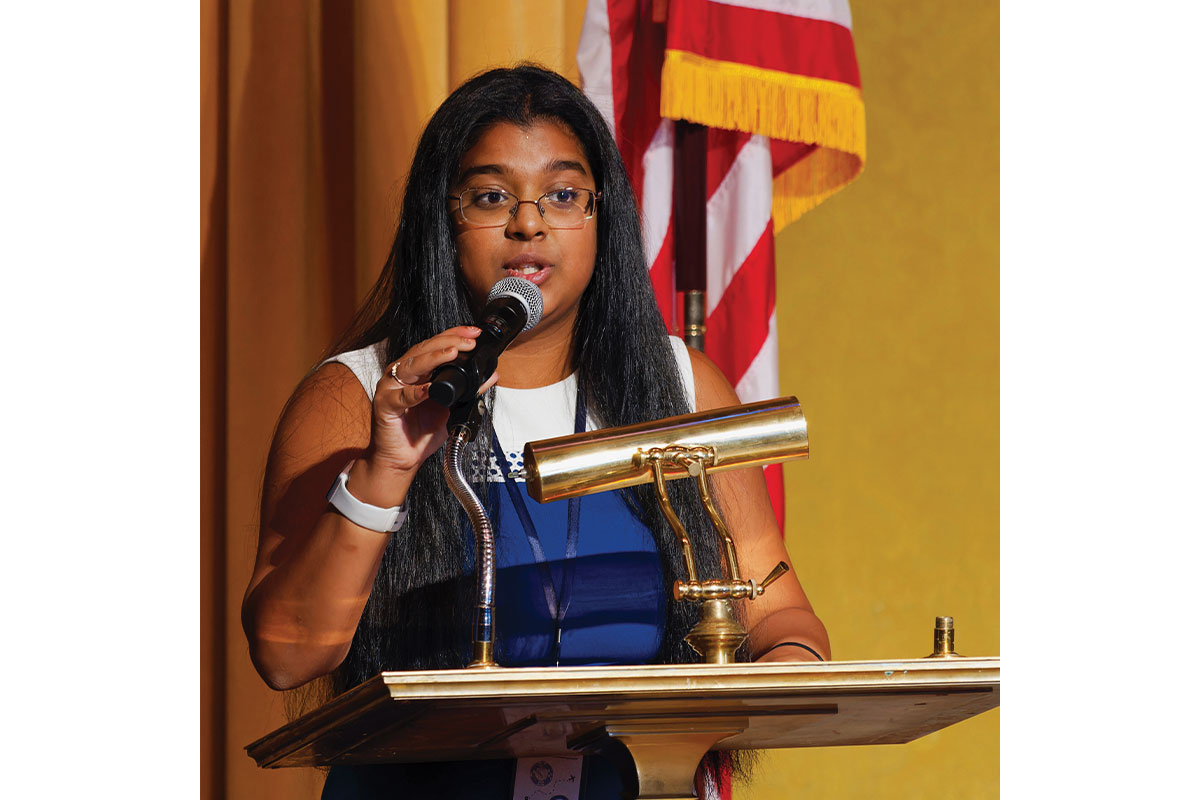
Project Pill Tracker is a 3D-printed medication bottle equipped with ultrasonic sensors that track when (or if) a patient has taken medication. Marrapu also designed an application that pairs with the device and features an artificial intelligence engine, which she coded herself, that can answer patient questions, suggest methods for relieving side effects, and even notify a doctor if the patient abuses a drug.
Last year, she won the Technical Excellence Award from the Institute of Electrical and Electronics Engineers for the invention, and she’s working to raise seed capital to bring it to market.
For Marrapu, taking common problems and manufacturing uncommon solutions is something for which she has a passion. On TEDx, she’s talked about transforming health care outcomes using AI. Using AI, she’s also designed an application that can scan melanoma images. It could help doctors diagnose the disease earlier. It’s these types of innovations that Marrapu hopes will improve the public’s perception of AI.
Rather than something to fear, Marrapu sees AI as capable of revolutionizing how we live, work, and administer health care. “I don’t think AI is going to be taking jobs, because the brain power all comes from humans. I think it’s more about cultivating today’s youth to develop the skills to cultivate AI,” says Marrapu.
Changing the world, in Marrapu’s eyes, is not contingent on a person’s age or experience: “We’re all humans trying to achieve the greater good, trying to evolve our world. That’s not something that happens overnight or by one person.”
Feature image courtesy Archi Marrapu
This story originally ran in our January issue. For more stories like this, subscribe to Northern Virginia Magazine.