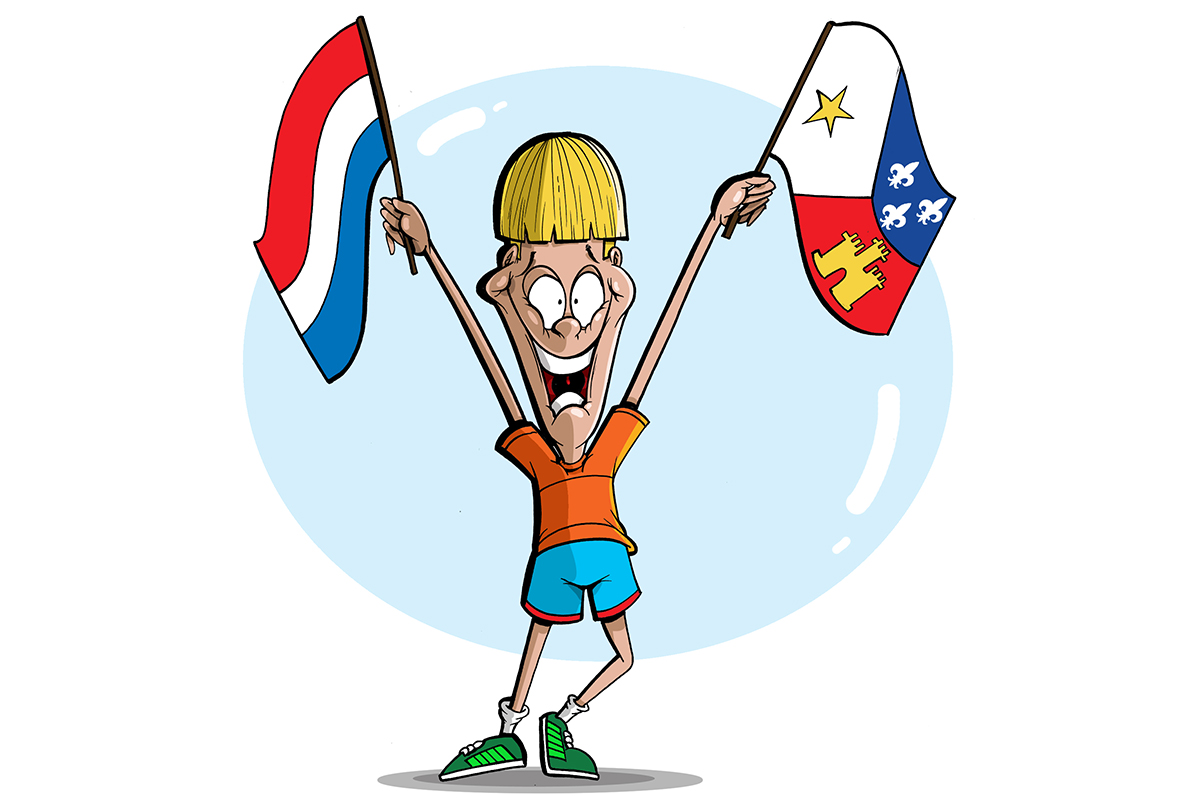
Every so often, usually around holidays, the subject of our family’s heritage arises. Our kids are a good, old-fashioned American blend. Mutts. There’s a lot of Dutch, on my side. A lot of Cajun, on my husband’s. There’s Hungarian Transylvanian; there’s a little German and Italian. There’s other stuff, but it starts to get complicated, so for clarity’s sake we normally just boil it down to the first two.
That’s when we, my husband and I, are discussing it between ourselves. The kids are still too young to understand the concept of heritage, much less the strains and nuances woven into their own.
What they know is sugar, and when it’s present in their diet. Sugar is why Dutch rules, Cajuns drool. It is, I thought, why we will raise our children to be Dutch.
On that last point, I was brimming with confidence.
Between Dutch and Cajun, there’s not a lot of shared territory. We both want representation in our kids’ notions of identity, and quietly—sometimes not so quietly—vie for it. Spoiler alert: I’m winning. The Dutch have stroopwafels and there is no beating the stroopwafel.
But it’s oversimple to reduce the Dutch to their stroopwafels. After all, the Dutch have canals, too. They have ice skating and bicycles. We in the States also have these things, but our having them’s part of it: We recognize ourselves in the Dutch, and for that, we love them. The Dutch are foreign, but not too foreign. Yes, we have fish here, and we eat fish in our diets. We do not, as a rule, gobble them raw with their tails on, after we’ve bought them from a shack on a bridge.
I like being Dutch, but I’m not, of course, Dutch. I identify as American. I live in America, raise my family in America. Sometimes I even do it on purpose. So if I don’t really need them to be through-and-through Dutch, is what I want for my kids to be me, to see the world the way I do, to understand and navigate it the same way I do?
No. What I want is for them to bite into a windmill cookie and think to themselves, “Good cookie!” Point, Mom.
But also: I want the funny poems Dutch people write for each other at Christmastime. I want the Dutch birthday song, sang loudly at birthdays. I want the wooden clogs in the dress-up box, the Dutch nursery rhyme framed and hanging in the nursery.
Every night before bed, I tell my kids a story about someone in our family. My dad did it for me and my brother when we were kids, and then, for whatever reason, we started calling them face stories.
I was gaga for face stories. I begged my dad for them nightly, fell asleep thinking about them and could never understand why my childhood never seemed as eventful as my dad’s. Why weren’t my toes ever subjected to frostbite? Why had I never been stuck in a barbed wire fence?
Fast forward to recently, when my brother, who was visiting, overheard me putting the kids to bed. What were my face stories, he wanted to know. I gave him a blank look. “Face stories are face stories,” I said, the reality dawning on me as the words left my lips. I just tell them the same ones Dad told us.
As might be obvious to anyone reading this, at some point I was supposed to be coming up with my own face stories. I’m supposed to be passing on some of my own little chronicles, and the kids’, not all ones about my dad and our Dutch great-aunts.
The family stories, its traditions, are an evolution. All of this is in flux, and all of it is supposed to be. For instance, we don’t eat raw herring in America. There’s a reason for that. It might be a good reason.
Shame-faced, I slunk to my husband. What was it, I asked him, that he wanted our kids to learn about being Cajun? Give me your top two, I told him, and we’ll take it from there.
In order, he said:Any gathering, because it’s bound to have fish caught fresh that day; and, canals running the length of every house behind its sidewalk.
There might, I conceded, be some shared territory.
Although, spoiler alert: The Dutch, like, invented the canal.
Susan Anspach is a product of Northern Virginia’s schools, swim teams and cultural mores. She eats more stroopwafels than a
person probably should.
Want more family content? Subscribe to our weekly newsletter.