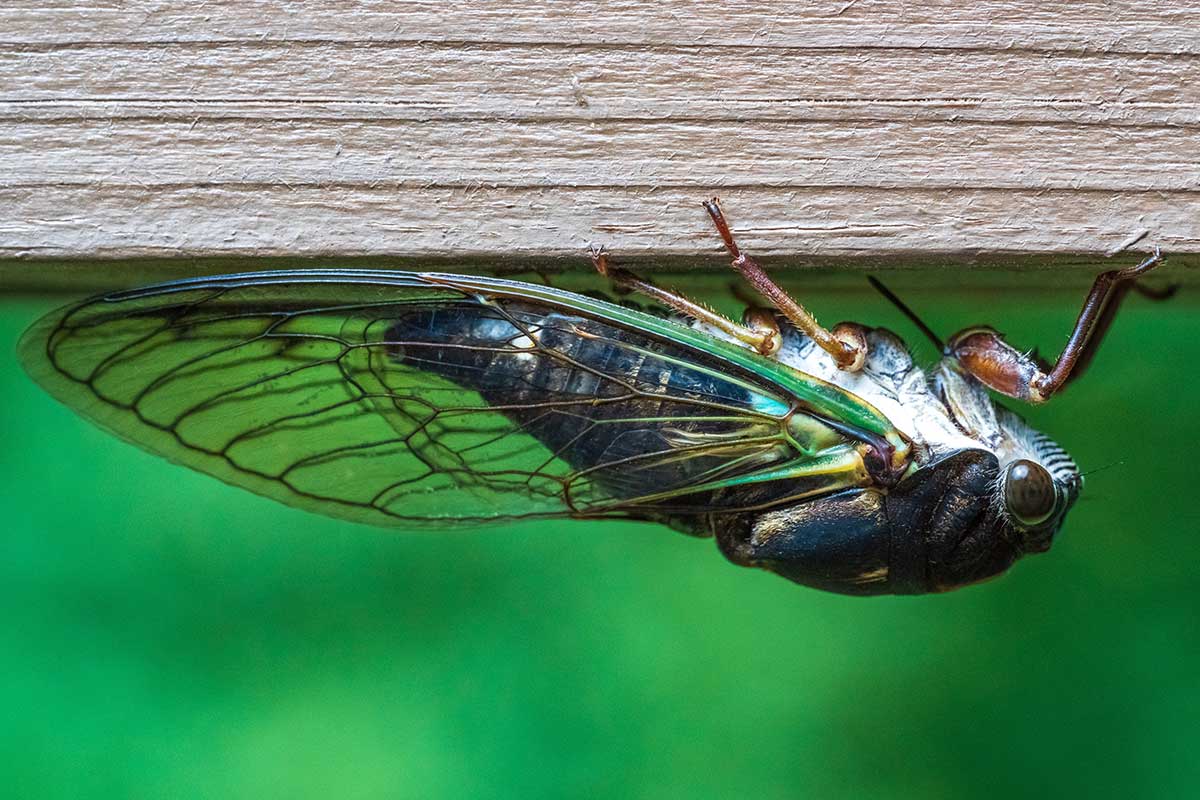
In early May, Brood X—one of 15 periodical cicada broods found in the United States–will emerge from the ground by the billions, shed their thin shells, and feverishly work toward the life goal they’ve been waiting 17 years to accomplish: mate, lay eggs, die, and start the cycle all over again. And the DMV will be the epicenter for this fascinating event.
Whether you’re an entomophobe anticipating the arrival of these orange-eyed-and-winged insects with dread, a bug nerd giddy with excitement, or just a local resident mildly curious about these creatures who will share our environs for a short time, you may be wondering what to expect when it’s Cicada Time. We asked Ciro Monaco Jr., an entomologist and senior environment analyst in the mosquito-and-forest-pest-management branch of the Prince William County Department of Public Works, and Sue Dickson, assistant professor at the Northern Virginia Community College Horticulture Program on the Loudoun Campus, for their thoughts:
There are cicadas every year. What makes Brood X different?
With more than 3,000 species of cicadas worldwide and multiple broods in the U.S. that emerge at different times, the term “annual cicada” is a misnomer, Monaco says. “What makes periodical cicadas interesting is that they have a very long nymph stage, where they spend many years underground,” generally either every 13 or 17 years. To put things in perspective, the last time Brood X made its appearance was 2004, the same year Howard Dean ruined his Presidential chances with that enthusiastic yet odd scream at the Iowa Democratic Caucus, Janet Jackson suffered a wardrobe malfunction at the Super Bowl halftime show, and the last episode of Friends aired.
When will they start emerging from the earth, and what can we expect to see and hear?
We’ll start seeing them in early May, with their number peaking late May into early June, Monaco says. We’ll know they’ve arrived when we hear the loud “singing” noise males use to attract their (silent) mates, which will go on during their fleeting adult life span–just four to six weeks. “Other than being a bit of a noise nuisance to some, there is no need to worry, as cicadas do not bite, sting, or spread disease,” says Monaco. Their mating season will wrap up by late June or early July, when they will disappear as quickly as they arrived.
Will they damage trees, landscaping, or my lawn?
After mating, the female will find a pencil-sized twig, extend her razor-sharp ovipositor, and lay her eggs into the resulting indentation, causing the twig to die and the leaves to turn brown and hang onto the tree; this can be a serious problem for vineyards and orchards with young or newly planted vines, as well as ornamental trees such as paperbark maples, oaks, maples, and ornamental pears and cherries, according to Dickson. On the flip side, she adds, since the tiny nymphs eventually drop to the ground, tunnel into the soil, and feed on tree roots for 17 years, the emerging cicadas can actually be beneficial to our lawns. “Virginia Tech entomologists tell us that there can be as many as 1.5 million insects per acre, [and] when the time and temperature is right, the nymphs burrow their way up to the surface,” she says. “With that many burrowing holes, it’s just like getting your lawn aerated without burning fossil fuels or spending a penny.”
At what time of the day will they be most noticeable?
Some years a large percentage of the brood emerges during one evening, Dickson says, so it’s possible that we will wake up one May morning to a big surprise. But, she adds, “insects are cold-blooded, so the height of the adult activity will occur during the hottest part of the day: in the mid-afternoon.”
How can I keep them out of my car and home?
Considering cicadas only have a few short weeks to perfect this flying thing, it shouldn’t come as a surprise that they are clumsy fliers with a tendency to crash into objects (and people). So keeping your car windows closed in parking lots and driveways and making sure screens are secure is a smart idea, Monaco says. But Dickson points out that humans don’t interest them, so they won’t bite or sting–maybe just startle. “They are only focused on finding a mate and sex.”
Are cicadas safe for pets (and people!) to eat?
At the onset of their arrival, people may notice animals–including Fido and Fluffy–gleefully devouring the newfound insects like they were at an all-you-can-eat buffet. While they aren’t poisonous, Monaco doesn’t recommend letting pets gorge on them since the hard exoskeletons can be difficult to digest, causing upset stomachs. If you are a fan of the chapuline (grasshopper) tacos at Oyamel, you might be interested in looking up recipes for the low-fat, high-protein snack, which can be eaten—dare we say enjoyed?–deep-fried, stir-fried, or skewered and grilled. “My co-workers and I have discussed a possible cookout this summer,” Monaco says.
For more stories like this, subscribe to our weekly newsletters.