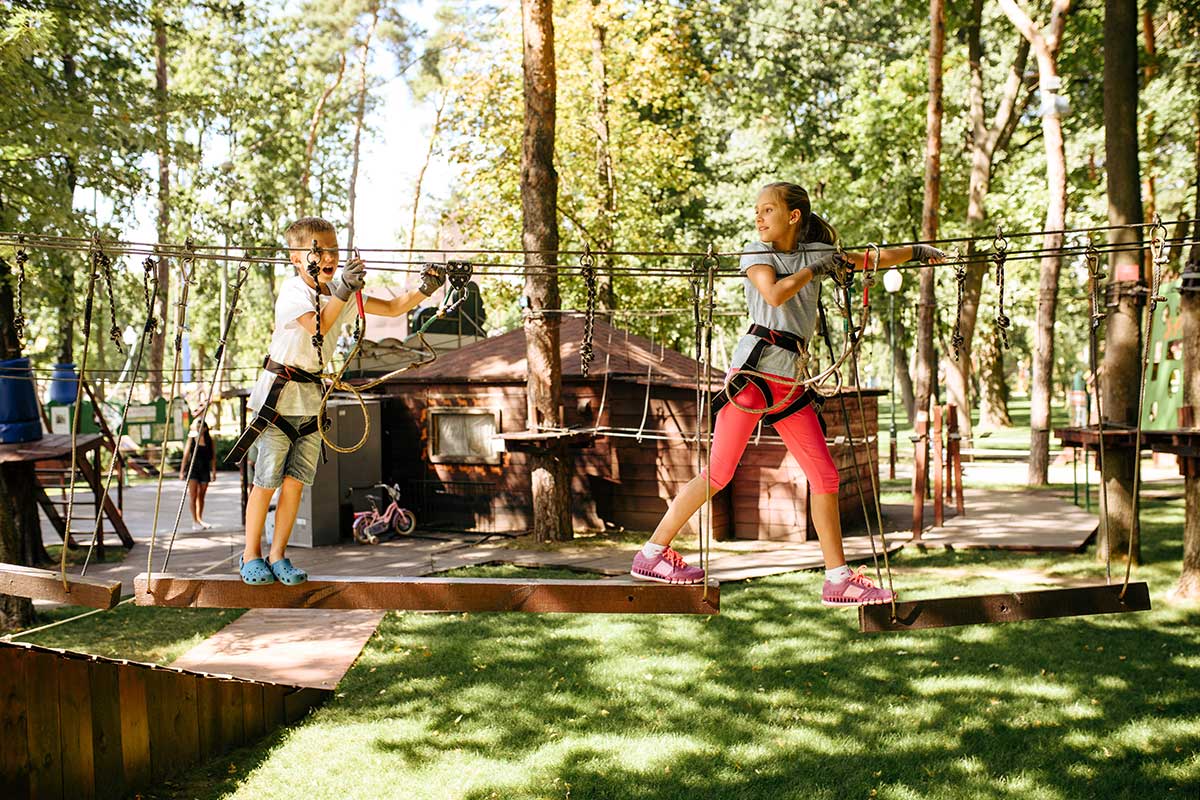
If you’ve ever been to camp—whether sleepaway or during the day—you likely have fond memories of those halcyon summer days of your youth. Spending time with fellow campers, learning life lessons and feeling the sunshine on your shoulders, there’s just something magical about the memories of summer camp. After summer 2020—when most kids had to experience summer camp through a computer screen, if at all—we’re ready to get back to the lazy, hazy days of in-person summer camps. Read on for fond memories of camp from three local writers.
News I Could Use
Stop the presses! Journalism camp taught me as much about independence as it did about writing.
By Aimee Agresti
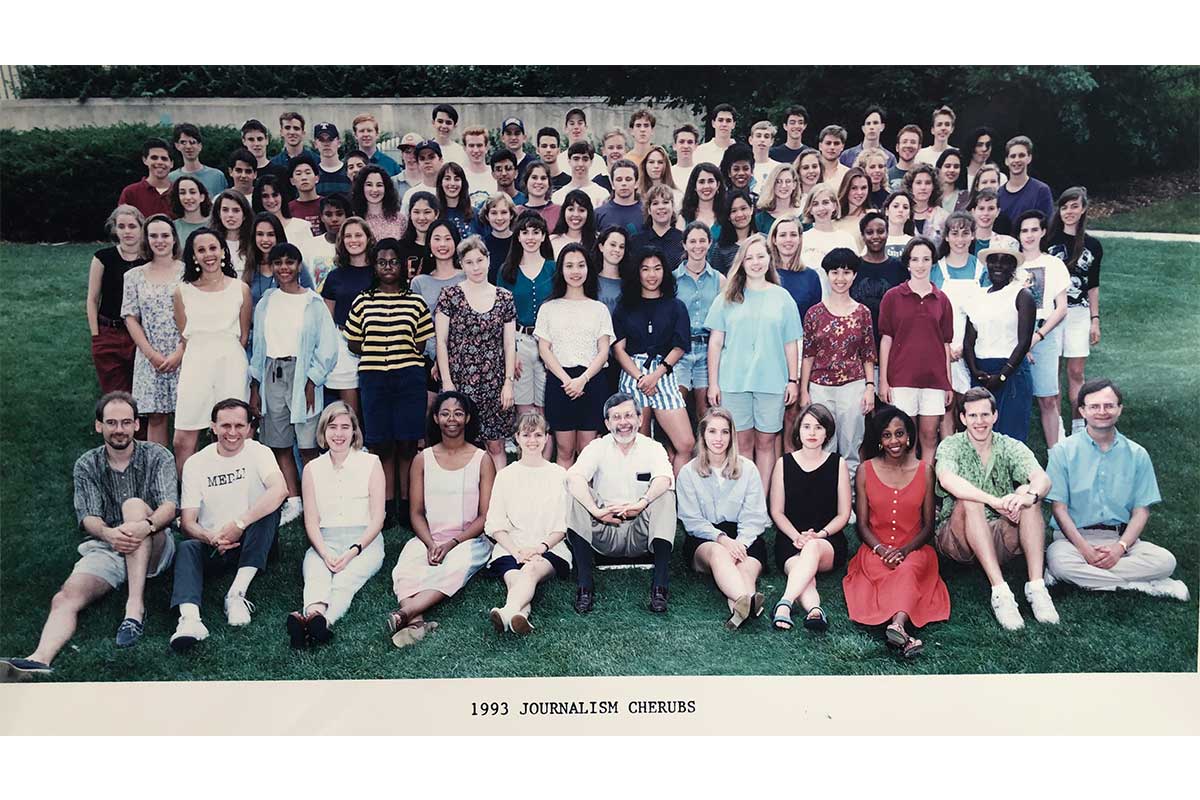
Dateline: Summer of ’93, Evanston, Illinois. It was the first day of what I called “journalism bootcamp” at Northwestern University as more than 50 of us rising seniors from across the country gathered in the auditorium. “Raise your hand if you’re the editor of your high school newspaper,” the assistant dean of the Medill School of Journalism greeted us. I proudly raised mine—I’d be taking over Sherwood High’s The Warrior in my native Maryland that fall. I glanced around: Every. Hand. Went. Up.
They called it the Cherub Program, and indeed I felt like a baby angel moving into the dorm for five weeks. I was 16 but had never been away from home except for the mandatory weeklong torture known as “Outdoor Education” in sixth grade. This was different; I had dreamed of coming here and doing well enough that I might have a shot at returning as an undergrad and eventually becoming a writer. (I was one of those intense types who always had a Plan.)
It wouldn’t be easy: I was as nervous about the rigors of 24/7 writing, reporting and editing as I was about basic survival skills. I had to do my own laundry?! And eat cafeteria food?!
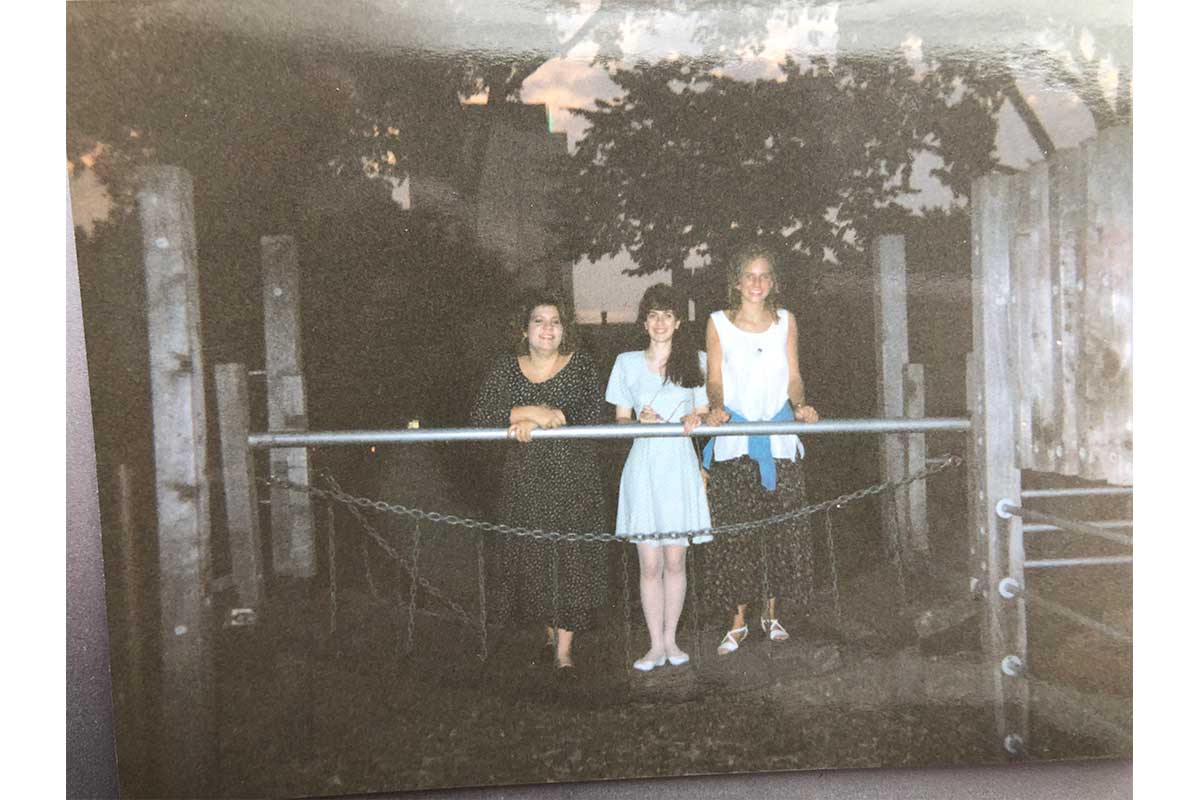
To help allay my fears, there were new friends, good ones. My suitemates were talented, hilarious and so warm that even this shy girl felt instantly welcomed. My brilliant roommate was like a sister who loved the same books, shared my concerns about how to tame our hair in the tropical rainforest of our un-air-conditioned room and comforted me when I choked on the very first writing assignment.
Our schedule dubbed it, ominously, “The All-Day Story.” It turned out to be a breaking news workshop. Our instructors played parts staging a full day of faux press conferences about a fictional event that we reported out, updating our stories every 20 minutes.
It was a marathon and a sprint. This was not how I rolled. I was used to writing in my bedroom with music playing and enough time (days!) to craft something perfect before showing it to anyone.
As everyone tapped away on their word processors (yes, word processors), I spent 20 minutes writing and rewriting my first sentence, struggling to make it just right. When the instructors called time and we filed our stories in a basket on their desks, my article was exactly one sentence long—and it was not a great sentence. It didn’t get much better as the day went on. I never ended up writing anything longer than a single double-spaced page.
We had been divided into small groups with an instructor acting as a mentor to us. Mine was a journalism rock star: a recent alum who had already worked in newsrooms and written and edited for national newspapers and magazines; he was living the dream. What would he say at our weekly one-on-one meeting? Would he tell me to pack my bags? Alert my parents to start the 11-hour drive to get me?
To my great shock, he was encouraging. Paging through my (abysmal) All-Day Stories, he kindly told me it was a good start and praised me for writing more with each consecutive version of the story. He said next time to remember to always keep going. Just keep going: The simplest advice, but it gave me hope.
That talk freed me to enjoy the process of learning without shooting for perfection. From then on, the summer was an exhilarating blur of work—reporting on an epic July Fourth parade, profiling fellow Cherubs, writing TV and radio pieces—and plenty of play. There were journalism-themed movie nights (Citizen Kane! Broadcast News!), baseball games, trips to the Art Institute and the theater and loads of Chicago-style pizza, plus so many unrequited crushes on so many Cherub boys from so many different states. It was like a mini version of college in five weeks.

I was desperate to come back to this school. Our generous mentor offered to read and give feedback on our college application essays, and I took him up on it. Northwestern was the only place I applied—I got in. My Cherub roommate became my freshman roommate. (We’re still great pals and even worked together at Us Weekly, where every day felt like an “All-Day Story” about celebrities.) And how many students are lucky enough to already know some of their professors the first day of college? As for my mentor, by then he had become the advice columnist for Playboy, and if ever you need a cool conversation-starter at a college party, you can’t go wrong with: “My admissions essay was edited by ‘The Playboy Advisor.’”
That summer taught me so much: that I could strike out on my own; that if I worked hard enough and kept going, I would get where I needed to; and that I would always love the Cubs and deep-dish pizza.
Aimee Agresti is a DMV-based journalist and author of five novels, including The Summer Set. She still sometimes freaks out about deadlines.
Crash and Burn
In the summer of 1979, Skylab crashed back to Earth—and my day camp experience wasn’t much better.
By Laura Hazan
“Skylab is falling! Skylab is falling!” the camp director shouted as he tossed candy from a helicopter. In July 1979, after six years in orbit, the NASA-designed space station was falling back to Earth, an unexpected return fraught with the unknown. That summer, after seven years in elementary school, I prepared to change orbit into junior high school, another huge transition fraught with the unknown. It seemed Skylab and I were on the same trajectory: no clarity where we’d land after years of the same orbit.
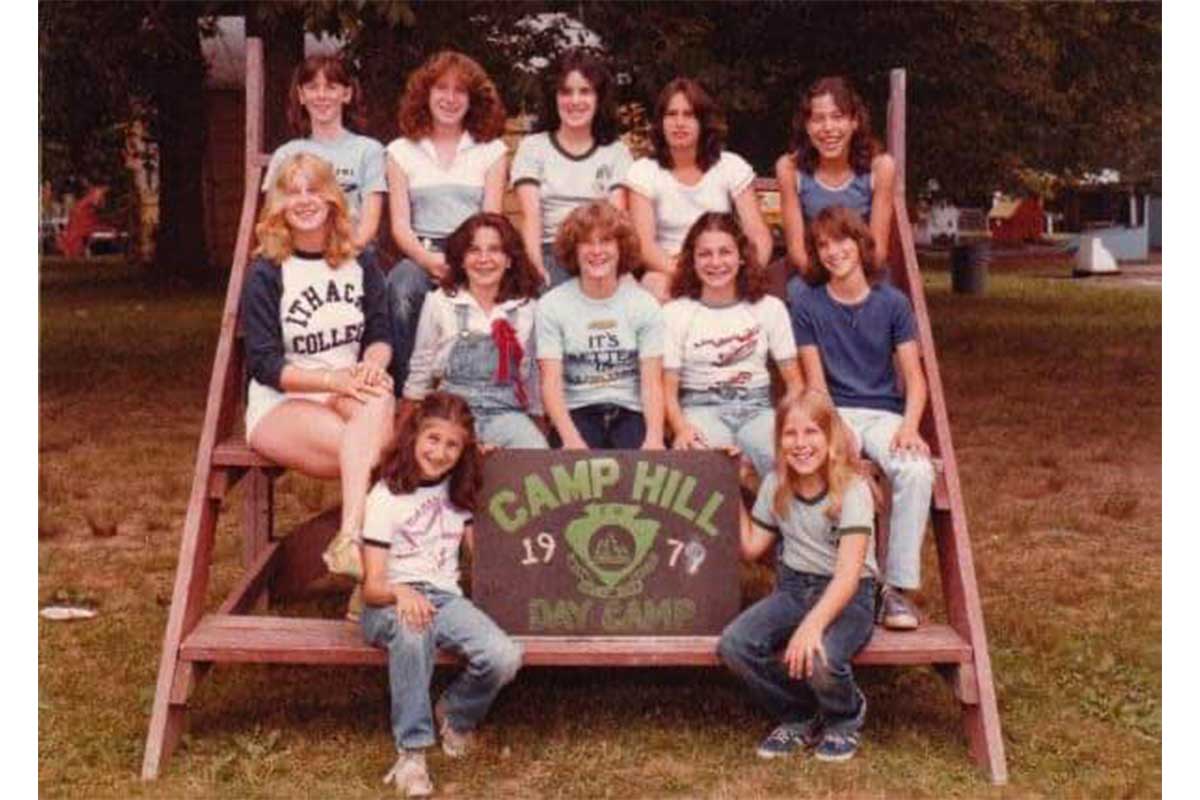
Memories of Camp Hill and Skylab recently rushed back to me while visiting the National Air and Space Museum Stephen F. Udvar-Hazy Center in Chantilly. One exhibit addressed NASA’s first space station and its return. Even though NASA knew Skylab had a limited lifespan, they didn’t build any mechanisms to bring it back. I remember reading it would most likely land in an ocean, but they weren’t certain. Months of speculation about Skylab’s crash point led to silliness like Skylab landing parties, reward offers for pieces of the space station and helicopter candy drops.
I wasn’t really a camp kind of kid. I typically spent my summers lazing around the house and maybe swimming at the neighbor’s pool. So how did I end up sprinkled with candy from “Skylab”? My best friend thought it would be fun if I spent part of my summer with her at Camp Hill. She’d attended for years and confidently determined that if I went with her, I’d meet other kids who’d be going to our junior high. Sounded like a solid plan … until I didn’t like it and didn’t fit in.
None of this was the fault of Camp Hill, a classic day camp in the suburbs of New York City with swimming, arts, crafts, sports and all kinds of activities to keep summer boredom at arm’s length. I wasn’t completely miserable. I did yoga for the first time and loved it. I enjoyed making friendship bracelets and lanyards with plastic lacing. On a rainy day, we even went to see the best camp movie, Meatballs with Bill Murray. But socially, I was a dud; I didn’t even get off the launchpad.
The other girls all knew each other after many summers together, and they seemed so trendy to 12-year-old me. They had enviable haircuts with wings and cute bathing suits, and they knew how to talk to boys. Meanwhile, I was certain I looked like a nerd in my camp-issued shorts and T-shirt with a mouth full of braces. They intimidated me. Irritated, my best friend couldn’t understand why I didn’t even try to befriend them. It just about destroyed our friendship.
Of course, at 12, this was the end of the world! On top of that, a giant piece of space junk hurtled toward Earth! This could easily have been a plot for an ABC Afterschool Special.
As I look back, I don’t know why I didn’t try to make friends—fear of rejection most likely. Twelve-year-olds are irrational, awkward and filled with hormones. No doubt all of that also played a role. There was a boy factor, too; some of the other campers were simply more mature than I and already interested in the junior high version of romance.
As predicted, Skylab crashed safely into the Indian Ocean, leaving a debris field in sparsely populated Western Australia. A motivated young Australian got on a plane with a chunk of the space station he found near his house and flew to San Francisco. He collected the $10,000 reward offered by a television station there.
A few weeks later, I finished my stint at day camp, and while it wasn’t for me, I didn’t crash and burn like Skylab. My reward was learning my social limits and that I wasn’t (yet) boy crazy. The only debris field was the candy scattered across Camp Hill.
Laura Hazan has been published in Natural Bridge, the Strongly Worded Women anthology and was a writer-in-residence for the Highlandtown Arts District in Baltimore. She wishes she could spend six weeks at summer camp. As an adult, it sounds like the perfect escape.
Circle Dance
When the pandemic shuttered my daughter’s sleepaway camp, her “camp friends” still made the summer a memorable one.
By Beth Kanter
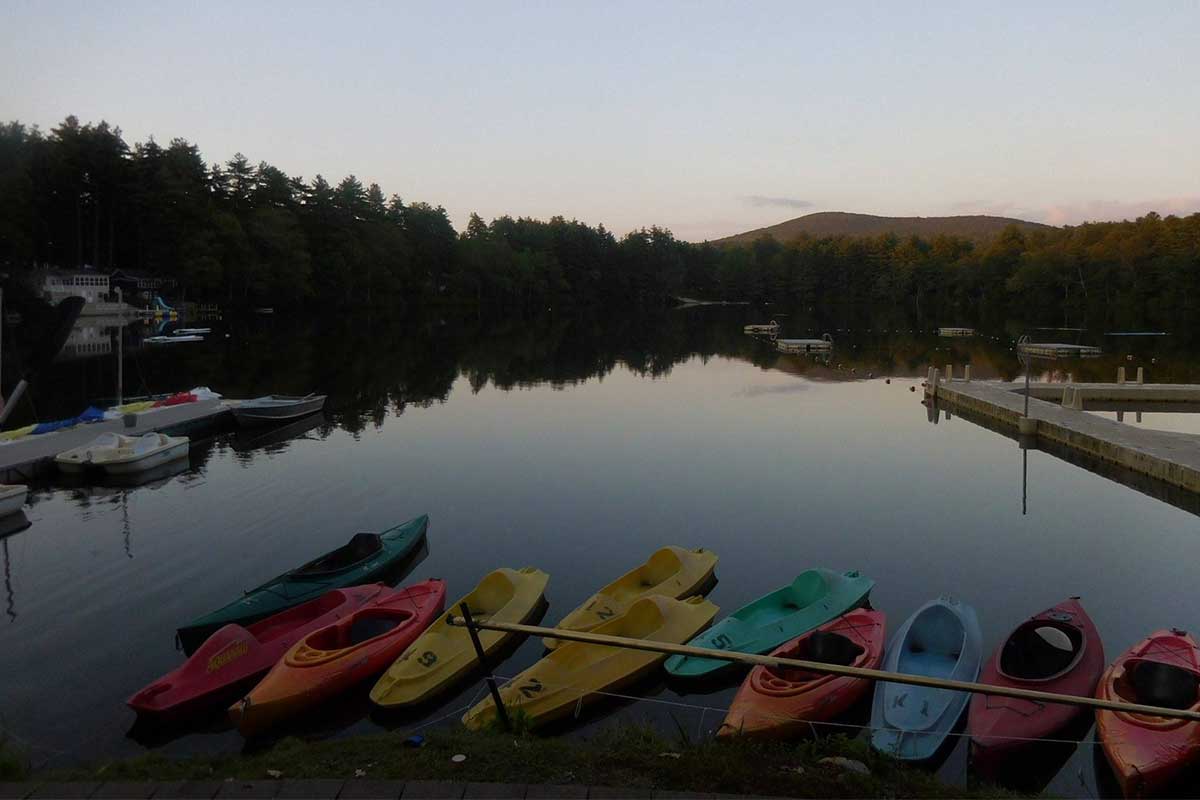
It’s the night before my daughter’s first full session at camp. She’s in bed clutching her barely-still-pink, barely-still-stuffed elephant that will accompany her to western Massachusetts tomorrow morning. I am sitting next to her, clinging to the hope that she might get a few hours of sleep before the sun comes up.
“I don’t want to go anymore,” my almost-11-year-old daughter declares for at least the third time since dinner. I can almost see the dense cloud of nerves surrounding her, cartoon-like squiggles of anxiety drawn around us.
“Mom, I’m not going,” she continues. She delivers each word with the careful deliberation of a Las Vegas dealer working a high-stakes table.
“Is that what you really want?” I finally answer, wondering if my question might be calling her bluff.
But the truth is there is no bluff to be called, and there is not a single easy answer to the question. Yes, she wants to go, and yes, in this exact moment, she wants to stay. Both are true. Both are valid. Yet both cannot happen. We are caught in a loop that takes us between and among these opposing ideas.
“This is so hard,” she says with a sigh during a lull in the circle dance of a conversation. I take this as my cue to begin one of my favorite “mom speeches,” but she beats me to it.
“I know; I can do hard things,” she rolls her eyes and forces back a smile while mimicking me. “I have done hard things before, like going to camp last year for the first time.”
“And you loved it,” I chime in.
“And I loved it,” she parrots back with the perfect amount of preteen snark. We laugh. A lot. The anxiety lifted a little, and we even got a few hours of sleep before it was time to place Pinky in her carry-on and head to BWI for the group flight.
Just as we had all hoped, my daughter had a wonderful summer at camp that year—“the best ever,” in her words—followed by three other “best ever” summers. Each one was preceded by similarly difficult nights before. But thanks to the magic of overnight camp, each time she came back a little more independent, a little more mature and a little more self-confident and sporting a growing collection of life skills that my husband and I always imagined she would call upon gradually and use over time.
Then 2020 happened, and the notion of gradual evaporated without warning. Difficult nights and days became the norm as death tolls climbed and schools and life as it had been shut down. There were more layers of “hard stuff” at once than any of us could fathom, more than any of our kids should have to experience, more than any of us could fix with “mom talks” or hugs. But even as it got darker and darker, a bit of light entered from a far-off place: camp.
While the weeks turned into months, my daughter’s camp community, her camp squad, became a regular part of each other’s lives in a new way against the dark, sad backdrop of a time. Hourslong group video calls filled with as many giggles as serious discussions went from weekly to almost nightly as screen limits and bedtimes readjusted to the new world order. My daughter and her “camp people,” as she likes to call them, texted, talked, played games, watched movies, arranged secret gift exchanges and even planned a few small, socially distanced, masked gatherings outdoors for a few who live close by.
When camp was inevitably canceled last summer because of the pandemic, the bond only grew stronger. My daughter and this subset of her camp friends seemed to unconsciously become each other’s life rafts. It’s a gift I wish none of us would have ever had a need for and, at the same time, one I remain more and more thankful for with each passing day.
My daughter’s camp people made and continue to make a dark, tragic, painful and often unbearable time a bit more bearable for one another. It didn’t fix the situation, not even close, but it sure did—and does—help. These young people flexed their resilience muscles while being asked to make an impossible lift. As my inbox begins to fill with my daughter’s camp forms for summer 2021, I remain hopeful that camp will be able to welcome my daughter and all its other campers this year. Even if it cannot, I know camp will continue to enrich our lives. And that is a feeling that is more comforting than a well-loved pink elephant, one that I hope we both will cling to for many, many more summers to come.
A DMV area writer, Beth Kanter’s books let readers explore the sites and taste the foods of the DMV area without ever leaving home. Beth is grateful that her daughter’s camp is working hard to open safely this summer.
This story originally ran in our March issue. For more stories like this, subscribe to our monthly magazine.