
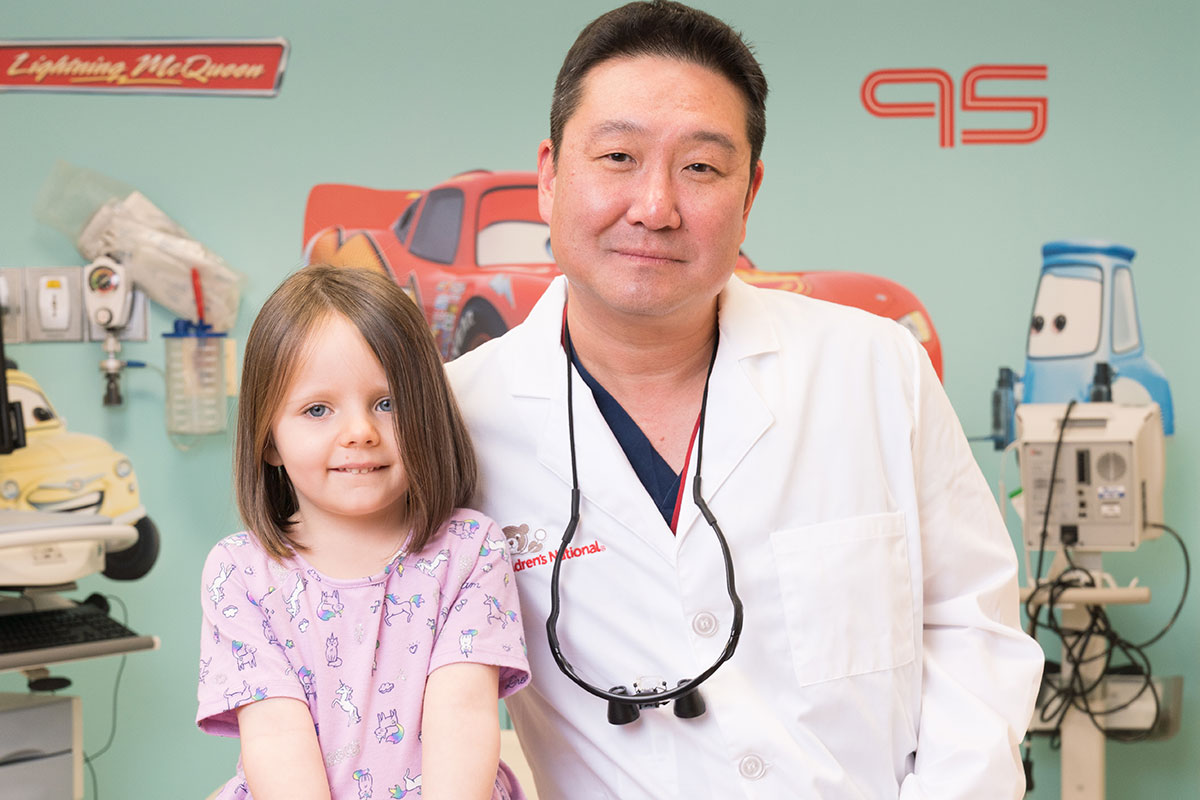
“The most exciting thing for pediatric plastic surgery is integrating pre-surgical planning into a lot of technology and outcomes,” says Dr. Oh, who collaborates with the Sheikh Zayed Institute for Pediatric Surgical Innovation at Children’s National. “We are using a lot of 3D modeling to plan procedures and quantify shape outcomes.”
An increasingly recognized problem, he says, is babies who are born with Pierre Robin sequence, a condition characterized by small jaw, collapsing tongue and airway obstruction. These can lead to difficulty with feeding and breathing.
Children’s National, Dr. Oh says, has spearheaded a lot of research protocols and outcome studies surrounding 3D modeling.
“We’ve done a lot of really exciting work in terms of determining objective data as opposed to subjective gut feeling,” he says.
Another issue he sees is complex craniosynostosis, a condition where the growth plates of the skull close too early, which can lead to pressure on the brain and cause blindness and seizures, among other issues.
Doctors work with engineers to compare 3D models of craniosynostosis with models of “normal” skull shapes, one of the largest databases, which is available at Children’s National. “We are trying to quantify how the head shapes of children with craniosynostosis differ from normal children,” Dr. Oh says.
For patients with Pierre Robin sequence, models of the jaw bones are made based off of CT scans. Using a 3D model can show the doctors precisely where to cut in order to grow jawbones that won’t interfere with nerves.
“An advantage of 3D technology,” says Dr. Oh, “is that we can know how thick the bone is, where the safest place is to cut, what length screws to use and how much to grow the bone.”
Models also help provide a tangible illustration for the families of patients. “We do this all the time and it’s kind of intuitive (for us),” he says. “For families, this is the one baby, the one case they’ll see, so I can show them on the image what it will look like.”
The most common facial birth defect is cleft lip and palate. According to the CDC, about 7,000 babies are born with cleft lip and/or palate each year. Environmental factors that increase a mother’s risk of giving birth to a child with this birth defect, according to the University of Virginia School of Medicine, include exposure to certain infections, vitamin deficiency, cigarette, alcohol or drug use and exposure to certain medications.
For older pediatric patients, some of the most common plastic surgeries include procedures to address breast differences, including breast reduction, gynecomastia (enlargement or swelling of breast tissue in men or boys) and asymmetry.
“The emotional and psychological effects (of these conditions) can be as severe as the physical effects,” says Dr. Olding. “Who would subject someone to that?”
Pediatric weight-loss surgery is becoming more popular for adolescent patients with morbid obesity, defined by the Children’s National website as “being overweight to the point where it interferes with daily functioning.”
Children’s National is one of the few dedicated pediatric centers in the United States that offers bariatric and weight-loss surgery, and is the only hospital in the area that is accredited to perform bariatric surgery on adolescents.
“A fair amount of research shows that if you do surgeries earlier, you encounter fewer obesity-related diseases later in life,” Dr. Oh says. “But they lose the weight and their bodies sag, then they need body contouring procedures—a tummy tuck, a breast lift, removal of excess skin.”
Because the needs and procedures for pediatric patients are so specific, Dr. Oh emphasizes that parents should always select for their children a surgeon who specifically specializes in pediatric plastic surgery.
This post originally appeared in our April 2020 print issue. For more stories on health and family, subscribe to our weekly newsletters.